Software companies have spent the last two years promising that AI will create operating leverage. Entrata’s IPO filing is more interesting because it puts several years of financial and staffing data next to that claim. The company grew much larger while employing fewer people, then explicitly said AI-enabled efficiency explains a substantial part of the change.1
Entrata says revenue rose from $266.3 million in 2022 to $509.3 million in 2025 while employee headcount fell from 2,316 to 2,148. GAAP operating margin improved from -1% to 16%. Those financial changes are disclosed in its IPO filing. The claim that AI caused a substantial part of the efficiency is management’s attribution, not a controlled test.1, 2
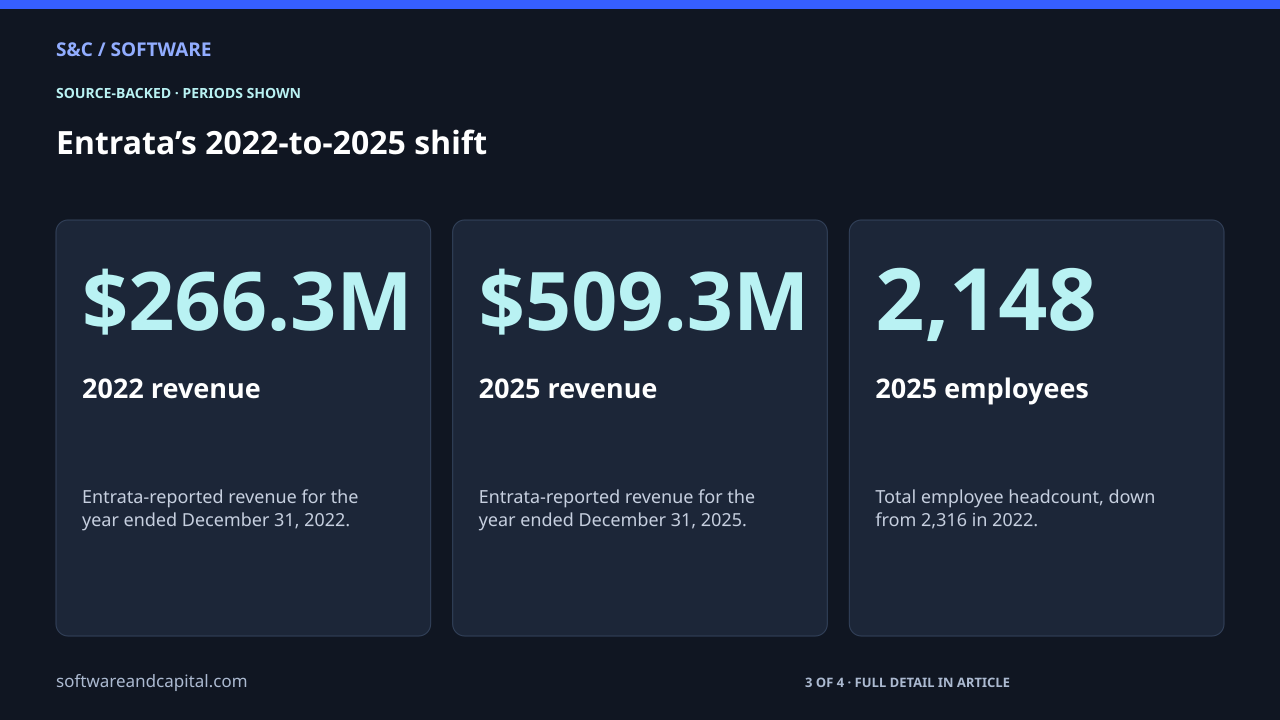
Entrata’s 2022-to-2025 shift
The financial improvement is real. The causal attribution is softer
The filing reports the headcount, revenue and margin figures as company financial information. It then says Entrata attributes the improvement in substantial part to AI-enabled efficiency. Those are not the same kind of evidence. The first is the trajectory. The second is management’s explanation for why the trajectory changed.1
| Measure | 2022 | 2025 | Change |
|---|---|---|---|
| Revenue | $266.3M | $509.3M | Up about 91% |
| Employee headcount | 2,316 | 2,148 | Down about 7% |
| GAAP operating margin | -1% | 16% | Up 17 percentage points |
| Net income (loss) | -$199.5M | $50.7M | Loss became profit |
AI is being used in the product and inside the company
Entrata describes AI as embedded across the organization, including development and testing. Its September product launch also added a more explicit agentic layer for customers through Entrata Pro, with tools for analytics, agent deployment and AI administration across the company’s operating system.1, 2
Revenue per employee is a useful ratio, not proof
Using the disclosed year-end headcounts, revenue per employee rose substantially over the period. That can be a useful operating-efficiency signal, but it does not isolate AI from pricing, product mix, customer growth, organizational changes or other cost decisions. A before-and-after ratio is not a controlled experiment.1
The IPO filing makes the claim unusually inspectable
Most companies discuss AI productivity through anecdotes, pilot metrics or selected tasks. Entrata is unusual because public-market disclosure puts the narrative beside multi-year financial statements. Readers can therefore see the outcome management is pointing to even if they cannot prove the exact amount AI contributed.1
What would strengthen the AI-efficiency case
- A breakdown of which functions reduced staffing or expanded output.
- Task-level productivity measures collected before and after deployment.
- Costs of models, tooling and implementation alongside the labor savings.
- Evidence that quality, support outcomes or release reliability did not deteriorate.
The comparison with Palantir’s growth-and-margin story is useful. Strong software economics can be measured. Assigning the improvement to one technology requires a higher evidentiary bar.
Sources and methodology
Sources checked September 26, 2026. Dates and periods for individual figures are stated beside them.
- Entrata: Amendment No. 2 to Form S-1 ↗Accessed 2026-09-26
- Entrata: Entrata Pro launch at Summit 2026 ↗Accessed 2026-09-26
Scope and assumptions
Entrata’s attribution of efficiency to AI is management’s explanation, not controlled causal evidence.
Headcount and financial comparisons span years in which many business variables changed.
The article does not assess the IPO or Entrata shares as an investment.