Autocomplete used to be the obvious picture of AI coding: the machine suggests the next line and a developer accepts or rejects it. Microsoft’s latest GitHub metric describes a different workflow. The company says one in three pull requests on GitHub now involves an agent.1
Microsoft said in its FY2026 fourth-quarter call that GitHub Copilot had 50 million users and one in three pull requests on GitHub now involves an agent. “Involves” is broader than “written entirely by AI.” GitHub’s current agent tools can work on branches, create pull requests, respond to review comments and use the same checks teams already rely on.1, 2
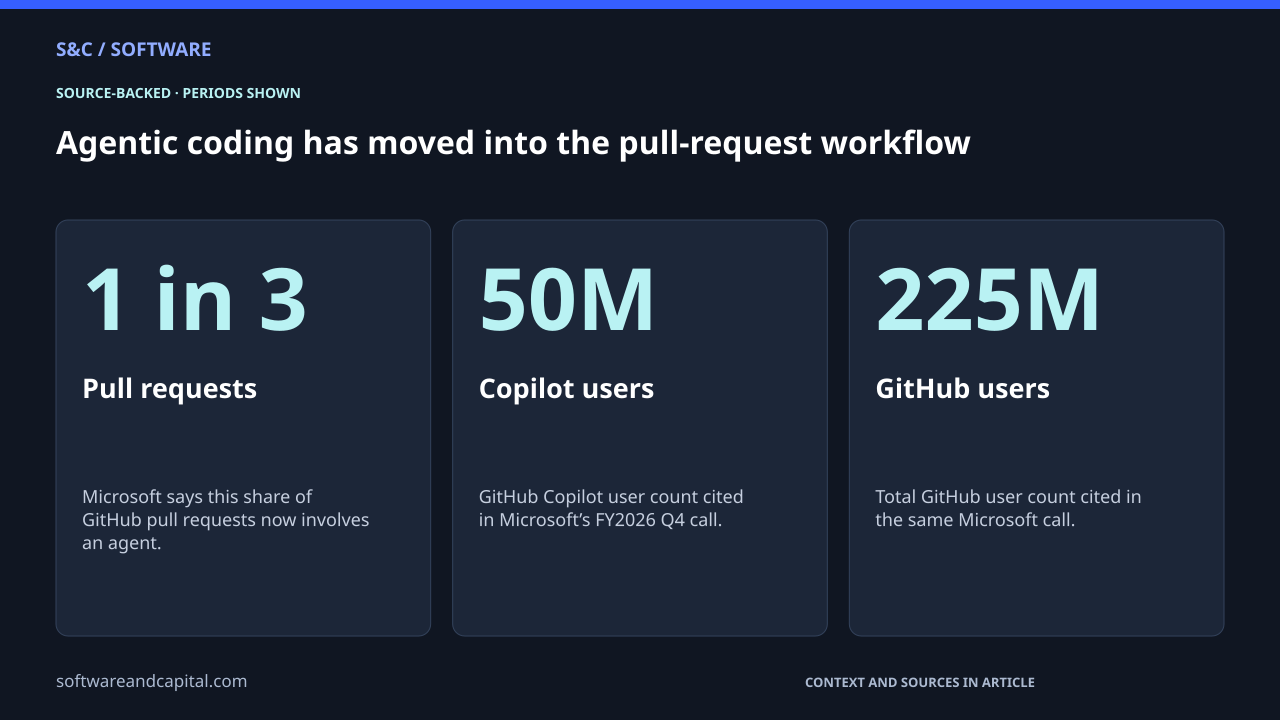
Agentic coding has moved into the pull-request workflow
The wording matters. Microsoft did not say one in three pull requests is fully authored by an agent. A pull request can “involve” an agent through code generation, delegated tasks, review changes or other workflow participation. Treating the figure as an authorship share would overstate what the source says.1
The unit of AI work is becoming a task, not a suggestion
GitHub describes its agent tooling as able to start from an issue, pull request or prompt, work in an isolated branch or worktree, run validation and open a pull request. That is a larger unit of delegated work than completing the next few characters in an editor.2
The developer’s role moves accordingly. Instead of approving every suggested line while it is generated, a developer can define the task, inspect a plan or diff, run checks and decide whether the resulting change belongs in the codebase.
| Workflow | AI role | Human control point |
|---|---|---|
| Autocomplete | Suggest the next code while a person types. | Accept or reject the suggestion inline. |
| Coding agent | Work on a scoped task across files. | Review the branch/diff and tests. |
| Pull-request iteration | Respond to review comments or failed checks. | Decide what feedback to accept and whether to merge. |
Review becomes more important, not less
GitHub’s documentation keeps pull requests, checks and review requirements in the workflow. Its Copilot app is designed to let users inspect diffs, validate changes and open pull requests using existing team controls. The agent can produce work, but the repository can still require the same gates before merge.2
GitHub also lets users ask Copilot to fix failing checks or address review comments on an existing pull request. That can shorten the loop between feedback and another code revision. It also means the reviewer must pay attention to whether the new change actually resolves the issue rather than simply producing another plausible diff.3
That connects directly to evaluating AI-agent success. A message saying “fixed” is not evidence the repository is healthy. The test suite, build, browser behavior or other external checks are the evidence that matters.
More agent participation changes software economics too
Microsoft said GitHub introduced usage-based billing alongside seat growth and reported significant consumption revenue. That suggests coding agents are not only changing product behavior. They can change how the software is priced, because more autonomous work consumes compute beyond a simple per-user license.1
A team therefore has two adoption questions. Does an agent make useful code changes? And do the saved developer hours, faster iteration or additional output justify the seat and consumption costs? A high share of pull requests involving agents answers neither on its own.
What agentic development makes more valuable
- Clear tasks: agents work better when the requested outcome and boundaries are explicit.
- Executable checks: tests and builds provide evidence outside the agent’s own explanation.
- Review discipline: people still need to inspect consequential changes and architecture decisions.
- Cost visibility: seat and usage-based charges should be compared with useful completed work.
One in three pull requests is a striking adoption marker because pull requests are where software changes become team decisions. The agent is no longer confined to a side panel offering suggestions. It is becoming another participant in the workflow that proposes, revises and helps prepare code for review.
Sources and methodology
Sources checked September 22, 2026. Dates and periods for individual figures are stated beside them.
- Microsoft: FY2026 Q4 earnings conference call ↗Accessed 2026-09-22
- GitHub: Copilot app generally available ↗Accessed 2026-09-22
- GitHub: Ask Copilot to make changes to a pull request ↗Accessed 2026-09-22
Scope and assumptions
The one-in-three and user counts are Microsoft-reported platform metrics; the source does not define every interaction included in 'involves an agent.'
No productivity, defect-rate or cost-saving claim is inferred from adoption.
AI-assisted research and editing. Our editorial standards.