A browser sounds like a commodity until it becomes the place where identity, company data, SaaS apps and AI agents all meet. Island is betting that this intersection is valuable enough to become an enterprise control point. Investors just put a large private-market number on that bet.1
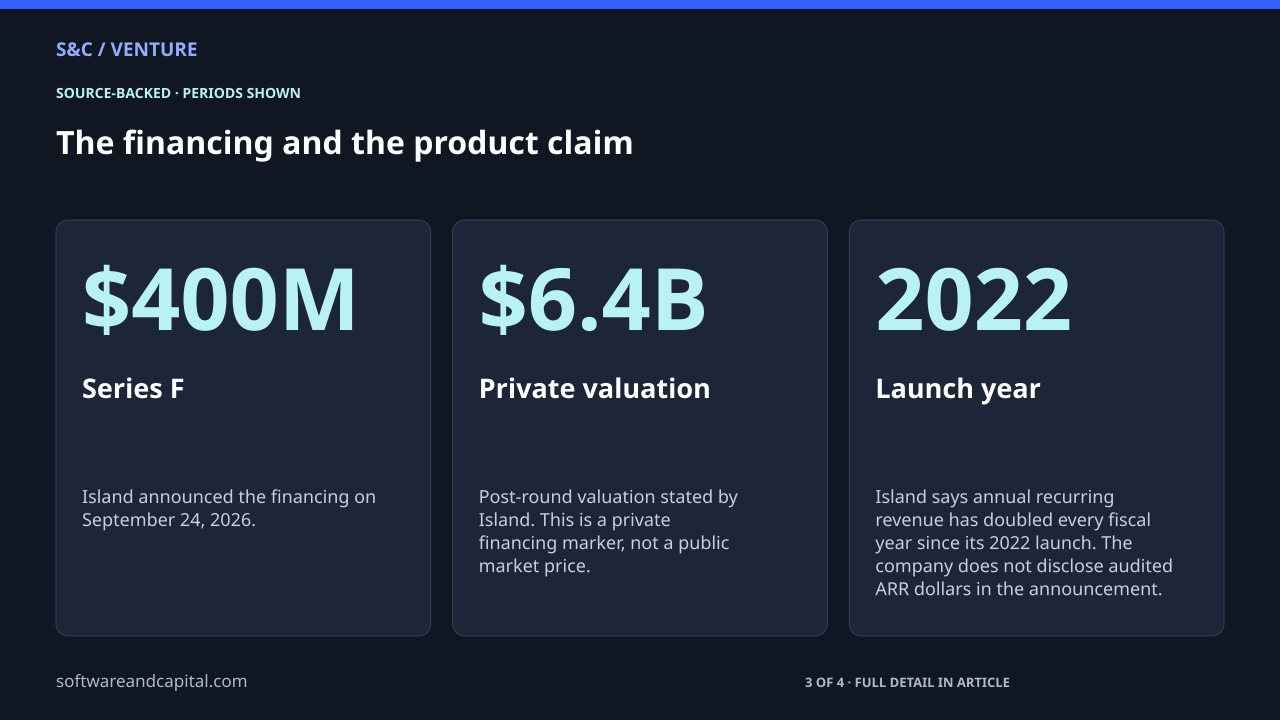
Island announced a $400 million Series F at a $6.4 billion valuation. Its pitch has expanded beyond a hardened browser into a control plane spanning browser, endpoint, network, identity and AI-agent activity. The financing shows investor appetite for that architecture. It does not prove the private valuation is durable or reveal audited revenue.1, 2
The financing and the product claim
Post-round valuation stated by Island. This is a private financing marker, not a public market price.
Island says annual recurring revenue has doubled every fiscal year since its 2022 launch. The company does not disclose audited ARR dollars in the announcement.
The browser is being turned into a policy layer
Island’s original wedge was the enterprise browser. The broader platform now applies identity, data protection, auditing and policy around the places people and agents access business applications. The strategic claim is that the browser sees context traditional network or endpoint tools may miss.2
| Activity | What a browser layer can see | Enterprise question |
|---|---|---|
| User opens SaaS app | Identity and live session context | Who should have access? |
| User pastes or uploads data | Content movement inside the session | Should this data leave? |
| AI agent acts through web apps | Tool and session activity | Was the action permitted and auditable? |
| Work moves across devices | Browser and platform context | Can policy follow the user and agent? |
AI agents make the control problem larger
A chatbot mostly returns text. An agent can click, upload, call tools and act across applications. Island’s current product story is built around governing those actions with policy and auditability rather than only filtering prompts. That gives the company a larger addressable problem than browser hardening alone.2, 1
A $6.4 billion valuation is not operating proof
Island says ARR has doubled every fiscal year since launch, but the Series F announcement does not disclose the ARR base, audited revenue, free cash flow or customer concentration. The financing tells us what investors agreed to pay for preferred private shares. It does not tell us what a public market would pay or what the company is worth under every outcome.1
The competitive question is whether control consolidates
Enterprises already buy identity, endpoint, network, data-loss and AI-security products. Island’s opportunity is to collapse some of those controls into one workspace layer. Its risk is that incumbents can integrate similar controls into products customers already own, leaving the browser as one piece of a larger security stack rather than the center.
What would make the valuation easier to judge
- Audited revenue or ARR dollars rather than only growth rates.
- Net retention and customer concentration.
- How often customers replace existing security products rather than add Island beside them.
- Gross margin and cash requirements as the platform expands beyond the browser.
This is adjacent to S&C’s AI cybersecurity speed story and personal-agent permissions guide. Island is the enterprise version of the same shift: software is not only answering questions anymore, so governance has to follow what it does.
Sources and methodology
Sources checked September 26, 2026. Dates and periods for individual figures are stated beside them.
- Island: $400 million Series F at $6.4 billion valuation ↗Accessed 2026-09-26
- Island: Makes AI Work for the Enterprise ↗Accessed 2026-09-26
Scope and assumptions
The $6.4 billion valuation is a private-round valuation, not a public market price.
Island does not disclose audited revenue or ARR dollars in the Series F announcement.
Product capabilities and category framing are company descriptions, not an independent security benchmark.
Continue reading
Unit 42 Says New CVEs Can Be Weaponized in 15 Minutes. Cybersecurity Is Becoming AI vs. AI →
Meta’s AI Can Send Emails and Make Purchases. What Should You Let It Touch? →