An agent can plan for 20 minutes, call five APIs, wait for a human approval and then crash one step before completion. If the system simply starts over, it can repeat expensive model calls—or worse, repeat a real-world action. That old backend reliability problem is suddenly an AI product problem.1
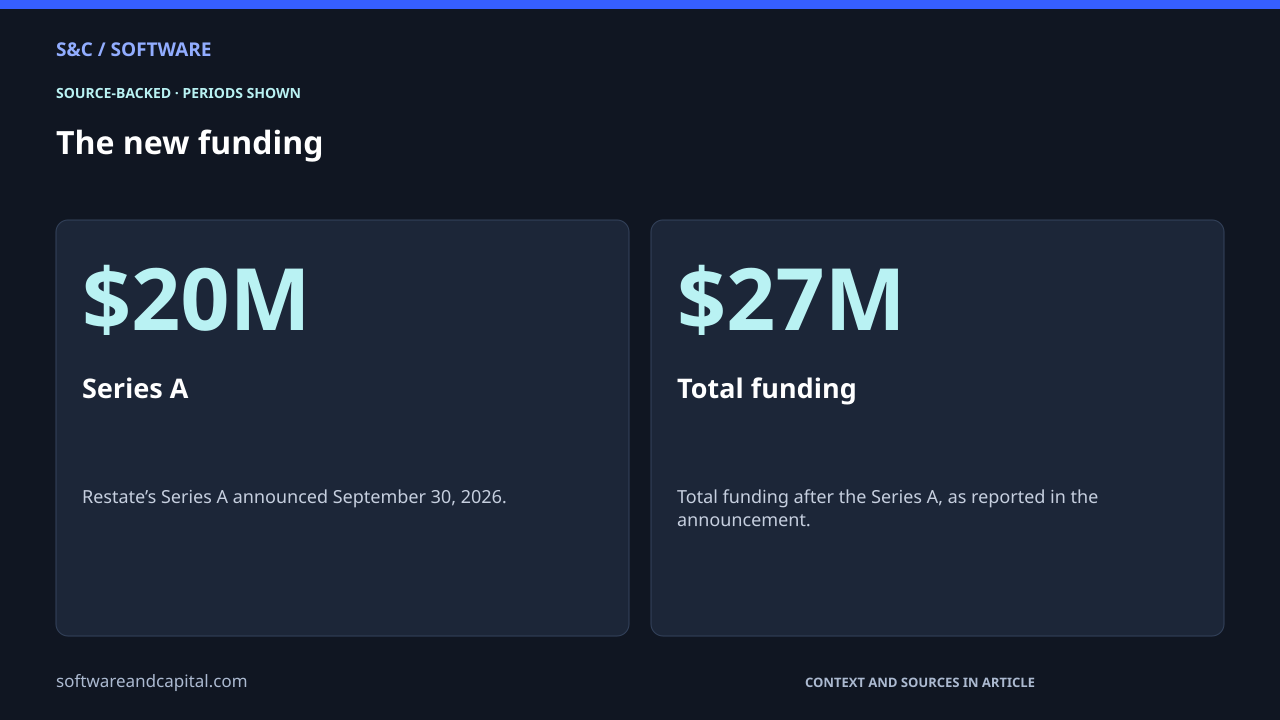
Restate raised a $20 million Series A to expand a durable-execution runtime for applications and AI agents. Durable execution records workflow progress so a long-running agent can recover after a crash, retry safely and avoid repeating completed side effects. The technology predates the agent boom. agents make the reliability problem much more visible because one task can involve hundreds of model, tool and API calls.1, 2
The new funding
Durability means the workflow remembers what already happened
Restate says its runtime records progress and state so failed work can resume rather than restart. It also provides durable functions, objects, queues and RPC primitives for long-running applications and agent loops.1, 2
| Failure at step 73 | Naive workflow | Durable workflow |
|---|---|---|
| Progress | May be lost or reconstructed manually | Recorded state identifies completed work |
| Retries | Can repeat prior API/tool calls | Retries can resume from the failed operation |
| Side effects | Risk of duplicate emails, payments or writes | Idempotent execution can suppress duplicates |
| Human approval | State may need rebuilding after a restart | Workflow can wait and resume around approvals |
AI did not invent this category
Workflow engines and distributed-systems runtimes have handled retries, state and failure recovery for years. What agents change is the frequency and visibility of the problem: one user-facing task can contain hundreds of asynchronous calls, external waits and nondeterministic model steps.1
The value appears when failure stops being exceptional
A short request-response API can simply fail fast. An agent expected to work for minutes or hours needs to survive transient outages, rate limits, network failures and human delays. Durability becomes part of the product experience rather than an implementation detail.
The durable-agent checklist
- Persist progress after every consequential step.
- Make external actions idempotent so retries do not duplicate side effects.
- Keep human approvals inside the durable workflow state.
- Record enough history to explain what the agent already did.
Restate’s financing is notable because it puts venture money behind a very unglamorous idea: agents need backend plumbing. The smarter and longer-running the agent becomes, the more valuable it is for the surrounding infrastructure to be boring, deterministic and recoverable.
Sources and methodology
Sources checked October 1, 2026. Dates and periods for individual figures are stated beside them.
- Restate: $20M Series A announcement ↗Accessed 2026-10-01
- Restate: Durable Runtime ↗Accessed 2026-10-01
Scope and assumptions
Customer contract-size and performance claims are company-reported.
Restate competes with established workflow and cloud infrastructure alternatives. the financing does not establish category leadership.
Continue reading
OpenAI’s Dots Turn the AI Assistant Into an Always-On Worker →