Robinhood used to be easy to describe as a stock-trading app. Its August operating report makes that shorthand harder to maintain. Customers traded 4.7 billion event contracts during the month, alongside equities, options and crypto activity that Robinhood reports in completely different units.1
Robinhood reported 4.7 billion event contracts traded in August 2026. That headline shows prediction markets have become a major activity category on the platform, but it should not be added to equity shares, option contracts or crypto dollars. The useful comparison is how many distinct financial behaviors Robinhood is bringing into one customer account.1, 2
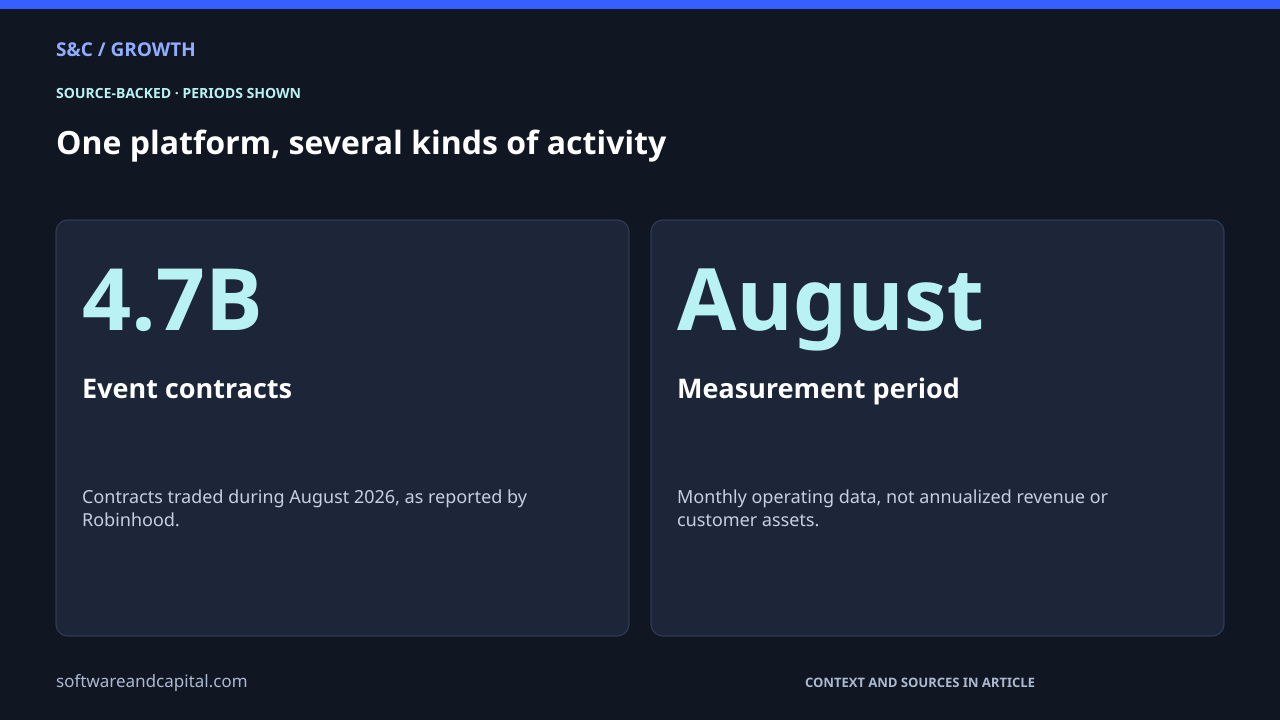
One platform, several kinds of activity
The numbers belong on one dashboard, not in one denominator
Equity trading can be expressed in shares or dollar volume. Options are counted as contracts. Crypto activity is commonly reported in dollars. Event contracts are contracts tied to outcomes. Adding those figures together would create a large but meaningless total because the units describe different things.
| Activity | Useful unit | What it describes |
|---|---|---|
| Equities | Shares or notional value | Stock-trading activity. |
| Options | Contracts | Derivative positions on securities. |
| Crypto | USD volume | Dollar value of crypto trading. |
| Events | Contracts | Outcome-based event-market positions. |
Event markets widen the reason to open Robinhood
The strategic significance is not that an event contract is economically equivalent to a share of stock. It is that the same customer account can now be used for more kinds of financial decisions. A platform that once competed mainly for investing activity can also compete for short-duration, event-driven attention.
Activity is not the same thing as revenue
A huge contract count does not tell us how much Robinhood earned from the category. Contract size, pricing and economics matter. Monthly operating data is useful evidence of engagement, but revenue and profit require separate financial measures.1
Four questions to ask as Robinhood broadens
- How many customers use more than one product category?
- How frequently do event-market users return outside major news cycles?
- How does revenue per unit of activity differ across stocks, options, crypto and events?
- Does broader activity deepen funded-account retention or mostly shift attention among products?
Robinhood’s evolution is therefore easier to see as a portfolio of financial behaviors than as one trading product. The 4.7 billion event-contract figure is striking because it shows a new behavior reaching platform scale. It does not make unlike trading units interchangeable.
Sources and methodology
Sources checked September 25, 2026. Dates and periods for individual figures are stated beside them.
- Robinhood Markets reports August 2026 operating data via GlobeNewswire ↗Accessed 2026-09-25
- Robinhood expands prediction-market access ↗Accessed 2026-09-25
Scope and assumptions
Monthly contract activity does not by itself disclose event-market revenue, profitability or unique-user counts.
Equity, options, crypto and event activity use different units and should not be summed or ranked mechanically.