The biggest number in Anthropic’s reported financing documents is not a valuation. Reuters says a confidential prospectus describes at least $518 billion of compute commitments over roughly a decade. The important word is commitments: much of the amount is reportedly owed even if Anthropic ultimately uses less capacity.1
Reuters reports that Anthropic’s confidential prospectus describes at least $518 billion of compute commitments over roughly a decade, with about 80% structured as non-cancelable or payable regardless of use. Because the prospectus is not publicly filed, S&C treats those figures as Reuters-reported rather than independently verified primary data. The key distinction is contractual capacity obligations versus current capex.1, 2
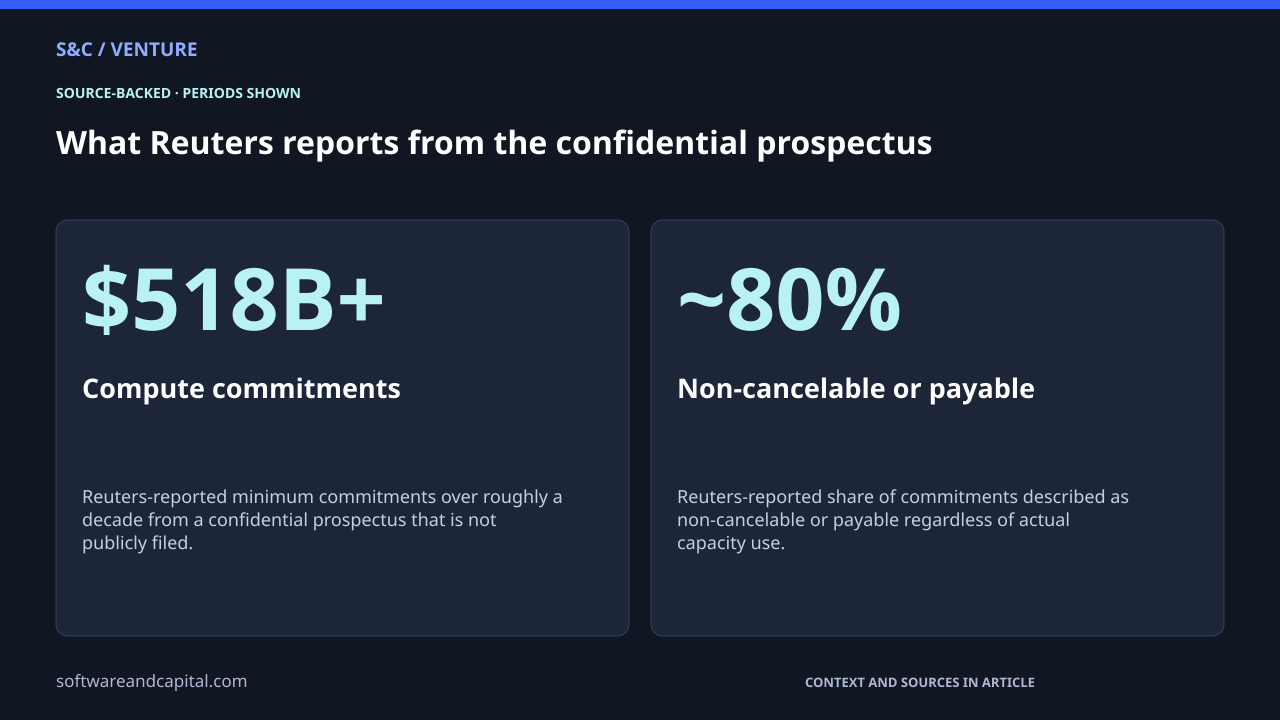
What Reuters reports from the confidential prospectus
A commitment is not the same thing as current capex
A company can secure future compute through cloud contracts, leases and other capacity agreements without owning the underlying data center. The economic exposure is the payment obligation, not necessarily a server or building appearing on Anthropic’s balance sheet today.1
| Number | Meaning | Main risk |
|---|---|---|
| Current spending | Money spent in the current period | Near-term cash use |
| Long-term compute commitment | Contractual capacity payments extending into future periods | Paying for capacity if demand underperforms |
| Flexible capacity | Compute that can be adjusted or not renewed | Availability if demand outperforms |
Why lock in capacity years ahead?
Frontier-model companies need enormous compute and can face scarcity while demand is uncertain. Long contracts can secure supply and pricing. They also move some demand risk from the infrastructure provider back to the model company.1
The risk runs in both directions
If usage grows faster than expected, reserved capacity can be valuable. If model economics weaken or efficiency improves faster than demand grows, a take-or-pay style obligation can leave the buyer paying for capacity it no longer needs at the expected level.
What the public evidence cannot yet answer
- The full confidential prospectus and exact contract language.
- How the commitments are distributed year by year.
- How much capacity is tied to specific cloud or infrastructure counterparties.
- How future model efficiency changes the amount of compute Anthropic actually needs.
The $518 billion figure is useful only with its label attached. It is a Reuters-reported long-term commitment total from confidential materials, not a claim that Anthropic has already spent $518 billion building data centers.1
Sources and methodology
Sources checked September 29, 2026. Dates and periods for individual figures are stated beside them.
- Reuters: Anthropic's $518 billion AI buildout ↗Accessed 2026-09-29
- Anthropic company overview ↗Accessed 2026-09-29
Scope and assumptions
The prospectus described by Reuters is confidential and not publicly filed, so S&C cannot independently inspect the primary document.
The reported aggregate does not provide enough public detail to model annual cash payments or every counterparty.
Continue reading
Anthropic at $965B: What Does a $47B Run Rate Actually Mean? →