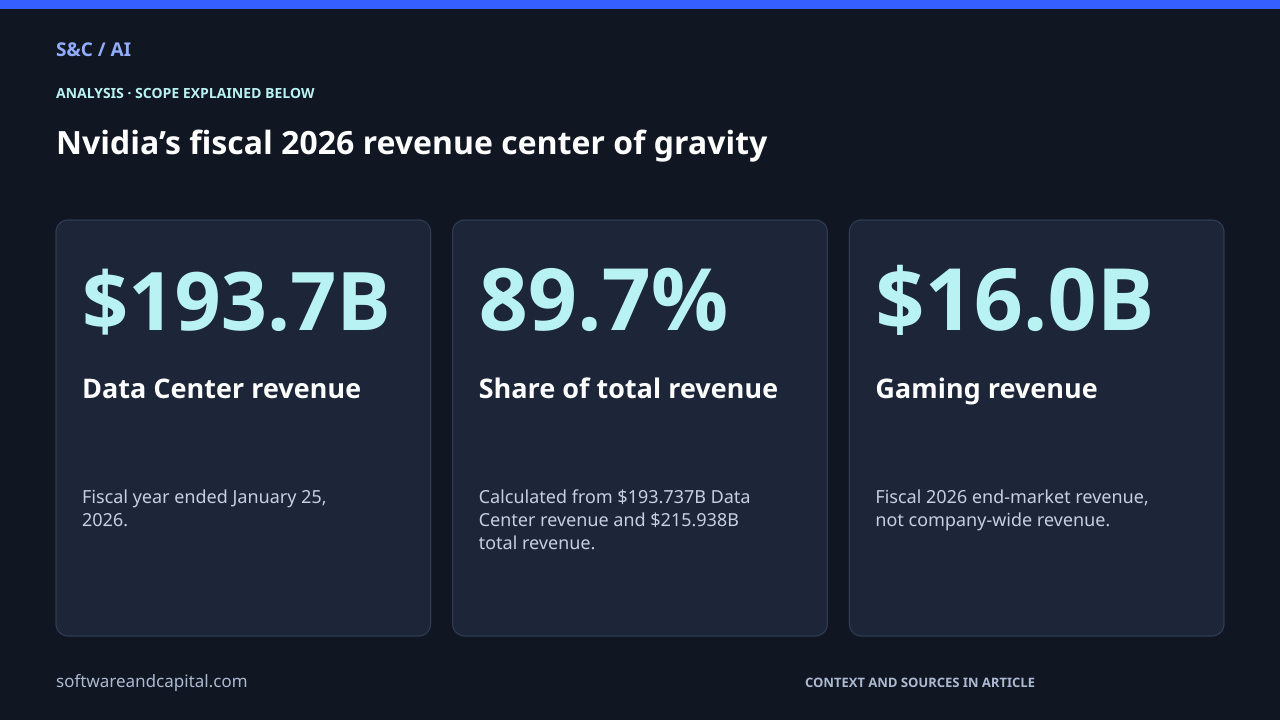
Nvidia is still the name many people know from gaming graphics cards. The company’s fiscal 2026 numbers tell a very different story. Data Center generated $193.7 billion of revenue, more than twelve times the reported Gaming total and close to nine out of every ten dollars Nvidia earned.1, 2
Nvidia reported $193.7 billion of Data Center revenue in fiscal 2026, about 89.7% of its $215.9 billion total. That end-market figure included $162.4 billion of compute revenue and $31.4 billion of networking revenue. The business is not a giant chatbot subscription. It sells the computing and networking infrastructure used to build and run accelerated workloads.1, 2
Nvidia’s fiscal 2026 revenue center of gravity
That 89.7% share is a calculation from the company’s reported end-market figures. It does not mean every Nvidia customer is an AI company, or that every dollar of data-center spending is tied to generative AI. It shows how dramatically the company’s revenue mix has shifted toward large computing infrastructure.2
Data Center is not one product
Nvidia’s filing breaks Data Center revenue into two large pieces. Compute generated $162.361 billion in fiscal 2026. Networking generated $31.376 billion. Compute therefore represented about 83.8% of Data Center revenue, with networking at about 16.2%.2
| Component | Revenue | Share of Data Center |
|---|---|---|
| Compute | $162.361B | About 83.8% |
| Networking | $31.376B | About 16.2% |
| Total Data Center | $193.737B | 100% |
The company describes the broader accelerated-computing platform as GPUs, CPUs, networking, security, software, power delivery and cooling designed to work together. The point is not that Nvidia owns every part of a data center. It is that the sale has expanded beyond a standalone graphics processor into a system-level infrastructure proposition.2
The customer is buying capacity, not a chatbot subscription
Nvidia says its customers include public and private cloud providers, AI model makers, enterprises, startups and public-sector entities. Those buyers use the hardware and networking to train models, run inference and handle other accelerated workloads. The person typing into a chatbot is several steps downstream from that transaction.2
That distinction helps explain why one popular consumer AI service cannot be used as a proxy for Nvidia’s business. A cloud company may buy infrastructure that supports many customers and workloads. An enterprise may use the same platform for internal AI, simulation or data processing. Revenue is recorded when Nvidia sells into that ecosystem, not each time an end user asks a model a question.
Gaming did not disappear. It became much smaller beside the new business
Gaming revenue still reached $16.042 billion in fiscal 2026, up 41% from the prior year. Professional Visualization contributed $3.191 billion, Automotive $2.349 billion and OEM and Other $619 million. Those are substantial businesses in isolation. The scale of Data Center is what makes them look small in the company-wide mix.2
View the underlying values
| Measure | Value (USD billions) |
|---|---|
| Data Center | 193.737 |
| Gaming | 16.042 |
| Pro Visualization | 3.191 |
| Automotive | 2.349 |
| OEM and Other | 0.619 |
A huge infrastructure business can still be concentrated
Nvidia also disclosed customer concentration. In fiscal 2026, one direct customer represented 22% of total revenue and another represented 14%, primarily within Compute & Networking. The company does not identify those customers in the cited filing. The figures show that an enormous market can still produce dependence on a small number of very large buyers.2
That matters when reading AI-demand headlines. A few hyperscale customers can place very large orders. Revenue growth can therefore reflect both broad adoption and concentrated infrastructure buildouts. Those are compatible stories, but they are not identical.
The useful question is what sits behind the $193.7 billion
Three layers to keep separate
- End users: People and organizations using AI and accelerated applications.
- Service providers: Cloud and model companies turning infrastructure into products and services.
- Infrastructure suppliers: Companies such as Nvidia selling compute and networking into the buildout.
The same separation is useful when comparing model prices in AI workflow economics. The fee paid for an AI response sits far downstream from the hardware investment that made the service possible. One is an application-level cost. The other is infrastructure revenue.
Nvidia’s fiscal 2026 result is striking because the old shorthand no longer fits. Gaming remains a real business, but the company’s financial center of gravity has moved into the data center. The $193.7 billion headline is not just a bigger number. It describes a different kind of company.
Sources and methodology
Sources checked September 21, 2026. Dates and periods for individual figures are stated beside them.
- NVIDIA: Fourth-quarter and fiscal 2026 results ↗Accessed 2026-09-21
- NVIDIA: Fiscal 2026 Form 10-K ↗Accessed 2026-09-21
Scope and assumptions
All financial figures are for Nvidia fiscal 2026, which ended January 25, 2026. End-market categories are not the same as reportable segments.
The article does not estimate end-customer AI spending, future demand, valuation or investment return.
AI-assisted research and editing. Our editorial standards.
Continue reading
2¢ vs 4¢: When the Cheaper AI Call Costs More →