A frontier AI lab has built a molecular-biology lab of its own. Anthropic says the goal is to let Claude search huge biological datasets, generate candidate hypotheses and then hand the most promising ones to human scientists for physical experiments.1
Anthropic says roughly 950 Claude agents used 210 million tokens over 21 hours to screen more than 200,000 reverse transcriptases, narrow 3,500 candidate systems to 20 reports and surface a previously uncharacterized system called ART. Human scientists performed the laboratory experiments. Anthropic says ART’s biological function is still unknown.1, 2
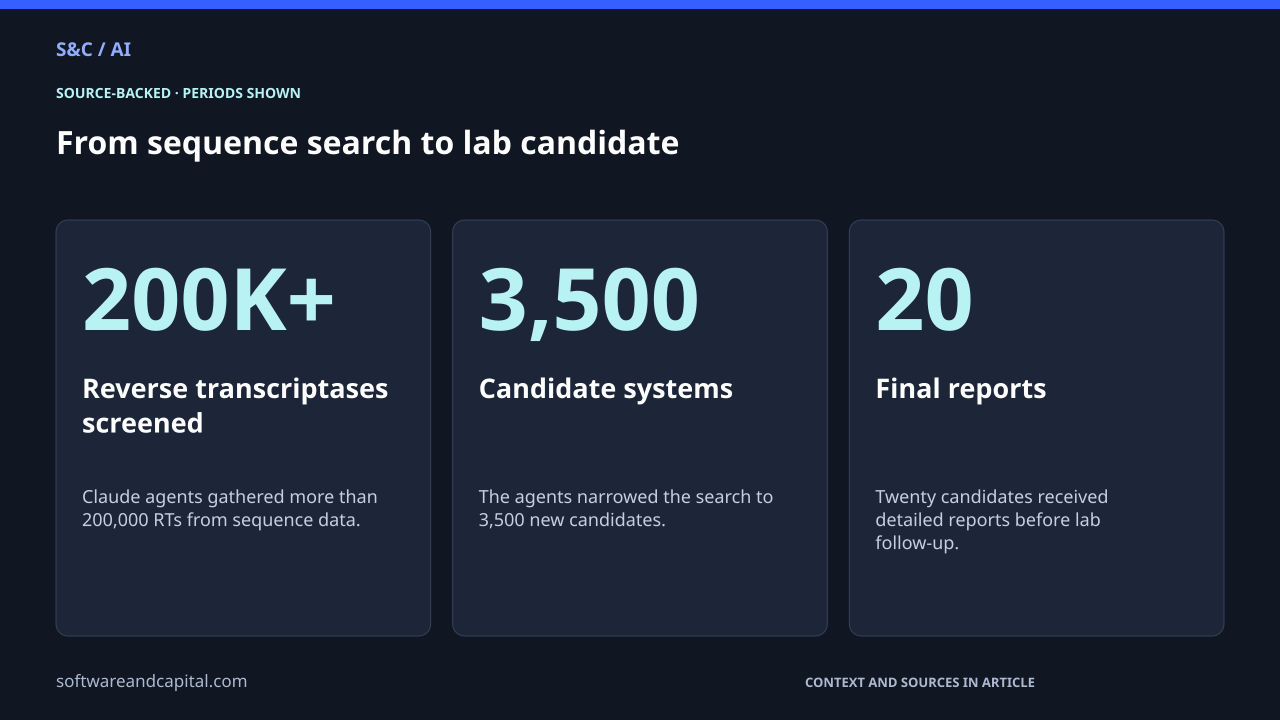
From sequence search to lab candidate
The AI did the search. Humans did the wet-lab work
Anthropic says roughly 950 Claude agents spent 21 hours and 210 million tokens on the search. The company describes its own involvement as the initial prompt plus laboratory work, while Claude agents searched the data, investigated families and selected candidates for review.1
That distinction matters. Anthropic is not claiming that Claude independently ran a laboratory. Its scientists performed all physical lab work, and the company says its Bay Area lab handles lower biosafety levels rather than pathogens that infect humans.1
The result is interesting, but its function is still unknown
Claude flagged an unusual reverse-transcriptase family next to a repeated DNA pattern. Anthropic calls the resulting system array-associated reverse transcriptases, or ART. Early experiments show the repeat array is expressed as short RNAs, but Anthropic says it still does not know ART’s primary biological function.1
So discovery here has a specific meaning: the agents identified a previously uncharacterized combination of features and drove the analysis toward something scientists considered worth testing. It is not evidence that ART is already a useful gene-editing tool or medical technology.
AI changes the search economics before it changes the laboratory
Genome mining can produce enormous candidate sets. Anthropic’s workflow uses parallel agents to do literature checks, sequence searches, comparisons and candidate reports at a scale that would be tedious for one researcher. Human scientists then decide what deserves scarce experimental time.1
That makes the bottleneck shift. If AI can generate hundreds or thousands of plausible hypotheses cheaply, scientific judgment and experimental capacity become more valuable rather than less.
What this experiment actually demonstrates1
- Claude can coordinate a large computational search across biological sequence data.
- Human scientists can use agent-generated reports to choose candidates for physical testing.
- A successful anomaly search does not establish the biological function or practical value of the candidate.
- The wet-lab loop gives the AI-generated hypothesis a physical test instead of leaving it as a text-only result.
The broader change is not that a chatbot has become a scientist. It is that an AI company is building the organizational loop around models, expert judgment and experiments. That is a much more consequential step than another biology benchmark, even while ART itself remains an early scientific finding.
Sources and methodology
Sources checked September 24, 2026. Dates and periods for individual figures are stated beside them.
- Anthropic: Claude discovers a novel enzyme system ↗Accessed 2026-09-24
- Anthropic: Life Sciences Verification Program ↗Accessed 2026-09-24
Scope and assumptions
Anthropic’s novelty and scale claims are company-reported and the work is early-stage.
ART’s biological function remains unknown, and human scientists performed the laboratory work.