Medical AI often arrives in public conversation as a chatbot that might one day diagnose a patient. The FDA’s current device list shows a much quieter reality. Many authorized AI-enabled products sit inside imaging and diagnostic workflows, especially radiology, where the input is already digital and the task can be tightly defined.1
The FDA’s current AI-enabled medical-device list is visibly dominated by Radiology entries, alongside devices in neurology, cardiovascular care, anesthesiology and other panels. The list is not comprehensive, and an FDA-authorized AI-enabled device is not the same thing as a general-purpose medical chatbot. Imaging is a natural early home because the input is already digital and the device can support a defined clinical task.1, 2
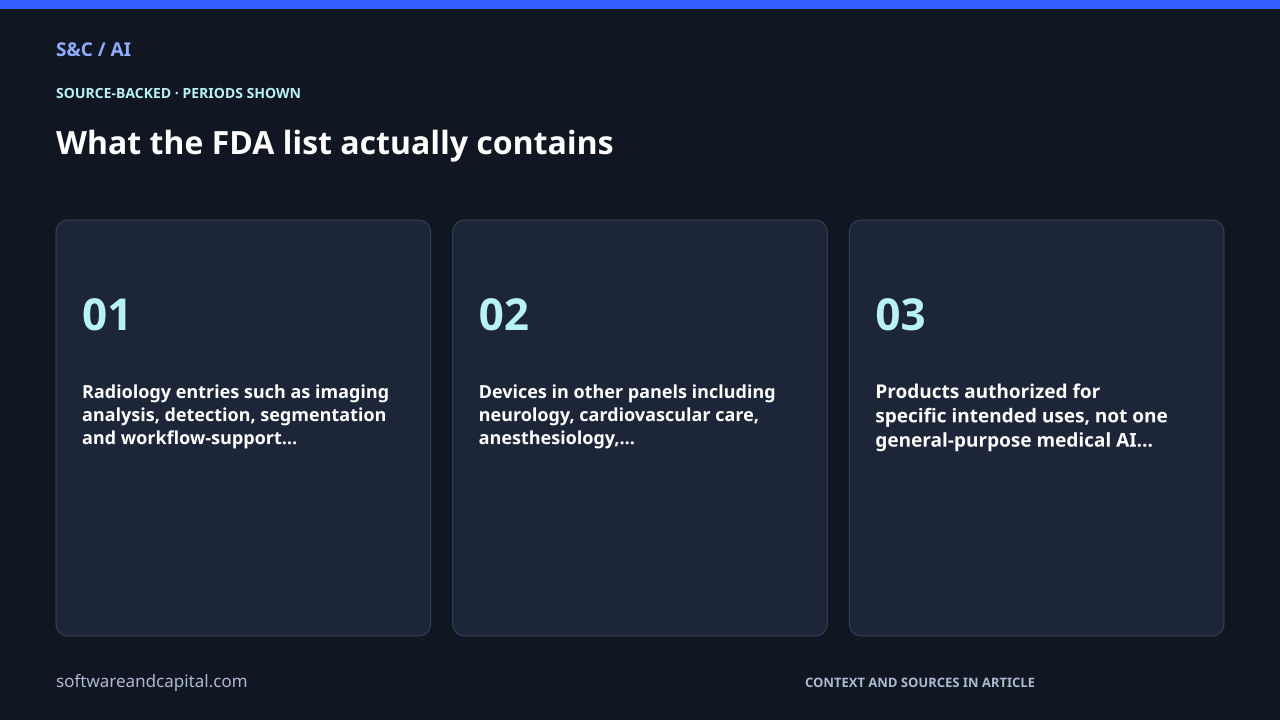
What the FDA list actually contains1
- Radiology entries such as imaging analysis, detection, segmentation and workflow-support tools.
- Devices in other panels including neurology, cardiovascular care, anesthesiology, pathology and surgery.
- Products authorized for specific intended uses, not one general-purpose medical AI category.
The FDA explicitly says the list is a transparency resource and is not comprehensive. Devices are identified largely from AI-related terms in public authorization materials and classifications. That makes the list useful for seeing the landscape, but not suitable for claiming an exact count of every AI-enabled medical device in the United States.1
Radiology starts with data computers already understand
X-rays, CT scans, MR images and ultrasound are already captured as digital data. AI software can therefore receive an input with a consistent technical structure and perform a defined task such as highlighting an area, segmenting anatomy, triaging a study or helping measure something. That is very different from asking one model to practice all of medicine.
| Lead panel | Example type visible in current list | What the AI-enabled device is not |
|---|---|---|
| Radiology | Image segmentation, triage, mammography and CT/MR assistance. | A replacement for every radiology decision. |
| Cardiovascular | Imaging and monitoring-related tools. | A general cardiologist in software. |
| Neurology | Sleep, imaging and neurotechnology-related devices. | A general neurological diagnosis engine. |
| Other panels | Products also appear in anesthesia, pathology, surgery and other areas. | Evidence that all specialties use AI at the same rate. |
Authorization is tied to an intended use
The FDA says devices on the list have met applicable premarket requirements, including review of safety and effectiveness for their intended use and technological characteristics. The public database links to authorization information for individual devices. That is a much narrower claim than saying “FDA approved AI for diagnosis” in general.1
This specificity is one reason medical-device AI can move through regulated pathways even while general-purpose AI remains difficult to evaluate for open-ended clinical use. A device can be judged against a defined function, user, input and workflow.
The human workflow stays part of the device story
FDA transparency principles emphasize intended users, use environments, inputs, outputs and how a machine-learning device is expected to affect health-care decisions. The guidance also highlights the performance of the human-AI team and the need to communicate limitations, bias and conditions where outputs may not apply.2
That means the useful question is rarely “is AI better than the doctor?” It is more often “what task does the tool perform, what evidence supports it, what should the clinician do with the output, and where can it fail?” The regulation and workflow are attached to the specific product.
The current list is also a map of where digital workflows are mature
Radiology’s visibility may reflect several things at once: abundant digital images, established software workflows, measurable tasks and a long history of computer-assisted imaging. It should not be read as proof that radiology is the only medical specialty where AI can matter.
The same principle applies when reading broader AI-adoption statistics. A field with more listed products may simply have a clearer regulatory and technical route for specific tools. It does not automatically tell us which specialty will see the largest productivity gain, the most clinical benefit or the biggest workforce change.
A better way to read a medical-AI headline
- Identify the device’s exact intended use rather than the broad word “AI.”
- Check which patient population, input and clinical workflow the authorization covers.
- Separate a tool that informs a clinician from one that would replace a clinical judgment.
- Look for the device’s limitations and performance evidence before generalizing from the category.
Medical AI is already real in a very practical sense. It is just less cinematic than the robot-doctor image. Much of the current regulated landscape is software helping with specific pieces of existing clinical work—and radiology happens to make those pieces unusually visible.
Sources and methodology
Sources checked September 22, 2026. Dates and periods for individual figures are stated beside them.
- FDA: List of Artificial Intelligence-Enabled Medical Devices ↗Accessed 2026-09-22
- FDA: Transparency for Machine Learning-Enabled Medical Devices — Guiding Principles ↗Accessed 2026-09-22
Scope and assumptions
The FDA says its AI-enabled device list is not comprehensive, so the article does not present the list as a census of all medical AI.
This is a technology/regulatory analysis, not medical advice and not an assessment of any individual device’s suitability for a patient or clinician.
Continue reading
1 in 4 Workers Is Exposed to AI. That Is Not a Layoff Forecast →