The model provider may collect the API bill, but enterprise AI creates work far beyond the model itself. Anthropic said in June 2026 that more than 40,000 firms had applied to its Claude Partner Network and more than 10,000 consultants had earned a Claude certification. That is a large funnel for companies hoping to make money helping other companies deploy AI.1
Anthropic says more than 40,000 firms applied to its Claude Partner Network and more than 10,000 consultants earned a Claude certification after it committed $100 million to partner training, support and marketing. Those figures show interest and training activity, not partner revenue. The program’s higher tiers require actual production customers and public references.1, 2
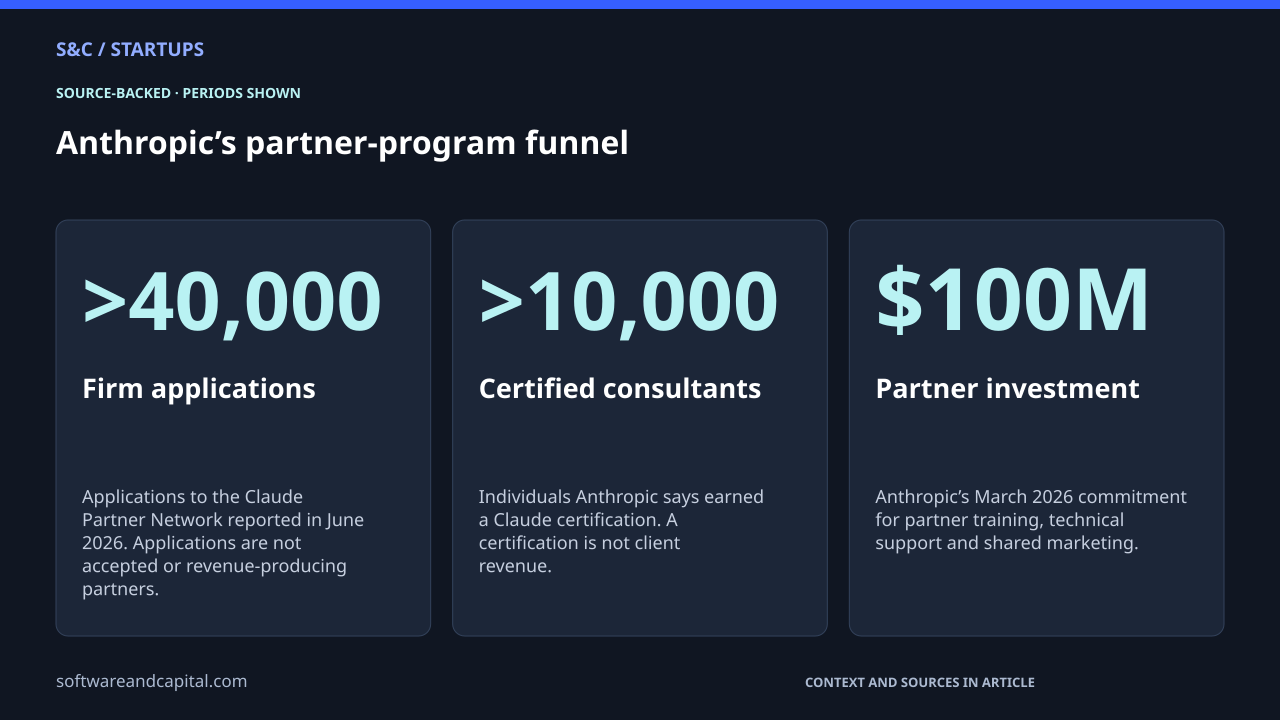
Anthropic’s partner-program funnel
Applications to the Claude Partner Network reported in June 2026. Applications are not accepted or revenue-producing partners.
Individuals Anthropic says earned a Claude certification. A certification is not client revenue.
Anthropic’s March 2026 commitment for partner training, technical support and shared marketing.
The caveat is the story, not a footnote. Forty thousand applications do not mean forty thousand active consulting firms earning money from Claude. Anthropic’s own tier system distinguishes interest, certification and production work by requiring deployed customers and public references for firms that want higher standing.1
Enterprise AI creates an integration business around the model
A company buying an AI model still has to connect it to data, redesign workflows, evaluate outputs, manage security and train people. Anthropic describes exactly those activities as partner work. That creates room for consultancies and systems integrators even when the underlying model comes from someone else.1
| Layer | What the customer needs | Who can get paid |
|---|---|---|
| Model access | Claude models and APIs | Anthropic |
| Integration | Connect models to data, applications and workflows | Consultancies and systems integrators |
| Evaluation and governance | Test quality, controls and deployment boundaries | Specialist teams and advisory firms |
| Change management | Redesign work and train employees | Consultancies, implementation partners and internal teams |
This is familiar enterprise-software economics. A platform can create a much larger surrounding market of implementation work because buying access is only the beginning. The difference with generative AI is that evaluation and workflow redesign can be unusually important because the system produces probabilistic outputs rather than deterministic forms and reports.
Anthropic is trying to make partner quality visible
The Services Track has three tiers. Select requires at least 10 active certified individuals, two joint customers in production during the trailing 12 months and one public customer story. Preferred raises those thresholds. Global Premier requires at least 1,000 active certified individuals, 100 deployed joint customers across three or more regions, 15 public customer stories and a joint business plan.1
That structure matters because partner directories often reward size or sales relationships more than demonstrated delivery. Anthropic says its tiers are based on certified people, production deployments and customer references, while referrals and deal protection are tracked separately.1
Large consultancies are already building Claude practices
Anthropic’s TCS agreement provides a concrete example. TCS said it would make Claude available to 50,000 of its own employees and build Claude-powered products for financial services, healthcare, the public sector and other regulated industries. The value proposition is not simply access to a chatbot. It is implementation inside systems with security, audit and regulatory requirements.2
That ecosystem is economically different from Anthropic’s own funding and run-rate story. The model company can grow revenue while partners build separate businesses around integration and deployment. The two markets can reinforce each other without being the same revenue pool.
Applications and certifications are leading indicators, not market size
What would show the partner economy is becoming durable
- More customers running Claude in production through partners, not only pilots or training programs.
- Repeat implementation work as customers expand from one workflow to several business functions.
- Public customer references that describe delivered systems rather than only signed alliances.
- Partner economics that remain attractive after certification, sales and implementation costs.
The 40,000-firm application count is useful because it shows how many businesses want a place in the ecosystem. It is not a revenue estimate. The stronger signal is Anthropic’s decision to make production deployments and customer references the currency of higher partner tiers.1
Sources and methodology
Sources checked September 22, 2026. Dates and periods for individual figures are stated beside them.
- Anthropic: Services Track and Partner Hub ↗Accessed 2026-09-22
- Anthropic and TCS partnership for regulated industries ↗Accessed 2026-09-22
Scope and assumptions
Partner applications, certifications and Anthropic’s $100 million program commitment do not establish the size or profitability of the external services market.
Examples are based on Anthropic’s own program announcements and do not measure independent customer satisfaction or partner margins.
AI-assisted research and editing. Our editorial standards.
Continue reading
Anthropic at $965B: What Does a $47B Run Rate Actually Mean? →