Coding agents can make software appear faster than teams can comfortably operate it. Autoheal’s $7.9 million seed round is built around the downstream consequence: once more code reaches production, someone—or another agent—still has to investigate incidents, patch vulnerabilities and keep the system running.1
Autoheal raised $7.9 million in seed funding to build agents for incident response, vulnerability remediation and other maintenance around software increasingly produced with coding agents. The thesis is that faster code generation moves part of the bottleneck downstream into operating, securing and repairing that code. Autoheal is early, so product savings claims need independent customer evidence.1, 2
Code generation can move the bottleneck instead of removing it
If an agent reduces the time needed to create a feature, the organization can ship more changes. That increases the surface area for incidents, security fixes and maintenance unless review and operations scale too. The new constraint becomes keeping generated software healthy after it exists.1
| Stage | Coding-agent effect | Downstream requirement |
|---|---|---|
| Build | More implementation can be generated quickly | Review and testing must absorb more changes |
| Release | More changes can reach production | Observability and rollback become more important |
| Operate | Larger software surface can create more incidents and vulnerabilities | Investigation, remediation and maintenance need to scale |
This is software for the remediation problem, not remediation labor
Autoheal attacks the downstream pressure from the software side: sell software that automates repair and operations rather than hire more people to clean up the output.
The feedback loop may matter more than the individual fix
Autoheal describes feeding incident and remediation context back into coding workflows. If the operational system can tell the coding agent which patterns caused failures, maintenance becomes an input to the next generation step rather than a separate queue at the end.1
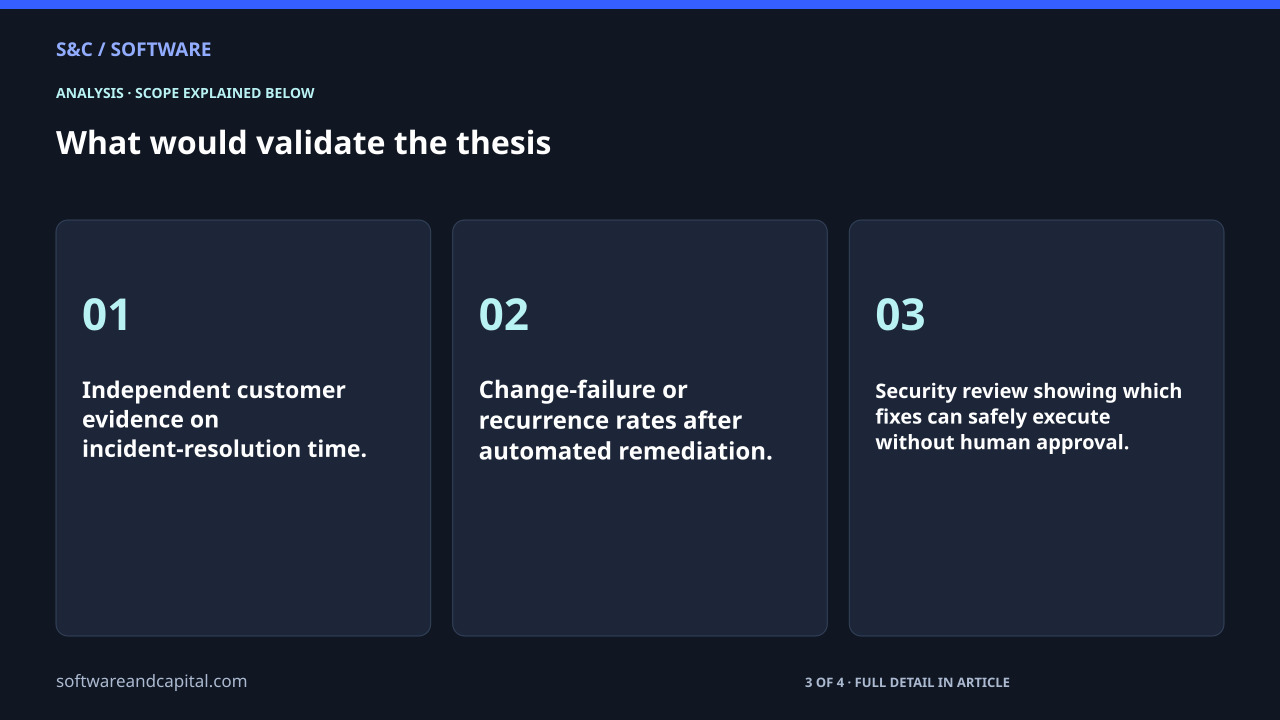
What would validate the thesis
- Independent customer evidence on incident-resolution time.
- Change-failure or recurrence rates after automated remediation.
- Security review showing which fixes can safely execute without human approval.
- Cost comparisons that include model calls, infrastructure and human review.
AI coding does not eliminate the software lifecycle. It can accelerate the first half of it. Autoheal’s bet is that the second half—operating, securing and repairing what gets shipped—will need its own agent infrastructure.
Sources and methodology
Sources checked September 29, 2026. Dates and periods for individual figures are stated beside them.
- Autoheal: seed funding announcement ↗Accessed 2026-09-29
- Autoheal product overview ↗Accessed 2026-09-29
Scope and assumptions
Autoheal is an early-stage company and the cited product savings claims are company-reported rather than independently validated.
The article does not assume that AI-generated code necessarily has a higher defect rate; the thesis also depends on increased software volume.
Continue reading
Google’s Security Agent Found 500+ XSS Bugs. The Trick Was Proving the Exploit →