AI adoption looks different when the software sits between a homeowner's call and a technician arriving at the door. ServiceTitan is pushing AI into that operating chain. Its Max package connects lead capture, booking, dispatch, job execution, estimates and payments inside the same vertical platform used by contractors.2, 3
ServiceTitan reported $292.8 million of fiscal Q2 2027 revenue, up 21% year over year, and $50.5 million of non-GAAP free cash flow. It also says it exceeded its Q2 goal for Max adoption and expects more than 700 enrolled Max locations by fiscal year-end. Max connects AI and automation across booking, dispatch, field work and back-office workflows.1, 2, 3
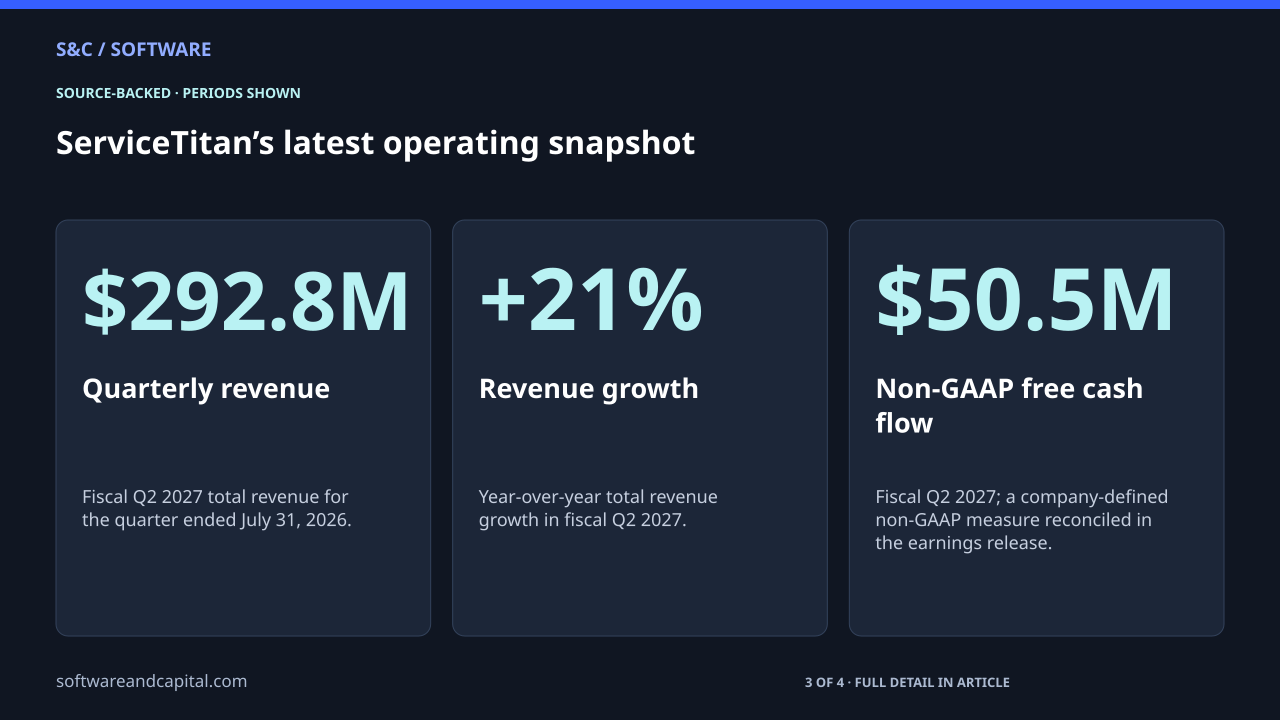
ServiceTitan’s latest operating snapshot
Vertical AI starts with workflows the software already owns
ServiceTitan Max is not a separate chatbot layered on top of contractor software. ServiceTitan describes it as a new experience built on its product foundation with a native AI layer. The product connects work that already runs through the system, from booking and dispatch to field execution and invoicing.2, 3
| Workflow | Existing operational data | AI or automation opportunity |
|---|---|---|
| Lead and booking | Calls, web inquiries, availability and customer history | Respond, qualify and book appointments. |
| Dispatch | Technician schedules, capacity and geography | Match jobs with available capacity. |
| Field work | Job history, equipment and estimates | Surface context and support technician decisions. |
| Back office | Invoices, payments, accounts and customer records | Automate follow-up, reporting and administrative work. |
The rollout metric is locations, not AI users
ServiceTitan says it exceeded its goal of doubling Max locations during Q2 and now expects more than 700 enrolled Max locations by fiscal year-end. That is a rollout measure for its Max package. It is not a count of individual workers using an AI agent, and it should not be converted into an AI-adoption percentage without a denominator.1
The financial results and AI claims belong in separate columns
Revenue growth and cash flow are reported financial results. Management's statements that AI is improving organizational velocity and creating a major opportunity are interpretations. The filing does not provide a clean experiment showing how much of the 21% revenue growth came from AI.1
That separation matters because the company can be growing while also investing heavily in AI, without the public numbers proving that AI caused the growth. The stronger evidence is narrower: ServiceTitan is putting AI into workflows it already owns and is tracking adoption of the Max package.1, 3
Trades software has an advantage general tools do not
A vertical platform can know the customer's history, the technician schedule, the job type, the estimate and the invoice because those records already live in the product. That context can make automation more useful than a general assistant that has to reconstruct the workflow through connectors.2, 3
What to watch as Max expands
- Whether enrolled locations translate into sustained use across multiple workflows.
- Whether AI features improve customer outcomes without adding operational complexity.
- How much Max changes pricing and revenue per customer versus simply replacing older modules.
- Whether ServiceTitan can keep specialized trade context as general AI platforms improve.
The pattern complements S&C’s Salesforce employee-agent rollout. Salesforce shows how internal enterprise agents depend on clean knowledge. ServiceTitan shows a different advantage: an AI system embedded in a vertical application can begin with the operational data and workflow already inside the product.
For plumbers, HVAC companies and other contractors, the AI shift may arrive through software they already pay for rather than through a new standalone assistant. That makes vertical SaaS one of the most practical places to watch agentic AI move from demo to daily operations.
Sources and methodology
Sources checked September 28, 2026. Dates and periods for individual figures are stated beside them.
- ServiceTitan: fiscal Q2 2027 earnings release filed with the SEC ↗Accessed 2026-09-28
- ServiceTitan Help: introduction to ServiceTitan Max ↗Accessed 2026-09-28
- ServiceTitan: Max package ↗Accessed 2026-09-28
Scope and assumptions
The >700 Max-location figure is a fiscal year-end expectation, not the current installed base or a count of individual AI users.
Non-GAAP free cash flow is a company-defined measure and is labeled accordingly.
The public filing does not isolate how much revenue growth is caused by AI, so management's AI productivity statements are not treated as causal evidence.
Continue reading
70,000 Employees Use Salesforce’s Internal AI Agent. The Hard Part Was Cleaning the Knowledge Base →
1M Businesses Already Use Meta’s AI Agent. Is Customer Service Becoming a Meta Product? →