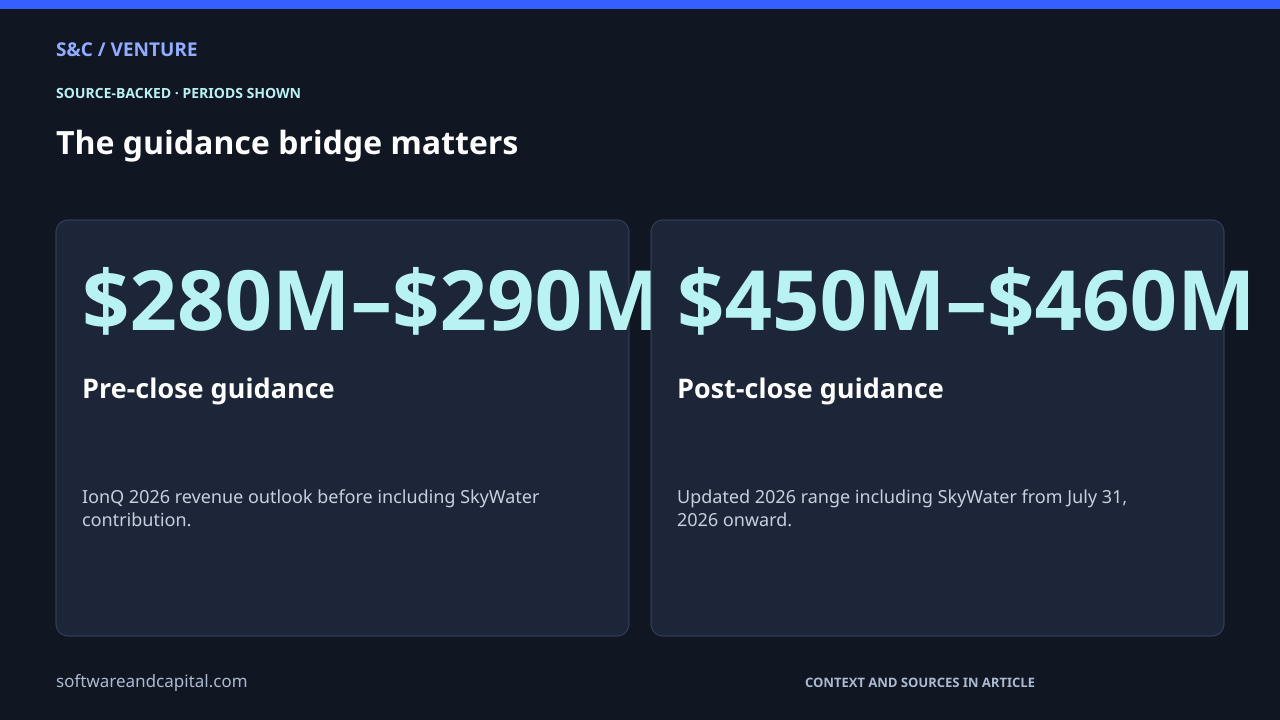
IonQ’s 2026 revenue outlook changed dramatically after it bought SkyWater Technology. The company now guides to $450 million–$460 million for the year. The important detail sits underneath the headline: the range includes SkyWater only from the July 31 acquisition close, so the increase is partly a change in what businesses are inside IonQ.1
IonQ raised 2026 revenue guidance to $450 million–$460 million after completing its SkyWater acquisition. The higher range includes SkyWater only from the July 31 closing date onward, so it should not be read as organic quantum-computing growth. Strategically, the deal gives IonQ semiconductor manufacturing capability inside a broader vertically integrated quantum stack.1, 2
The guidance bridge matters
The higher number is not an organic-growth comparison
A company can grow revenue because its existing products sell more, because it acquires another revenue-producing business, or both. IonQ’s revised range changes the reporting perimeter during the year. Comparing the two guidance ranges without the acquisition note would overstate what the number says about underlying quantum demand.1
Why would a quantum company buy a semiconductor foundry?
Quantum systems still depend on conventional semiconductor manufacturing, packaging and control hardware around the qubits. Owning SkyWater gives IonQ direct access to fabrication capabilities and engineering infrastructure that can shorten the distance between device design and manufacturing.2
| Layer | Before vertical integration | Potential benefit of ownership |
|---|---|---|
| Device design | IonQ controls architecture and system design | Closer coordination with fabrication. |
| Fabrication | External manufacturing dependency | Internal foundry capability through SkyWater. |
| Packaging and integration | Coordination across suppliers | More control over manufacturing handoffs. |
| Systems | IonQ-branded quantum products | A broader stack under one corporate owner. |
Vertical integration trades flexibility for control
Owning manufacturing can improve coordination and secure capacity, but it also adds a different operating business with its own customers, costs and capital needs. A foundry is not merely a feature inside a quantum computer. IonQ now has to integrate an industrial operation while pursuing its quantum roadmap.
Keep three growth questions separate
- How much of reported growth comes from IonQ’s pre-acquisition businesses?
- How much revenue is contributed by SkyWater after the July 31 close?
- Does owning manufacturing improve product speed, cost or reliability over time?
The acquisition makes IonQ a broader company and immediately makes its revenue headline larger. The harder test comes later: whether controlling more of the manufacturing stack creates an operating advantage that is worth the complexity of owning it.
Sources and methodology
Sources checked September 25, 2026. Dates and periods for individual figures are stated beside them.
- IonQ increases 2026 outlook following SkyWater acquisition ↗Accessed 2026-09-25
- IonQ launches SuperIon product line ↗Accessed 2026-09-25
Scope and assumptions
The revised guidance includes SkyWater only after the acquisition close and cannot be treated as a like-for-like organic growth rate.
Potential manufacturing benefits are strategic possibilities; the acquisition does not by itself prove lower costs, faster development or better quantum performance.
Continue reading
Why Qubit Count Is No Longer Enough to Judge a Quantum Computer →