If quantum progress were only a qubit race, IBM’s newest Nighthawk revision would look oddly uneventful. Nighthawk r2 still has 120 programmable qubits. IBM’s headline improvement is that the processor can cycle through far more circuits in the same amount of time.1, 2
Qubit count measures scale, but it does not tell you how accurately or quickly a quantum processor can execute circuits. IBM’s Nighthawk r2 has 120 programmable qubits while IBM says it exceeds 100,000 circuits per second and delivers up to 25 times Heron’s throughput. Quantum hardware should be read across scale, quality and speed, not one number.1, 2
| Metric | What it asks | Nighthawk r2 example |
|---|---|---|
| Scale | How much programmable quantum capacity is available? | 120 programmable qubits |
| Quality | How reliably can circuits run? | IBM says r2 matches Heron fidelity |
| Speed | How much circuit work can the system execute over time? | More than 100,000 circuits per second, according to IBM |
Qubits are capacity, not completed work
A programmable qubit is one piece of the processor’s working state. More qubits can allow larger problems, but a large machine that spends too much time resetting, waiting or correcting errors may do less useful work than the headline count suggests.
IBM’s r2 change is a clean example because the programmable-qubit count stays fixed. The company added fast reset hardware that can return qubits to the ground state much faster between runs, reducing idle time.1
Speed can change while scale stays the same
IBM says Nighthawk r2 can execute 100,000 circuits per second, roughly 25 times Heron’s rate of about 4,000. Its documentation lists throughput above 100 kHz while retaining 120 programmable qubits.1, 2
That does not make a circuit-per-second figure a universal performance score either. Workloads differ, circuit depth matters and quality has to survive the faster pace. The point is that throughput answers a question the qubit count cannot.
Quality is the third axis
Quantum operations are noisy. A processor with more qubits or faster repetition is not automatically more useful if errors overwhelm the computation. IBM frames hardware performance across scale, quality and speed for that reason.1
Nighthawk r2 is therefore a useful reading lesson rather than proof of general quantum advantage. IBM’s figures are vendor-reported, and the processor’s ability to run large circuits does not by itself establish that those circuits beat the best classical method on an economically useful task.
How to read the next quantum hardware announcement
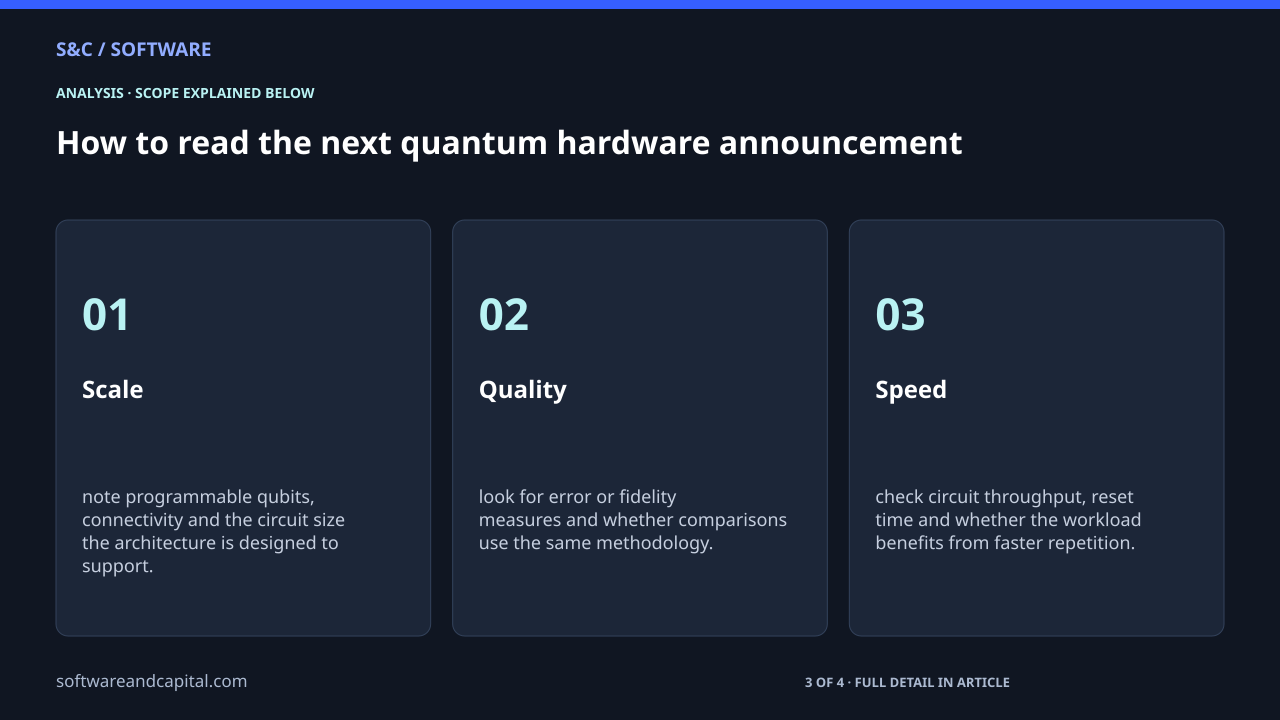
- Scale: note programmable qubits, connectivity and the circuit size the architecture is designed to support.
- Quality: look for error or fidelity measures and whether comparisons use the same methodology.
- Speed: check circuit throughput, reset time and whether the workload benefits from faster repetition.
- Usefulness: separate engineering progress from a demonstrated advantage on a real problem.
Qubit count is still important. It is just one dimension of a machine whose usefulness depends on how much reliable work the whole system can complete. Nighthawk r2 makes that visible because the count barely tells the story.
Sources and methodology
Sources checked September 24, 2026. Dates and periods for individual figures are stated beside them.
- IBM Quantum: Nighthawk r2 ↗Accessed 2026-09-24
- IBM Quantum processor types ↗Accessed 2026-09-24
Scope and assumptions
IBM’s throughput and fidelity statements are vendor-reported and workload-dependent.
The cited hardware metrics do not by themselves demonstrate commercially useful quantum advantage.