“One in four workers” is a number that can make someone look nervously at their job description. But the ILO’s 2025 estimate does not say that a quarter of workers are about to be replaced. It asks which occupations contain work that generative AI could affect. That is a map of possible change, not a redundancy list.1, 3
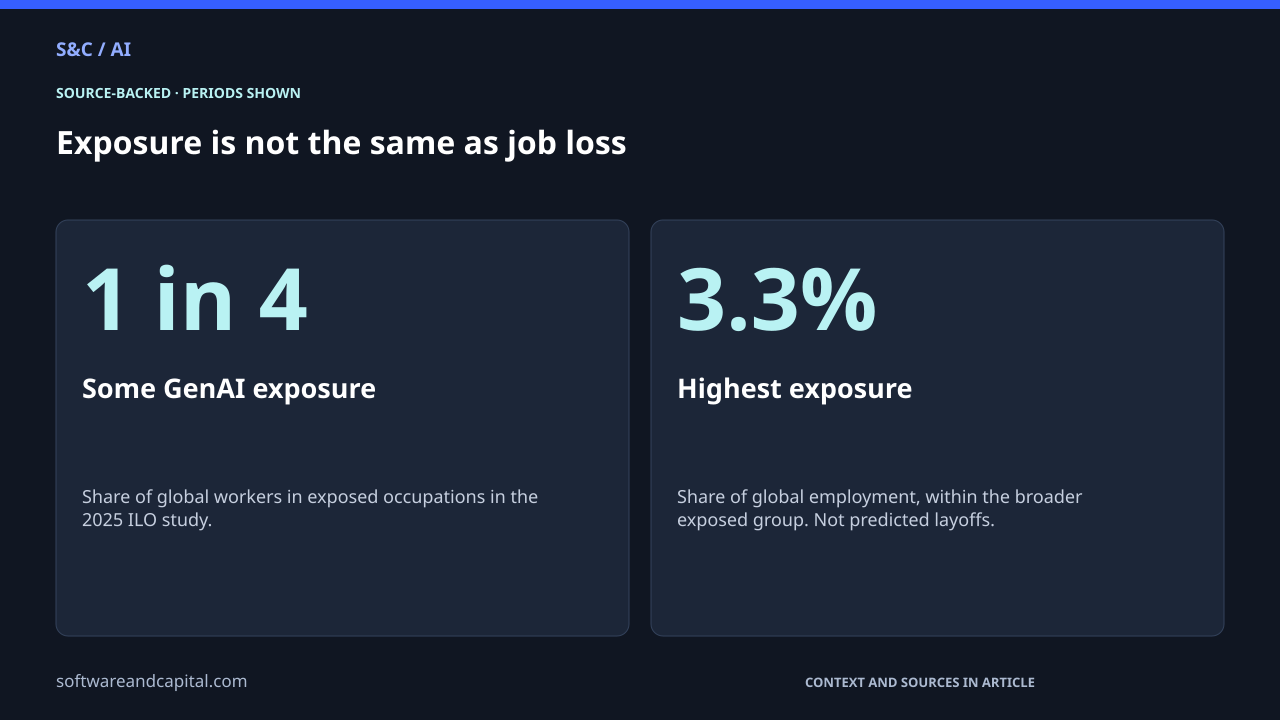
The ILO’s 2025 study estimated that one in four workers worldwide was in an occupation with some generative-AI exposure. Only 3.3% of global employment was in the highest exposure category. Exposure measures potential task change, not observed layoffs or a prediction that every affected job disappears.1, 3
Exposure is not the same as job loss
A job is a bundle of responsibilities, not a single task with a salary attached. Writing a first draft, checking facts, negotiating with a client and taking responsibility for a decision can all belong to one role. A tool becoming useful for one part does not automatically remove the rest.
What the researchers actually measured
The ILO’s research combined task-level information, worker input, expert review and AI-assisted scoring. Its brief describes an assessment covering nearly 30,000 tasks and four levels of exposure. The purpose was to distinguish different amounts and types of potential change, rather than give every occupation a simple safe-or-doomed label.2
The study places clerical occupations at the highest exposure levels and identifies increasing exposure in some highly digitized professional and technical work. It also reports different exposure across economies: 34% of employment in high-income countries, compared with 11% in low-income countries. Those are shares within each income group, not shares of the world’s layoffs.1
A task can shrink while a job changes shape
Consider a hypothetical employee preparing a client presentation. AI might help draft slides or summarize supplied notes. Someone still has to decide what the client needs, check the claims, secure permission to use information and handle questions in the meeting. This is an illustration of the distinction, not a measured productivity result.
| Part of the work | A possible AI contribution | The question that remains |
|---|---|---|
| Preparing material | Generate a first draft from supplied information. | Is it accurate and suited to this audience? |
| Reviewing the output | Suggest edits or flag inconsistencies. | Who checks the evidence and accepts the result? |
| Working with the client | Help organize follow-up notes. | Who understands the relationship and makes commitments? |
This is also why choosing AI tools by the job is more useful than counting how many features a tool advertises. A useful first draft and a completed professional responsibility are different outcomes.
There are several steps between capability and employment
The ILO’s announcement explicitly warns that potential exposure is not actual job loss. It identifies constraints such as infrastructure, skills and technology that affect implementation. Its central expectation is more transformation of jobs than outright replacement, while emphasizing that policy and workplace choices shape the result.3
Do not skip the middle of the story
- Capability: can a tool perform a relevant task at an acceptable standard?
- Adoption: does the organization have a workable, permitted way to use it?
- Redesign: how are tasks, review and responsibilities reorganized?
- Employment: does the employer change staffing, output, services or the mix of roles?
Those steps create different possible outcomes. A team might serve more customers with the same staff. It might reduce hiring, reorganize roles or cut positions. An exposure score alone cannot tell us which route a particular employer will choose, or when.
Nor is “transformation” a promise that every change feels good. A role can survive while its pace, required skills or degree of discretion changes. The ILO calls for employers, workers and governments to help shape the transition, including the quality of the work that remains.3
The better question for someone reading their job description
Instead of asking whether your title appears on an AI list, separate the work you do into parts. Which outputs are easy to specify? Which mistakes matter? Which responsibilities depend on context, relationships or accountability? That makes the discussion concrete without pretending to predict your employer’s staffing plan.
For a team trying a tool, inspect what actually happens after the output arrives. A result that still needs extensive repair has not eliminated that work. Our guide to evaluating AI agents explains why a confident completion message is not sufficient evidence.
The one-in-four figure deserves attention because it describes a wide reach. It does not supply a timetable or a dismissal count. The useful conversation starts with what changes inside the job, and who has a say in how that change is used.
Sources and methodology
Sources checked September 21, 2026. Dates and periods for individual figures are stated beside them.
- ILO Working Paper 140: Refined global index of GenAI occupational exposure ↗Accessed 2026-09-21
- ILO: Generative AI and jobs, 2025 research brief ↗Accessed 2026-09-21
- ILO–NASK: Study announcement and explanation of exposure limits ↗Accessed 2026-09-21
Scope and assumptions
The numerical estimates belong to the ILO–NASK research published in May 2025. They are not a live 2026 count of adoption, redundancies or vacancies.
The presentation task example and possible employer responses are explanatory illustrations, not a workplace trial or an individual employment forecast.
AI-assisted research and editing. Our editorial standards.