A bank cannot give an AI agent a broad password to the trading stack and hope the model behaves. Nasdaq Calypso’s agent strategy points to a more constrained design: put workers beside the system of record, limit their connections and keep people in the approval path for consequential actions.1
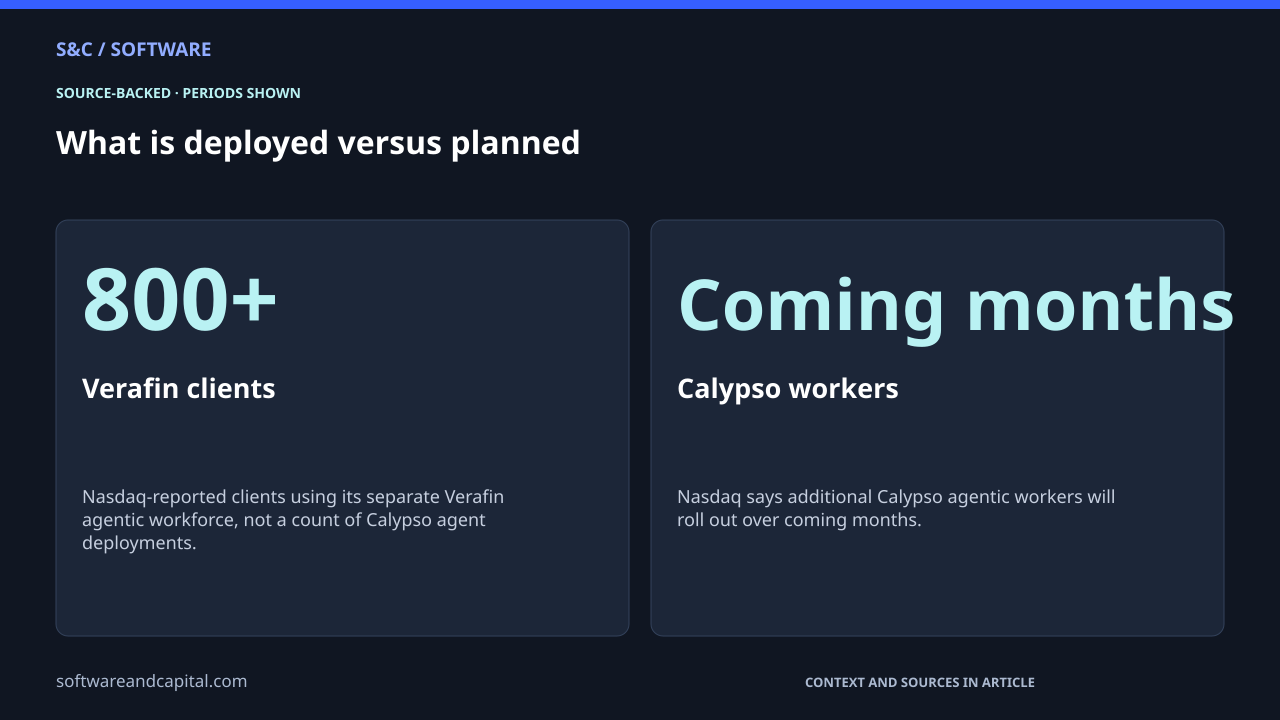
Nasdaq Calypso is adding agentic capabilities around trade, risk, collateral and settlement workflows using sandboxing, human oversight and controlled connections to enterprise systems. Nasdaq says its Verafin agentic workforce is already used by more than 800 clients, but most Calypso-specific workers are planned for release over coming months. The architecture is more established than the Calypso productivity evidence.1, 2
| Layer | Role | Boundary |
|---|---|---|
| Calypso records | Trades, risk, collateral and settlement state | Authoritative business data |
| Agent sandbox | Reconciliation, investigation or workflow assistance | Governed execution environment |
| Approved connections | MCP and enterprise tools | Explicitly exposed systems rather than unrestricted access |
| Human oversight | Review and escalation | Control for consequential actions |
The agent is being put inside the workflow, not beside it
The attraction of an embedded worker is context. A reconciliation agent that can see the relevant trade and settlement state does not need a user to copy data into a separate chatbot. The risk is that context can become authority, which is why sandboxing and oversight are part of the product design.1
What is deployed versus planned
MCP is a connection mechanism, not a permission model by itself
Nasdaq highlights Model Context Protocol connectivity so agents can interact with approved enterprise tools. That can standardize the connection. Firms still need identity, authorization, logging and business rules around what the connected agent may actually do.1
Regulated adoption may look deliberately boring
The first useful jobs are likely to be bounded operational tasks such as reconciliation, investigation and exception handling rather than an autonomous agent making unrestricted trading decisions. That is less dramatic than a general AI trader and much closer to how financial infrastructure changes safely.1
Four controls the architecture needs
- A defined business record the agent can read and update.
- A sandbox limiting code, tools and network access.
- Explicit connections to approved external systems.
- Human review or escalation for actions with material financial consequences.
The important shift is from asking an AI about the trading system to letting software work inside it. In capital markets, that shift is likely to happen one governed workflow at a time.
Sources and methodology
Sources checked September 29, 2026. Dates and periods for individual figures are stated beside them.
- Nasdaq Calypso agentic capabilities announcement ↗Accessed 2026-09-29
- Nasdaq Calypso agentic capabilities syndicated release ↗Accessed 2026-09-29
Scope and assumptions
The 800+ client figure refers to Nasdaq’s Verafin agentic workforce, not Calypso deployments.
Most Calypso-specific workers are planned for coming months, so the announcement does not establish measured productivity outcomes.
Continue reading
When Banking Lives Inside Business Software, Who Owns the Customer? →
If an AI Agent Can Act Like an Employee, It Needs an Identity →
Google’s Security Agent Found 500+ XSS Bugs. The Trick Was Proving the Exploit →