A small business could open an account or move money without ever leaving the software it uses to run invoices, expenses or operations. That does not mean the software company has become the bank. FIS's new Embedded Banking Platform makes the split explicit: the bank owns the account and relationship, the software partner owns the interface, and FIS connects the two.1
In FIS's model, the bank keeps the account on its own balance sheet and retains the customer relationship and regulatory control. A software partner owns the user experience, while FIS provides the infrastructure connecting them. The result can look like banking inside an accounting or vertical-software product even though the underlying account still belongs to the bank.1, 2
| Layer | Role |
|---|---|
| Bank | Keeps accounts on its own balance sheet, retains customer ownership and regulatory control. |
| Business software or fintech | Owns the user experience where the customer opens an account or moves money. |
| FIS | Provides the infrastructure connecting the bank's products to the software interface. |
| Business customer | Uses banking functions without leaving the software it already uses. |
The interface can move without the bank account moving
FIS says the account remains on the bank's balance sheet rather than on a third-party ledger. That distinction matters. The visible front door can sit inside accounting or industry software, while the regulated deposit account, customer ownership and compliance responsibility remain with the bank.1
This is a distribution strategy as much as a banking product. A bank no longer has to make a customer return to a separate portal for every financial task. It can place banking functions inside software where the customer's invoices, payables or operating data already live.1
FIS sits between two companies that want different things
The software company wants a seamless experience. The bank wants to preserve the regulated relationship and keep deposits in its own institution. FIS supplies APIs, SDKs, embeddable widgets and white-label applications so those two goals can coexist without requiring the software vendor to become a bank.1
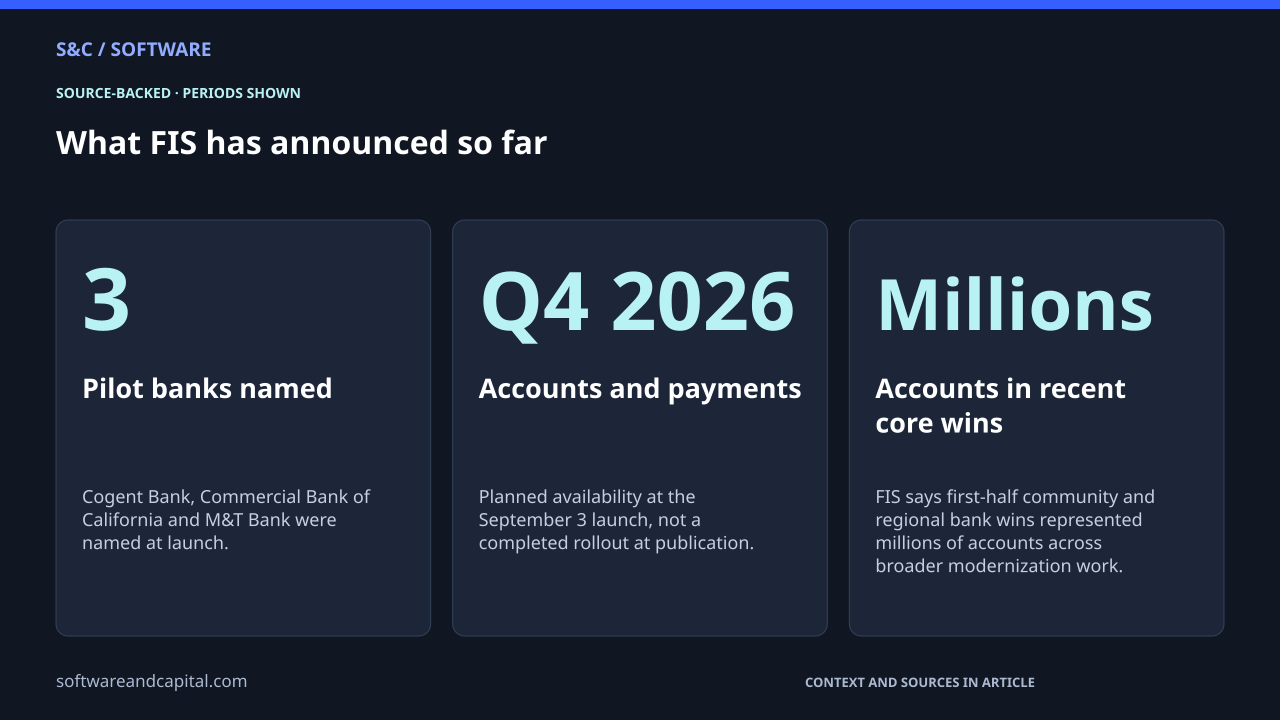
What FIS has announced so far
Embedded banking still depends on old-fashioned core infrastructure
FIS's broader bank-modernization announcements are a reminder that the embedded interface is only one layer. Accounts, balances and transactions still have to connect to core systems that banks expect to be resilient and auditable. Putting the experience inside software does not remove the infrastructure underneath it.2
Three questions to ask when banking appears inside software
- Which regulated bank actually holds the account or funds?
- Who owns the customer relationship and handles regulated obligations?
- Which company controls the interface, integrations and everyday workflow?
The distinction also helps explain why Chime's proposed Stride acquisition is strategically different. Embedded banking can preserve a bank-software partnership. Chime is moving the other way by trying to own one of the regulated institutions beneath its app.
The bank may become less visible without becoming less important. Embedded banking changes where a customer encounters the product. It does not automatically change who holds the account, owns the regulated relationship or carries the banking obligations underneath the screen.
Sources and methodology
Sources checked September 28, 2026. Dates and periods for individual figures are stated beside them.
- FIS: Embedded Banking Platform launch ↗Accessed 2026-09-28
- FIS: community and regional banks modernizing core systems ↗Accessed 2026-09-28
Scope and assumptions
FIS's Embedded Banking Platform was newly launched, with accounts and payments planned for Q4 2026, so broad adoption and economics are not yet demonstrated.
The article describes FIS's announced architecture and does not imply that every embedded-banking provider uses the same balance-sheet or customer-ownership model.
Continue reading
Why Revolut Wants to Become a Bank in America →