A model price cut sounds like a billing change. At enough volume, it becomes a product-design change. OpenAI says GPT-6 Sol and Luna are priced 50% below GPT-5.6 promotional pricing, creating more room to put stronger models behind tasks that happen thousands or millions of times.1
OpenAI says GPT-6 Sol and Luna API prices are 50% lower than GPT-5.6 promotional pricing. At Standard short-context rates, Sol costs $2 per million input tokens and $10 per million output tokens, while Luna costs $0.10 and $0.50. Lower model prices can make high-volume features and routing cheaper, but tools, retries, infrastructure and model quality still determine total cost per successful task.1, 2
| Model | Input | Output |
|---|---|---|
| GPT-6 Astra | $10.00 | $50.00 |
| GPT-6 Sol | $2.00 | $10.00 |
| GPT-6 Luna | $0.10 | $0.50 |
Cheaper tokens can change which model gets the routine job
A product does not need the most capable model for every request. Lower-priced models make routing more useful: reserve the expensive model for hard cases and send predictable, high-volume work to a cheaper tier.
A 50% model cut is not a 50% product-cost cut
The API bill can also include cached tokens, cache writes, long-context premiums, tools and other processing. Applications add their own databases, observability, orchestration and retries. A cheaper model therefore lowers one input to the system rather than every cost around it.2
That is why our cost-per-successful-task framework matters alongside token price. A cheap call that fails and repeats can cost more than a pricier call that works once.
The biggest effect may be features that were previously too expensive to run often
When inference gets cheaper, developers can afford to invoke AI more frequently for classification, drafting, extraction, routing and other repetitive work. Whether that is worthwhile still depends on accuracy and user value.
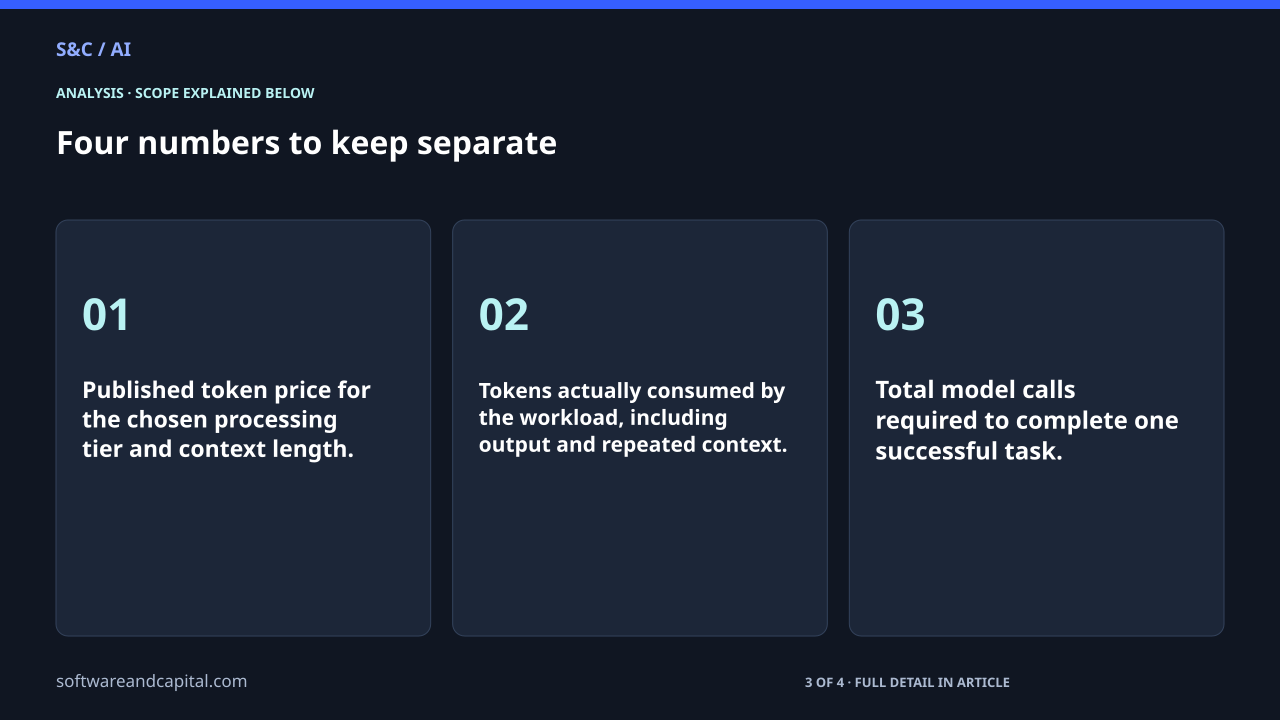
Four numbers to keep separate
- Published token price for the chosen processing tier and context length.
- Tokens actually consumed by the workload, including output and repeated context.
- Total model calls required to complete one successful task.
- Non-model costs such as tools, storage, infrastructure and human review.
Price compression does not make every model interchangeable. It changes the economic frontier. The useful question is no longer only how intelligent the model is, but how much intelligence a product can afford to use every time the user clicks.
Sources and methodology
Sources checked September 25, 2026. Dates and periods for individual figures are stated beside them.
- OpenAI: GPT-6 Sol and Luna release ↗Accessed 2026-09-25
- OpenAI API pricing ↗Accessed 2026-09-25
Scope and assumptions
The 50% comparison is specifically against GPT-5.6 promotional pricing.
Processing tier, context length, tool usage and application overhead can materially change total cost.