A 90% discount is the kind of number that makes an AI budget look suddenly manageable. With prompt caching, the catch is what the discount applies to: reused input, not the whole answer. You also pay to create the cache. One request and no repeat can cost more than skipping the cache.2
Cache savings apply to the input that actually gets reused, not to every part of an AI request. Using Claude Sonnet 4.6’s documented rates, one hit makes its five-minute cache cheaper for that repeated input. The one-hour cache needs two hits. Output, tools, misses and other costs still belong in the total bill.2, 1, 3
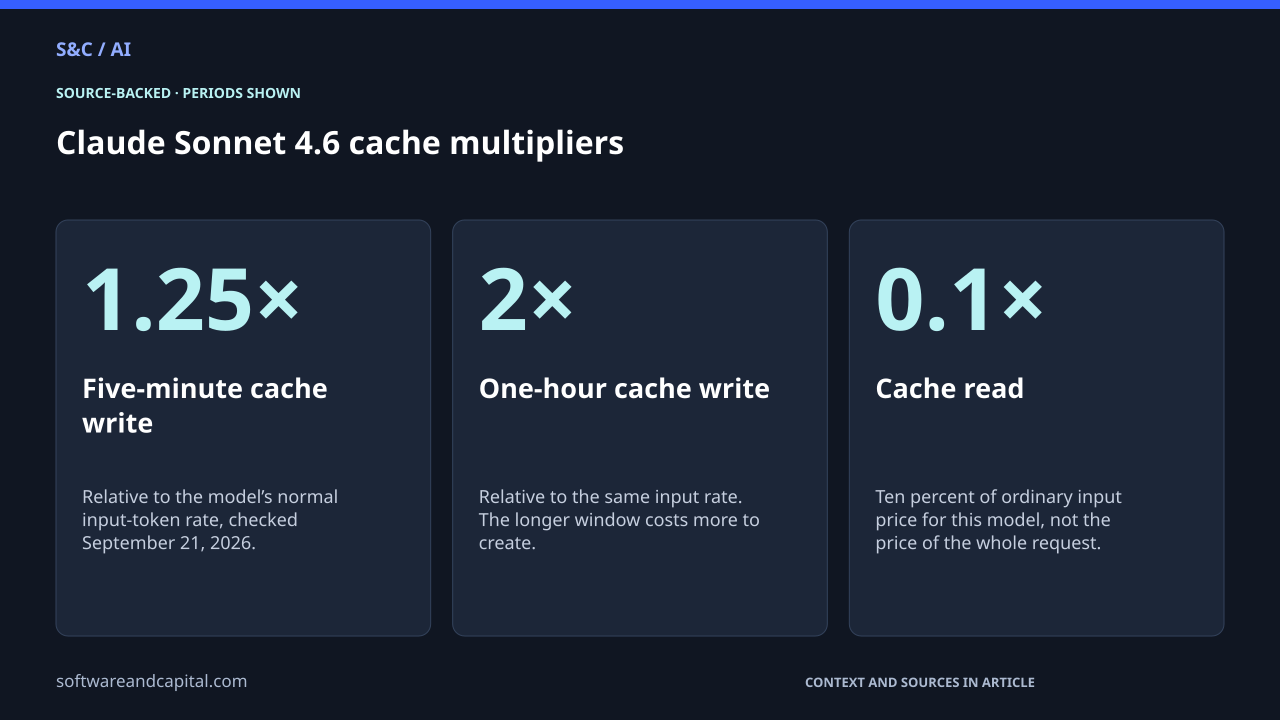
Claude Sonnet 4.6 cache multipliers
We use Sonnet 4.6’s documented multipliers to keep this calculation specific. Not every Claude model has the same read multiplier. The current pricing table lists exceptions, so use the row for the model you actually run.2
You are reusing the briefing, not buying the answer twice
Picture a support assistant that receives the same long company policy with each customer question. Prompt caching lets an eligible repeated beginning of the prompt be reused instead of charged as ordinary input each time. It does not mean recycling the previous customer’s answer.1
That distinction explains the opportunity. A large, stable policy used repeatedly may be a useful candidate. A short instruction that changes on every request may not be. The question is how much input really repeats, and how soon.
The first repeat can make the five-minute option pay
Let one unit mean the price of sending the reusable portion once without caching. The table shows only that portion’s input cost. Request counts are hypothetical, using the documented multipliers above. Every later request is assumed to get a cache hit.
| Pattern | No cache | 5-minute cache | 1-hour cache |
|---|---|---|---|
| One request, no reuse | 1.00 | 1.25 | 2.00 |
| Initial request + 1 hit | 2.00 | 1.35 | 2.10 |
| Initial request + 2 hits | 3.00 | 1.45 | 2.20 |
| Initial request + 9 hits | 10.00 | 2.15 | 2.90 |
With one later hit, the five-minute option costs 1.25 + 0.10 = 1.35 units instead of 2. That is a 32.5% saving on the repeated input across the two requests. The one-hour option still costs more at that point. It becomes cheaper than no caching after its second hit.
The general break-even check is simple: write cost + number of hits × read cost must be below the uncached cost of those same requests. Count a fresh write whenever the relevant cached input has to be stored again.
Timing can erase the saving
Anthropic documents a five-minute default lifetime that refreshes when the cache is used, plus an optional one-hour lifetime. The cache also has matching and minimum-length requirements. A repeated prompt does not automatically guarantee a hit.1
A burst of similar requests is different from one request every few hours. The burst may reuse a single write. The spaced-out requests may repeatedly pay to create a cache that nobody uses again. Average daily volume alone hides that difference.
Other providers need their own calculation. Gemini’s caching documentation distinguishes implicit and explicit caching, and explicit caching has storage-related pricing as well as token costs. Do not transplant Claude’s break-even table into a Gemini budget.3
Measure the share of the bill that can actually fall
Suppose reused input accounts for half your model bill and a change reduces that part by 50%. The total bill falls 25%, not 50%, if everything else stays the same. That is illustrative arithmetic, but it is the right way to think about a discount on one part of a request.
Check these before forecasting the saving
- How many input tokens are genuinely reusable, rather than newly added each time?
- How often do requests actually hit the cache before it expires?
- How much do new writes and any storage charges add?
- How much of the full bill comes from output, tools and human checking instead?
Use actual usage records to compare cache writes, reads and uncached input. Then place the saving inside the cost of finishing the task. A smaller prompt bill is useful. It is not the whole business case.
Sources and methodology
Sources checked September 21, 2026. Dates and periods for individual figures are stated beside them.
- Anthropic: Prompt caching ↗Accessed 2026-09-21
- Anthropic: Claude API pricing ↗Accessed 2026-09-21
- Google: Gemini API context caching ↗Accessed 2026-09-21
Scope and assumptions
Request patterns and workload shares are illustrative. Rates are scoped to the documented model and may change.
No API requests were run. Matching requirements, minimum lengths, misses and provider-specific storage charges must be included in a real budget.
AI-assisted research and editing. Our editorial standards.