Your team processes 1,000 customer requests. One automation plan records 3,000 tasks, another records 1,000 executions. Did the first product do three times as much work? In this hypothetical setup, no. The two services are counting different parts of the same job.
Start with the work your team needs done, then translate it into each product’s billing units. Seats, tasks and workflow runs are different meters. Our hypothetical 1,000-job month uses 3,000 Zapier tasks or 1,000 n8n executions. That difference alone says nothing about which option costs less.1, 2, 3
| Product | What is counted | Important boundary |
|---|---|---|
| Slack | Active paid members under its Fair Billing Policy. | The policy covers eligible website purchases by credit card or self-serve invoice. |
| Zapier | Successful billable actions. | Triggers, Filter and Paths do not use tasks. Some features have their own rates. |
| n8n paid plans | Runs of an entire workflow, rather than each step. | A completed execution is not proof that the business result is correct. |
Slack is not an alternative to an automation platform. It is here to show the difference between paying for access and paying for activity. A five-person team can use five seats while generating thousands of actions in another service. Putting both numbers under “usage” does not make them comparable.
Write the job before pricing the software
Imagine each customer request creates a CRM contact, adds a project record and sends a notification. Assume each is one ordinary billable Zapier action, while the whole job is one n8n workflow run. There are no failures, replays, sub-workflows or separately metered AI features in this example.
| Work pattern | Business jobs | Zapier tasks | n8n executions |
|---|---|---|---|
| Every job takes three billable actions | 1,000 | 3,000 | 1,000 |
| 600 jobs take three actions, 400 take one | 1,000 | 2,200 | 1,000 |
The second row changes the work, not the customer count. Six hundred jobs use three actions and 400 use one, giving 2,200 tasks. Each still starts one workflow in our n8n design. Neither row tells you which platform is cheaper. You still need each plan’s price, allowance and rules.
Zapier’s task documentation is why a diagram’s step count is not a sufficient estimate. Triggers and certain built-in logic steps do not consume tasks. Use the billing definition of the steps you actually need, not a blanket assumption that every box costs one task.1
A cheap meter can sit inside an expensive plan
A plan with enough usage may still lack the integration, permissions or operational feature you need. First identify an eligible plan. Then compare the cash commitment for your expected workload, including what happens when usage exceeds the included amount.
Slack adds a different wrinkle. Its Fair Billing Policy describes active-member billing and eligible prorated account credits when members become inactive. The headline seat count is therefore not the whole calculation. Check whether the purchase is covered by that policy rather than assuming all negotiated agreements work the same way.3
Use one worksheet, not one unit
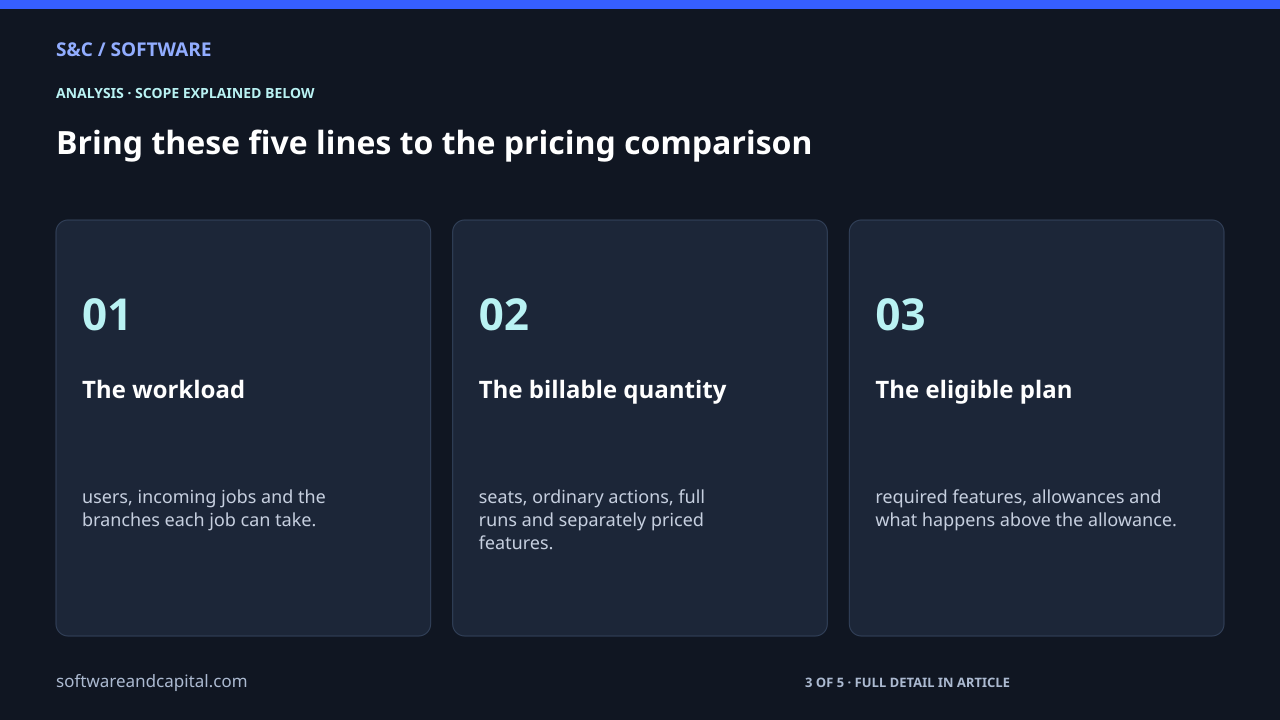
Bring these five lines to the pricing comparison
- The workload: users, incoming jobs and the branches each job can take.
- The billable quantity: seats, ordinary actions, full runs and separately priced features.
- The eligible plan: required features, allowances and what happens above the allowance.
- The cash commitment: billing period, currency, renewal terms and upfront payment.
- The operating effort: who maintains the workflow and fixes failed or duplicated work.
Run the worksheet for a normal month and a plausible busy month. Use your own counts, not a guess chosen to make a favorite product win. Keep one-off implementation work separate from recurring fees so a new setup is not unfairly compared with an established one.
There is no need to force everything into a universal “task.” Convert the business workload into each vendor’s meter, price it under the relevant plan, then compare the total cost of achieving the same result.
The invoice and the value answer different questions
A billable execution may finish without producing the record your team actually needs. Keep a second measure for cost per accepted task. It includes checking and repair work, so the lowest subscription does not automatically become the best operating choice.
Before buying, you should be able to finish one sentence: “For this amount of work, under these plan rules, this is what we expect to pay.” A small number on the pricing page is not a substitute for that sentence.
Sources and methodology
Sources checked September 21, 2026. Dates and periods for individual figures are stated beside them.
- Zapier: How is task usage measured in Zapier? ↗Accessed 2026-09-21
- n8n: Plans and pricing, including execution definitions ↗Accessed 2026-09-21
- Slack: Fair Billing Policy ↗Accessed 2026-09-21
Scope and assumptions
Workload counts are illustrative, not vendor price quotations or a hands-on product comparison.
Plan eligibility, overages, negotiated contracts and actual operational effort must be checked for the intended purchase.
Continue reading
2¢ vs 4¢: When the Cheaper AI Call Costs More →
Your SaaS Export Is Not an Escape Plan →
Why Qubit Count Is No Longer Enough to Judge a Quantum Computer →