An AI-written article can read well, build successfully and still publish the wrong number. Or the right draft can be approved while a different version goes live. A useful publishing pipeline needs to catch both problems. Neither is solved by making the writing prompt longer.
Before publishing, check four things: the evidence supports the claims, the package matches the approved version, the release passes its blocking checks, and the live page is the intended one. Keep approval attached to a specific version. A green build cannot prove that the article is true.1, 2
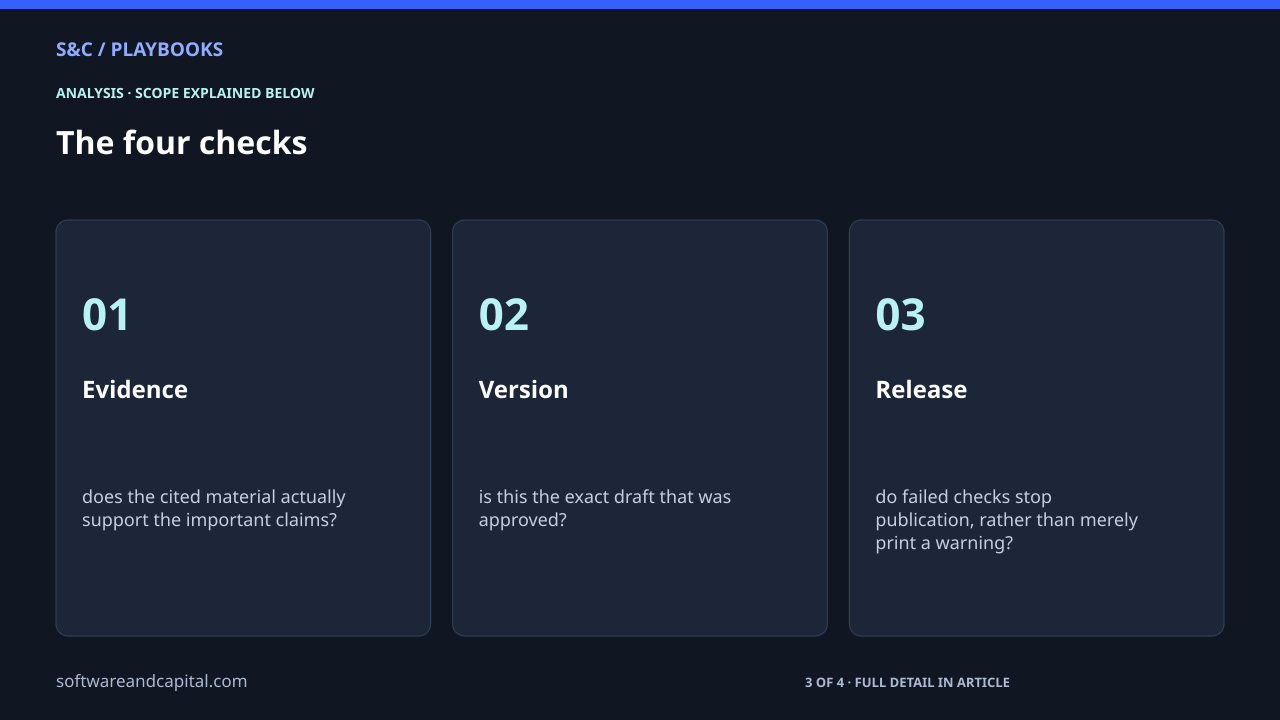
The four checks
- Evidence: does the cited material actually support the important claims?
- Version: is this the exact draft that was approved?
- Release: do failed checks stop publication, rather than merely print a warning?
- Live page: is the intended version accessible with the correct links and indexing settings?
1. Check the claim, not just the link
A source URL that loads proves very little about the sentence beside it. The page might concern a different period, use a different definition or contain no support for the claim at all. Check important numbers, quotations and comparisons against the relevant passage.
Separate the checks a program can perform from the ones that need editorial judgment. Software can catch a missing source identifier, a malformed table or a duplicate URL. That does not establish whether a reported funding round has been confused with revenue.
Write down the evidence review before approving the candidate. The draft generator’s own “approved” field is not a separate editorial decision. A good release record identifies who authorized this version and what the authorization covers.
2. Keep approval attached to one version
GitHub Actions can pass stored artifacts between jobs. Its documentation describes v4 artifacts as immutable, and jobs can depend on earlier jobs through the needs setting. Those are useful building blocks for passing the same package through a release.1
Give the candidate a version identifier and checksum. A checksum is a fingerprint of the chosen bytes. Record which article inventory it was built against, so an older draft cannot quietly overwrite a newer edit. If the draft changes after approval, approve the changed candidate rather than relying on the old decision.
| Record | What it protects |
|---|---|
| Candidate ID and package checksum | The identity of the content being approved |
| Baseline article revision | Changes made after research began |
| Evidence review and authorizing decision | Who approved the candidate and what was checked |
| Live revision confirmation | The difference between sending a release and serving it |
3. Make failure stop the release
Here is an easy detail to miss: GitHub says an artifact digest mismatch produces a warning in the interface and logs. Do not assume that warning terminates the workflow. When matching bytes is a release requirement, make your own comparison fail the job.1
GitHub also offers deployment-environment controls such as required approval. Their availability depends on the plan and repository, and bypass settings matter. Use the controls your repository actually has, not a diagram of controls you hoped it had.2
Try a missing source, a changed package and an outdated baseline in a nonpublishing rehearsal. Each should stop for the right reason. Then try a valid candidate. A system that rejects everything has not proved that it can publish safely.
4. Check the page readers get
After deployment, verify the live revision rather than assuming a successful upload is the end. Confirm that the intended page opens, the links resolve and the indexing settings match your intent.
Google’s noindex guidance makes one distinction particularly important: a crawler must be able to access the page to see the noindex directive. Blocking the page in robots.txt is not a substitute. Private drafts need access controls, not just a request to stay out of search.3
Keep “published” and “discovered by search” as separate milestones. The search measurement guide explains what to count after a release. Passing these four checks makes the release more traceable, not guaranteed to rank.
The goal is a boring release process behind an interesting publication. Spend the editor’s attention on the claims and the reader’s attention on the story. Let the system remember which version was cleared to ship.
Sources and methodology
Sources checked September 21, 2026. Dates and periods for individual figures are stated beside them.
- GitHub: storing and sharing workflow artifacts ↗Accessed 2026-09-21
- GitHub: deployment environments and protection rules ↗Accessed 2026-09-21
- Google: blocking indexing with noindex ↗Accessed 2026-09-21
Scope and assumptions
The checklist is a proposed design based on documentation, not an audit or test of any existing pipeline.
Deployment approvals and bypass controls vary by repository and plan. Mechanical checks do not certify factual accuracy or search visibility.
AI-assisted research and editing. Our editorial standards.
Continue reading
4 Numbers to Keep Separate: AI Citations Are Not Website Visits →