50,000 impressions. 1,050 clicks. In the hypothetical dashboard below, those numbers describe the same period, but very different achievements. The larger one is about appearing in Google. The smaller one is about getting a click. Neither tells you how many visitors an AI citation sent to the site.
Impressions count appearances, clicks count qualifying clicks, sessions group activity on your site, and AI citations count source mentions within a particular report. Keep all four separate. A citation is not a visit, and adding the numbers together does not produce a meaningful audience total.1, 2, 5
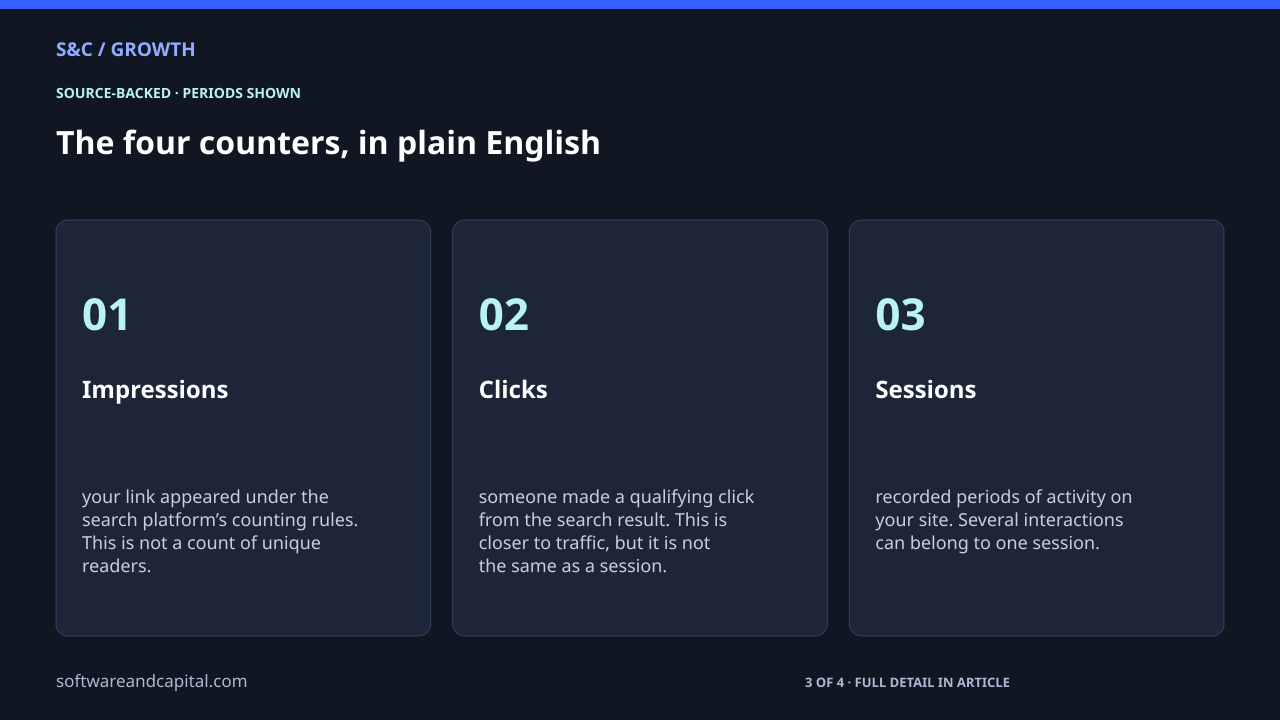
The four counters, in plain English1, 2, 5
- Impressions: your link appeared under the search platform’s counting rules. This is not a count of unique readers.
- Clicks: someone made a qualifying click from the search result. This is closer to traffic, but it is not the same as a session.
- Sessions: recorded periods of activity on your site. Several interactions can belong to one session.
- AI citations: your page appeared as a source within the services covered by that report. A citation does not establish that anyone clicked.
A bigger audience number can hide a smaller change
Here is an invented dashboard for two equal 28-day periods. The Google figures use the same pages and filters in both periods. The Analytics row covers google / organic traffic. Bing citations cover Bing’s stated AI services. None of these figures describes Software & Capital.
| Measure | Period A | Period B | What changed |
|---|---|---|---|
| Google impressions | 40,000 | 50,000 | Up 25% |
| Google clicks | 1,000 | 1,050 | Up 5% |
| Google click-through rate | 2.5% | 2.1% | Down 0.4 percentage points |
| GA4 google / organic sessions | 850 | 880 | 30 more sessions |
| Bing AI citations | 600 | 900 | Up 50% within that report |
The tempting headline is “visibility up 25%.” The less dramatic traffic result is 50 additional clicks. Both are true in this example. Choosing only the bigger percentage makes the distribution result sound stronger than the click count supports.
The click-through rate, or CTR, fell because impressions grew faster than clicks. Divide 1,050 by 50,000 and you get 2.1%. That does not prove the title got worse. The page could have appeared for a different mix of searches or in different positions. Those are explanations to investigate, not findings from this invented example.
Google and Bing are not counting the same thing
Google includes AI Overviews and AI Mode in Search Console’s overall Web performance reporting. That total is not a separate count of AI citations. Google’s guidance describes the reporting scope.3
In an AI Overview, every cited link shares the overview’s position number. It tells you where the overview appeared, not where your link sat inside it. Impression rules also vary by result format, so some links count only after someone scrolls or expands the result.1
Bing’s February 2026 AI Performance announcement covers citations in Microsoft Copilot, AI-generated Bing summaries and selected partner integrations. Its citation total is about those supported services, not all AI products. Its displayed grounding queries are a sample of retrieval phrases, not necessarily the exact questions people typed.5
Keep the platform name beside the number. “900 Bing AI citations” tells the reader what was measured. “900 AI visits” says something the citation report has not established.
Clicks and sessions will not line up perfectly
A GA4 session groups interactions, with a default inactivity timeout of 30 minutes. It is not another name for a click or a unique person. Google also explains why Search Console clicks and Analytics sessions can differ, including tagging, time zones and the way pages are attributed.2, 4
When the gap looks large, compare the same dates, pages and traffic source first. Then check the measurement setup. Do not declare missing visitors simply because two reports count different events.
Two calculations to avoid
- Do not divide Google sessions by Bing citations and call it an AI conversion rate. Those figures come from different systems.
- Do not add impressions, sessions and citations into a total audience. The units differ, and the people behind them may overlap.
Build a dashboard that answers a business question
Use impressions to ask where your pages appear. Use clicks to ask which appearances bring traffic. Use sessions and the outcomes you actually measure, such as completed signups, to ask what visitors do. Use citations to see where your pages are being used as sources.
Our CTR calculator lets you explore the arithmetic. At 50,000 impressions, a 2.5% CTR implies 1,250 clicks, versus 1,050 at 2.1%. The difference is 200 clicks. It is a scenario, not a promise that rewriting a headline will produce them.
Before the next growth review, put four clearly labeled lines on the dashboard. A smaller number with a clear definition is more useful than an impressive total nobody can explain.
Sources and methodology
Sources checked September 21, 2026. Dates and periods for individual figures are stated beside them.
- Google Search Console: impressions, position and clicks ↗Accessed 2026-09-21
- Google Analytics: sessions ↗Accessed 2026-09-21
- Google Search Central: AI features and your website ↗Accessed 2026-09-21
- Google: using Search Console and Analytics data for SEO ↗Accessed 2026-09-21
- Microsoft Bing: AI Performance public-preview announcement, February 2026 ↗Accessed 2026-09-21
Scope and assumptions
The dashboard is hypothetical, not S&C traffic. No private analytics account or title experiment was used.
Reporting definitions and AI-service coverage can change. Follow the dated primary sources for the scope of each metric.
AI-assisted research and editing. Our editorial standards.