A robot needs more than a powerful chip and an AI model. It also has to decide how an arm, gripper or mobile manipulator should move through physical space without colliding with the world around it. Qualcomm is buying PickNik Robotics, bringing a key contributor to the open-source MoveIt ecosystem inside a major compute company.1
Qualcomm is acquiring PickNik Robotics, the company behind major development and stewardship of MoveIt, an open-source motion-planning framework used in robotics. The deal extends Qualcomm’s robotics strategy from compute hardware toward software that plans and executes robot movement, while raising a key question: how open-source stewardship works inside a hardware platform owner.1, 2
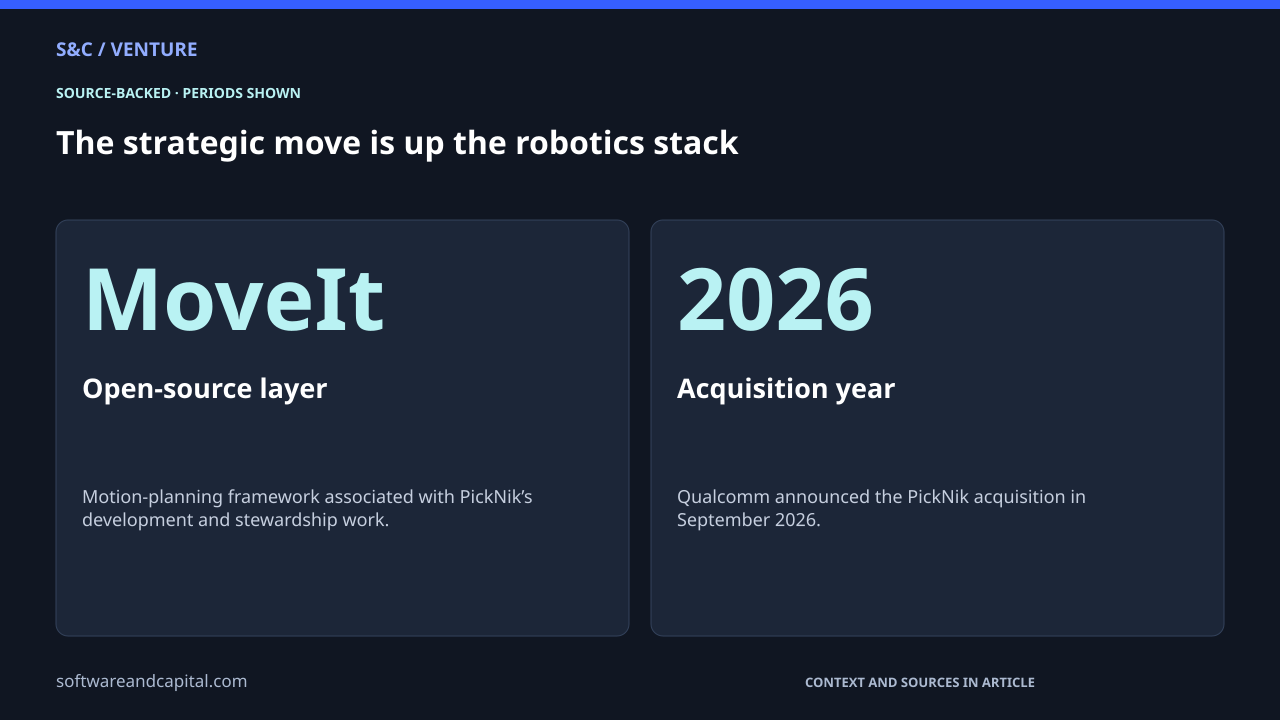
The strategic move is up the robotics stack
Motion planning sits between intelligence and motors
A model can decide that a robot should pick up an object. Motion-planning software has a different job: calculate a feasible path, account for constraints and translate the intent into movement the robot can execute. That layer is a practical bridge between high-level intelligence and physical action.1
| Layer | Job | Example role |
|---|---|---|
| AI or task model | Decide what should happen | Choose the goal or action. |
| Motion planning | Decide how the robot should move | Plan paths and respect constraints. |
| Compute platform | Run models and control software | Provide processing and acceleration. |
| Robot hardware | Execute physical movement | Motors, joints, sensors and actuators. |
Qualcomm gains a software control point
Qualcomm already sells compute platforms into robotics. PickNik gives it expertise closer to the application layer, where developers turn robot capabilities into reliable motion. Tighter integration can make Qualcomm hardware easier to use for robotics workloads, although the acquisition itself does not prove a performance advantage.1
Open source makes the ownership question different
MoveIt is open-source software, so acquiring a company that contributes to it is not the same as buying exclusive ownership of every line of community code. Qualcomm says it intends to continue supporting open robotics and MoveIt. The credibility of that commitment will depend on governance, contribution and developer trust after the deal.1
What developers should watch
- Whether MoveIt development remains broadly hardware-neutral.
- How Qualcomm contributes engineering resources back to the open-source project.
- Which integrations become easier on Qualcomm robotics platforms.
- Whether community contributors continue to view the project as an open control layer.
The acquisition is a reminder that important AI infrastructure is not always a model. In robotics, the software that turns a goal into safe physical movement can be a strategic layer too. Qualcomm is moving closer to that layer while promising not to close it off.
Sources and methodology
Sources checked September 25, 2026. Dates and periods for individual figures are stated beside them.
- Qualcomm to acquire PickNik ↗Accessed 2026-09-25
- Qualcomm newsroom releases ↗Accessed 2026-09-25
Scope and assumptions
The transaction announcement does not prove that Qualcomm hardware will outperform alternatives because of the acquisition.
MoveIt is open source; PickNik’s acquisition should not be described as Qualcomm gaining exclusive ownership of the community project.
Continue reading
Why Nvidia Is Paying $12.9B for Hugging Face →
Show a Robot One Video. Skild Says It Can Learn the Task Without Retraining →