Teaching a robot a new job usually means collecting examples and changing the model. Skild’s S1 is trying something closer to prompting: show the robot one video of the desired task and let the existing model infer what to do without changing its weights.1
Skild says S1 can use one video demonstration as an in-context prompt to execute unseen manipulation tasks without task-specific fine-tuning. In its internal benchmark, unseen tasks improved roughly sevenfold versus language prompting, and one demonstration reached a success level that required about 380 post-training demonstrations for the comparison policy. These are Skild’s internal results, not a universal robotics benchmark.1, 2
| Conventional task adaptation | S1 in-context approach |
|---|---|
| Collect task-specific teleoperation data | Record one demonstration |
| Fine-tune or post-train the policy | Put the demonstration in the model context |
| Validate the newly trained task policy | Execute with the same model weights |
The video is the instruction
Skild says S1 was pretrained to infer intent from demonstrations that can differ in viewpoint, scene or embodiment. At deployment, the demonstration enters the context window and the policy maps that intent onto the robot and environment in front of it.1
The striking result is on tasks the model did not see in pretraining
Skild reports tasks lasting up to ten minutes, including plant potting, pancake cooking and pour-over coffee. On its internal unseen-task benchmark, it says in-context demonstration prompting produced roughly a sevenfold improvement over language prompting.1
Those are company research results. They do not mean one video can teach any robot any task, and the benchmark uses Skild’s own training and evaluation setup.
One demonstration can replace a lot of data before it stops winning
Skild compared the one-demo in-context policy with a conventional policy post-trained on 1 to 2,000 teleoperation demonstrations. It estimates the one demonstration matched the success level reached at roughly 380 post-training examples, which took 50 to 100 hours to collect for long tasks.1
More training eventually won. Skild reports the in-context policy at 66% success while the post-trained policy reached 86% with 2,000 demonstrations. The result is therefore about rapid adaptation, not proof that training data no longer matters.1
Why this matters outside a robotics lab
Factories, kitchens and warehouses change. If every new object arrangement or procedure requires another data-collection and training cycle, deployment stays slow and expensive. In-context learning tries to move some of that adaptation into the moment the task is assigned.
What S1 changes in the workflow
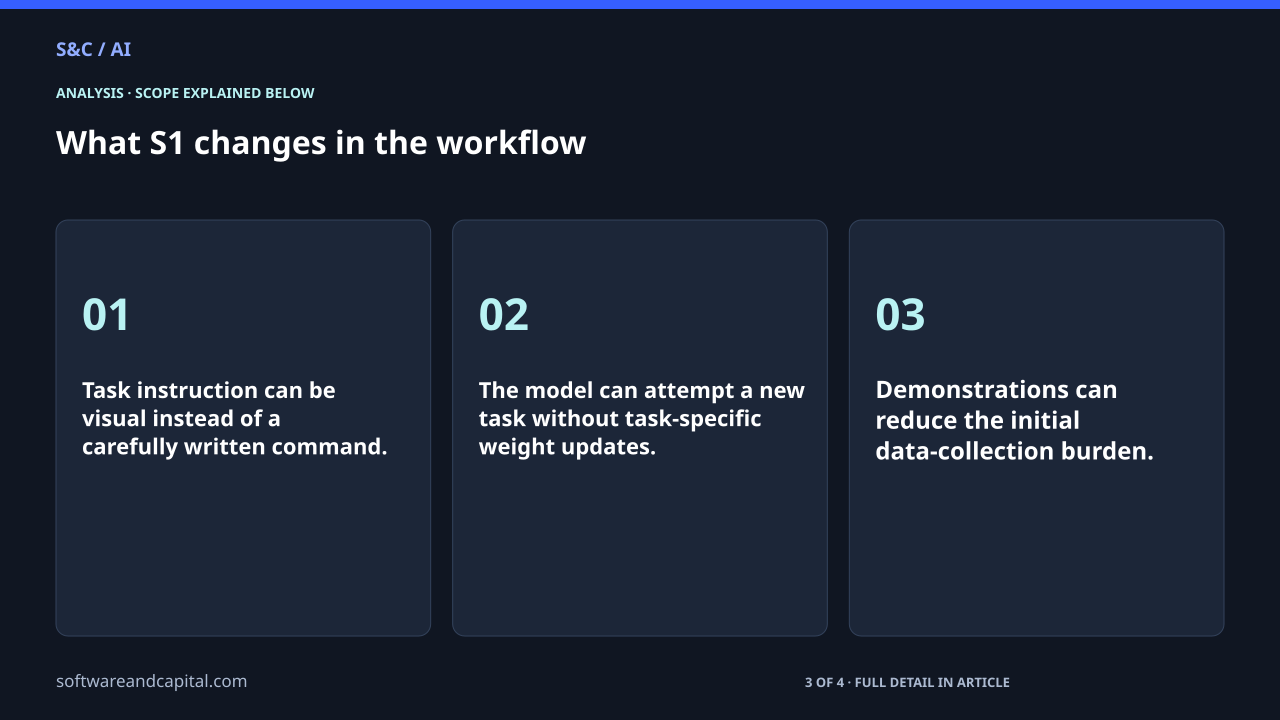
- Task instruction can be visual instead of a carefully written command.
- The model can attempt a new task without task-specific weight updates.
- Demonstrations can reduce the initial data-collection burden.
- Post-training can still improve performance when higher reliability justifies the extra data.
Language models became easier to use when people could teach them through context instead of retraining them for every request. Skild is testing whether robotics can make a similar shift. Its internal results are early, but the workflow change is clear: show first, train later if needed.
Sources and methodology
Sources checked September 25, 2026. Dates and periods for individual figures are stated beside them.
- Skild AI: Introducing S1 ↗Accessed 2026-09-25
- NVIDIA: Skild AI S1 physical AI ↗Accessed 2026-09-25
Scope and assumptions
The performance figures come from Skild’s internal research setup and should not be generalized to all robots or tasks.
Skild’s own comparison shows extensive post-training eventually surpassing the one-demonstration policy.
Continue reading
Skild Says It Reached $100M ARR 10 Months After Its First Robot Deployment →