You rewrite a dull headline. Clicks go up the next week. It is tempting to declare a winner and repeat the formula across the site. But perhaps Google showed different wording, the page moved up the rankings, or the topic suddenly became news.
Check three things: whether searchers saw the new title, whether you are comparing similar searches, and whether the gain lasted through the review period you chose in advance. Google can display a different title from the one you supplied. A before-and-after chart alone cannot isolate the headline’s effect.1, 2
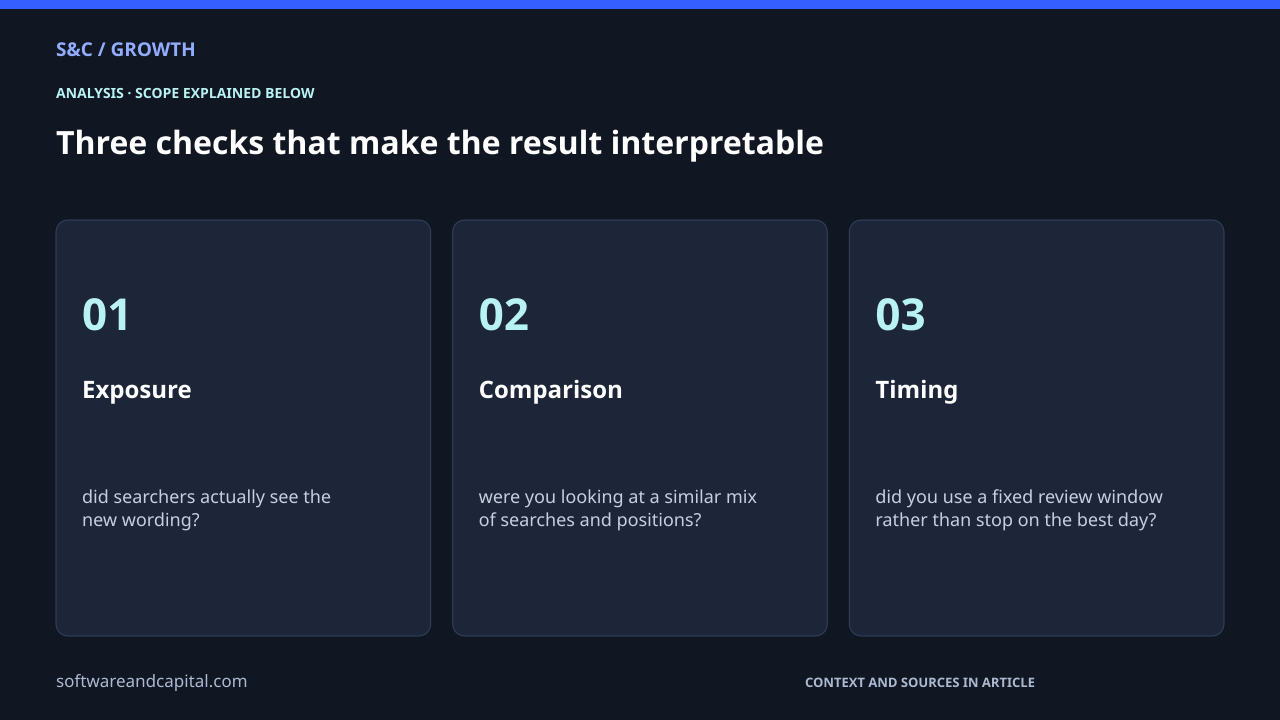
Three checks that make the result interpretable
- Exposure: did searchers actually see the new wording?
- Comparison: were you looking at a similar mix of searches and positions?
- Timing: did you use a fixed review window rather than stop on the best day?
A clearer headline may be a good editorial decision even without a traffic experiment. The point of testing is to learn something stronger than “I prefer the new version.” Separate that preference from the evidence about what changed.
1. Check what Google actually showed
Google’s title guidance says title links are generated automatically from sources including the title element, visible main title and other page signals. The displayed wording may differ from what you entered. Updates also need recrawling and reprocessing, which can take days to weeks.1
Record the original title, replacement title and deployment date. Note whether your edit changed only the browser title or also the visible article heading. Many publishing systems derive both from the same field. That is fine, but the test then concerns the combined change.
For an illustrative tutorial, “Pagination guide” might become “Cursor pagination: fetch every page without duplicate records.” The second version promises a specific outcome. It is only a better candidate if the page actually teaches that outcome.
Check a few relevant searches and record the date, country and device. Treat those observations as spot checks, not proof of what appeared for every searcher. If the old wording is still appearing, the experiment’s exposure is uncertain.
2. Compare the same kind of search traffic
A page can gain clicks because it gets more impressions, reaches a better position, or appears for a different set of queries. A change in overall click-through rate does not separate those effects from the wording of the title.
Before editing, save the page filter, dates and query group you intend to compare. Google’s Search Analytics API supports query, page, country and device dimensions. Its dates use Pacific Time, and the returned detailed rows are not guaranteed to cover every query. Keep those limits in the experiment record.2
| What changed | Why the headline is not the only explanation |
|---|---|
| More people search for the topic | Demand can lift clicks even if the title is unchanged. |
| The page moves to a better position | Visibility changes alongside the wording. |
| Branded searches become a larger share | The new audience may already be looking for the company or site. |
| A promotion sends extra attention | Another distribution change overlaps the test. |
A set of similar unchanged pages can help show whether the whole site moved together. It is not a perfect control if those pages have different audiences or demand. For a small site, an honest directional result is more useful than calling every comparison an A/B test.
3. Choose the review window before the result
Pick an end date, a transition period and the size of improvement that would matter to you. Use comparable weekdays where practical. Do not keep checking until the chart happens to look flattering and then declare that day the finish line.
Sparse traffic may leave you with an inconclusive result. That is not a failed article. It means the observation does not support a strong claim about the title. Keep the clearer wording on editorial grounds if it serves the reader, but do not label it a proven growth tactic.
A useful final record
- Old and new wording, including every page field that changed.
- Deployment date and observations of the title actually shown.
- Fixed filters and comparison periods, plus other changes that could matter.
- Keep, reverse or inconclusive, with the reason and limitations.
For metric definitions, see AI citations, impressions and visits. For the actual wording, follow the reader: make the subject and value specific, keep the promise accurate, and remove generic padding. A surprising number helps only when the article earns it.
The win is not just a better headline. It is a record that helps you make the next headline decision without inventing a success story from a noisy week.
Sources and methodology
Sources checked September 21, 2026. Dates and periods for individual figures are stated beside them.
- Google Search Central: Influencing your title links in search results ↗Accessed 2026-09-21
- Google Search Console API: Search Analytics query ↗Accessed 2026-09-21
Scope and assumptions
This is a proposed testing method, not a completed title experiment. No private Search Console data was used.
Search spot checks and before-and-after comparisons cannot fully identify title exposure or causality. No universal sample size or waiting period is claimed.
AI-assisted research and editing. Our editorial standards.
Continue reading
4 Numbers to Keep Separate: AI Citations Are Not Website Visits →