AI training data used to evoke large teams labeling images or ranking text responses. Snorkel says frontier-model customers now want something harder: expert-designed tasks, interactive environments and evaluation rubrics that can take hours or days to construct. Its latest financing and run-rate claim suggest that specialized data production is becoming a large business of its own.1, 3
Snorkel says its data-as-a-service offering crossed a $375 million annualized revenue run rate after growing more than 18× in roughly a year. The company also raised $350 million at a $3.5 billion valuation. The run-rate figure annualizes a current revenue pace. It is not the same as audited trailing revenue, GAAP revenue or necessarily contracted ARR.1, 2, 3
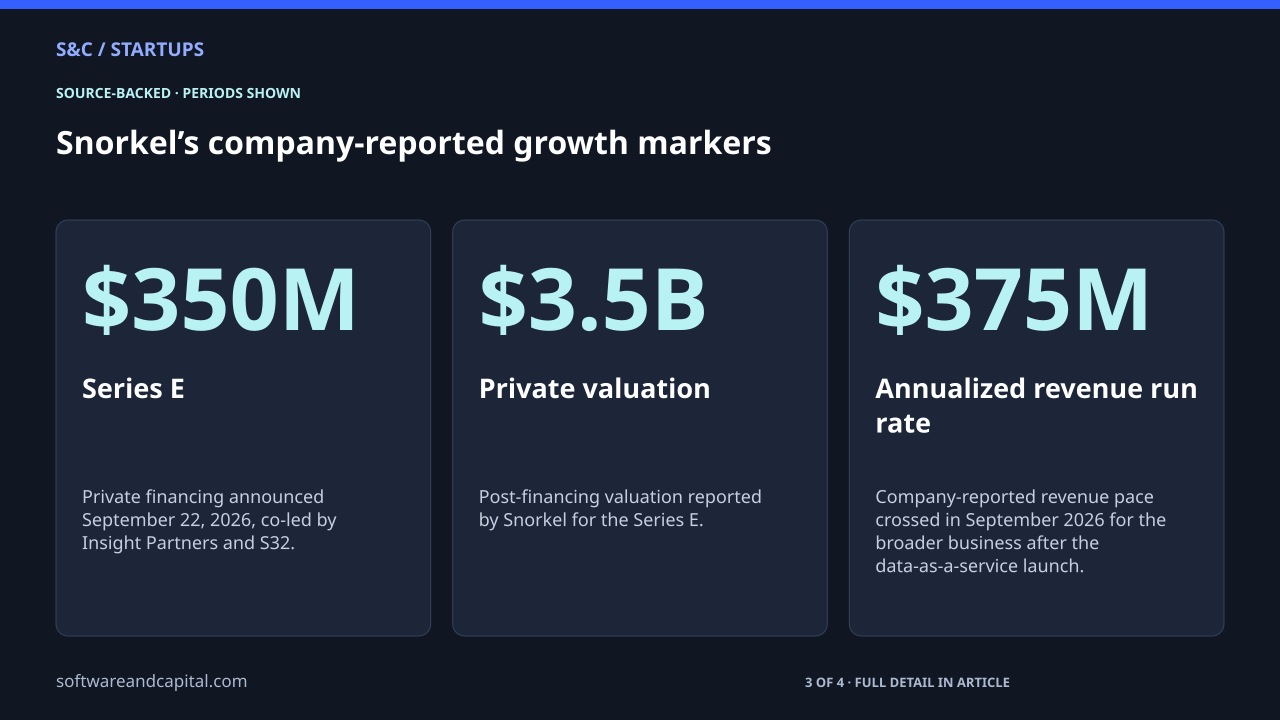
Snorkel’s company-reported growth markers
Private financing announced September 22, 2026, co-led by Insight Partners and S32.
Company-reported revenue pace crossed in September 2026 for the broader business after the data-as-a-service launch.
Company-reported growth in the new data-as-a-service offering since launch nearly a year earlier.
The product is moving beyond labeling queues
Snorkel describes the newer work as building agentic tasks, environments and rubrics for training and evaluating advanced systems. Instead of asking a worker to label one static example, a project may require creating a realistic environment, defining what success looks like and producing expert feedback that a model can learn from.1, 3
| Older pattern | Newer frontier-AI pattern | Why it is harder |
|---|---|---|
| Label an image or response | Design a multi-step agent task | The task has to stay coherent across several actions. |
| Rank two outputs | Build an evaluation rubric | Experts have to define what good performance means. |
| Collect static examples | Construct interactive environments | The model needs a setting where actions produce realistic consequences. |
| Scale with more annotators | Combine experts, research and tooling | Quality depends on domain knowledge as well as volume. |
A run rate is a pace, not a full-year revenue result
Snorkel's $375 million figure is an annualized revenue run rate. That means the company is taking a recent revenue pace and expressing it on a one-year basis. The announcement does not present $375 million as audited trailing-12-month GAAP revenue, and it should not be relabeled as ARR without a definition from the company.1
The financing and the operating metric answer different questions
The $350 million Series E is capital raised. The $3.5 billion figure is the private valuation attached to that round. The $375 million run rate is an operating metric. Putting all three together is useful only if their units remain separate. A valuation does not become revenue, and capital raised does not prove profitability.1, 2
The customer is buying research capacity as well as data
Insight Partners describes the new market as specialized data, environments and evaluations that often require domain expertise to structure and validate. That makes the supplier look less like a commodity labeling marketplace and more like a research-and-production partner embedded in model development.3
That model can also be harder to scale. Expert work may be expensive, customer requirements can differ and quality is harder to standardize than a simple labeling task. Snorkel's growth claim shows demand, but it does not tell us gross margins, customer concentration or how much human labor sits behind each dollar of run rate.
Four questions behind the $375M run-rate headline
- How much of the run rate comes from repeatable software versus managed expert services?
- How concentrated is revenue among frontier labs, hyperscalers and large enterprise customers?
- How quickly can specialized environments and rubrics be reused across customers?
- What margins remain after expert labor, research and infrastructure costs?
The article also complements S&C's Anthropic R&D automation analysis. Anthropic is measuring how much AI can lead work inside a frontier lab. Snorkel is building an external supply layer for the tasks, environments and evaluations those labs use to train and test systems.
If the market continues moving from simple labels toward research-heavy training environments, the AI-data business becomes less about collecting more examples and more about designing better work for models to learn from. Snorkel's reported run rate is an early financial marker for how valuable that layer may be becoming.
Sources and methodology
Sources checked September 28, 2026. Dates and periods for individual figures are stated beside them.
- Snorkel AI: Data 2.0 and the research era of AI data ↗Accessed 2026-09-28
- Snorkel AI: $350 million Series E release ↗Accessed 2026-09-28
- Insight Partners: Behind the investment in Snorkel AI ↗Accessed 2026-09-28
Scope and assumptions
The $375M annualized revenue run rate and >18× data-service growth figures are company-reported and are not presented as audited trailing revenue.
The public financing materials do not disclose gross margins, customer concentration or the software-versus-services revenue mix.
Insight Partners is an investor in Snorkel and is used for market and product context rather than independent performance validation.
Continue reading
Claude Now ‘Leads’ 26% of Anthropic’s AI R&D Work →
86% Agreement Can Still Miss Half the AI Failures →
1B Weekly Users, 2.5M Businesses: OpenAI’s Two-Sided Growth Flywheel →