ChatGPT became famous as a consumer product, but OpenAI increasingly describes a business that moves in both directions. People learn the product at home, bring the habit to work, and companies buy enterprise products and APIs that make AI more embedded in everyday software.1, 2
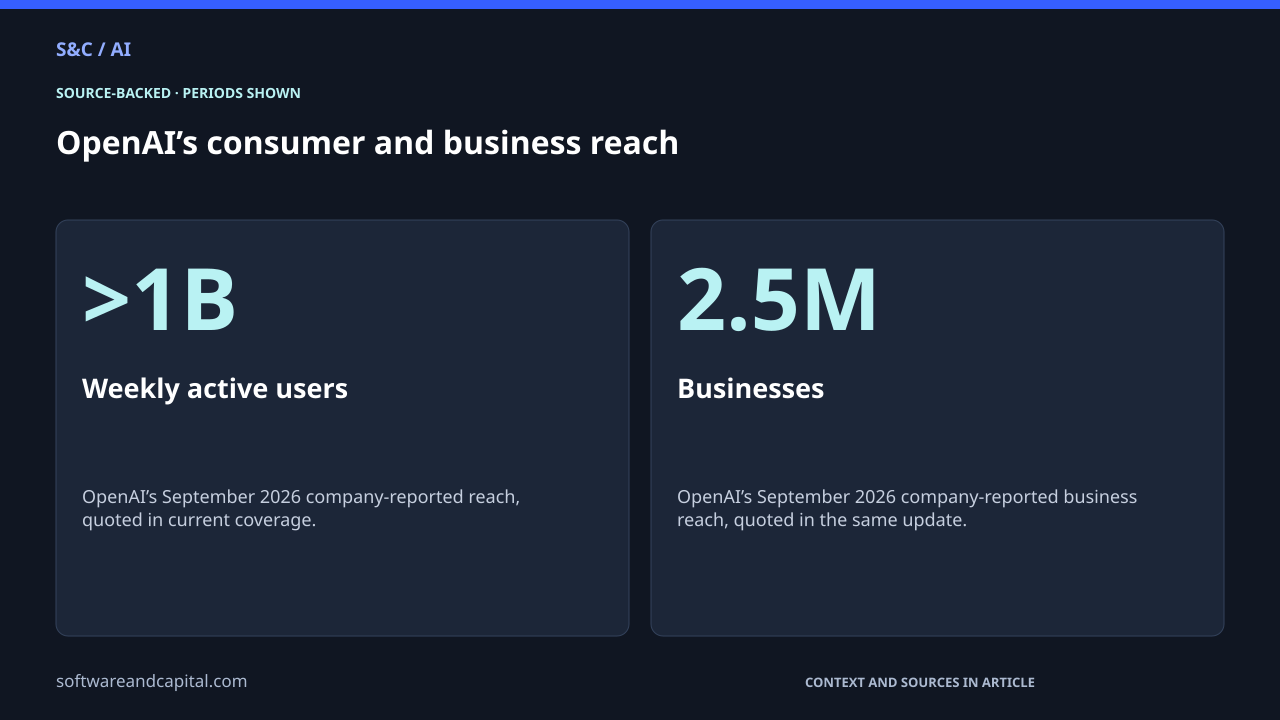
OpenAI’s September 2026 company update says its products reach more than one billion weekly active users and 2.5 million businesses. The company describes a flywheel in which consumer familiarity helps workplace adoption and business use expands what people expect AI to do. Those scale figures describe reach, not revenue or profit.1, 2
OpenAI’s consumer and business reach
The billion-user and 2.5-million-business figures were reported together in OpenAI’s September 2026 company update. OpenAI’s own enterprise research had already documented the feedback loop between widespread consumer familiarity and deeper workplace adoption. Reach still should not be confused with revenue or profit.1, 2
Consumer use can lower the barrier to enterprise adoption
OpenAI describes a flywheel in which people who already know how to use AI bring that familiarity into their jobs. A company evaluating an enterprise product is therefore not always introducing a completely unfamiliar interface. Some employees have already learned the basic behavior as consumers.1
That does not mean consumer popularity automatically creates enterprise revenue. Companies still need security, administration, integrations, governance and a business reason to pay. The consumer side can reduce learning friction without eliminating the work required to deploy AI across an organization.
| Customer | What they may buy | Why it matters |
|---|---|---|
| Consumer | ChatGPT subscriptions and other consumer experiences. | Builds familiarity, habit and direct consumer revenue. |
| Business | Enterprise/workplace products and administration. | Turns individual use into organization-level deployment. |
| Developer | API access and coding products. | Lets other software and workflows build on OpenAI models. |
Enterprise also changes the product
OpenAI’s enterprise update emphasizes agents that can work across company systems and workflows. Enterprise customers bring requirements around permissions, data access, auditing and reliability that are less visible in a casual consumer chat. Those requirements can shape the products OpenAI builds.2
The company also says it sees a connection between enterprise use and broader product demand. Businesses can expose employees to deeper workflows, while developers build more applications using the APIs. The flywheel is therefore not simply consumer users converting into paid seats one by one.
One research investment can support several revenue paths
A frontier model is expensive to train and serve, but the same underlying research can support more than one product line. Consumer subscriptions, enterprise products, developer APIs and coding tools can all draw on shared models and infrastructure. That gives OpenAI several ways to monetize improvements in capability.
The same pattern appears elsewhere in technology: YouTube earns through advertising and subscriptions, while Reddit combines ads with licensing and user products. The important question is not how many revenue streams exist, but whether each solves a real customer need.
Scale does not answer the margin question
OpenAI’s enterprise research describes organizations moving from casual assistance toward repeatable workflows and deeper deployment. That shift requires organizational readiness and implementation, not merely consumer familiarity.2
What to watch as the flywheel grows
- Consumer reach: whether people keep using the products frequently enough to sustain habit.
- Enterprise depth: whether companies move from individual experimentation into repeatable workflows.
- Developer activity: whether outside software increasingly depends on OpenAI APIs and agents.
- Economics: whether revenue growth outruns the compute and operating costs required to serve that demand.
The scale figures make OpenAI unusual because the consumer and enterprise businesses are both already large. The interesting part is how they interact. A product learned at home can enter the workplace, and a workplace deployment can make AI part of more jobs, software and daily routines.
Sources and methodology
Sources checked September 22, 2026. Dates and periods for individual figures are stated beside them.
- Unite.AI: OpenAI scale update quoting 1B weekly users and 2.5M businesses ↗Accessed 2026-09-22
- OpenAI: The State of Enterprise AI 2025 report ↗Accessed 2026-09-22
Scope and assumptions
The user/business counts and >40% enterprise revenue share come from different company updates and are kept separately dated.
The cited company materials do not provide enough information for a current margin, profit-per-user or enterprise-profitability calculation.
Continue reading
5 AI Tools for Work: Choose by the Job, Not the Demo →
YouTube’s $60B-Plus Year Wasn’t Just Advertising →
$2.2B From Online Conversations: How Reddit Makes Money →
ChatGPT Ads Hit a $1B Annualized Run Rate. What Is OpenAI Selling? →