A startup employee can be wealthy on paper and still unable to spend any of it. A company valuation does not pay a mortgage. Stripe’s February 2026 tender offer addressed that gap: a chance for current and former employees to sell shares, without announcing an IPO.1
Stripe’s February 2026 tender offer valued the company at $159 billion, but that was not the amount employees would receive. Outside investors supplied most of the planned buying power, with Stripe also repurchasing shares. The point was liquidity for shareholders, not a public listing or a $159 billion cash injection.1
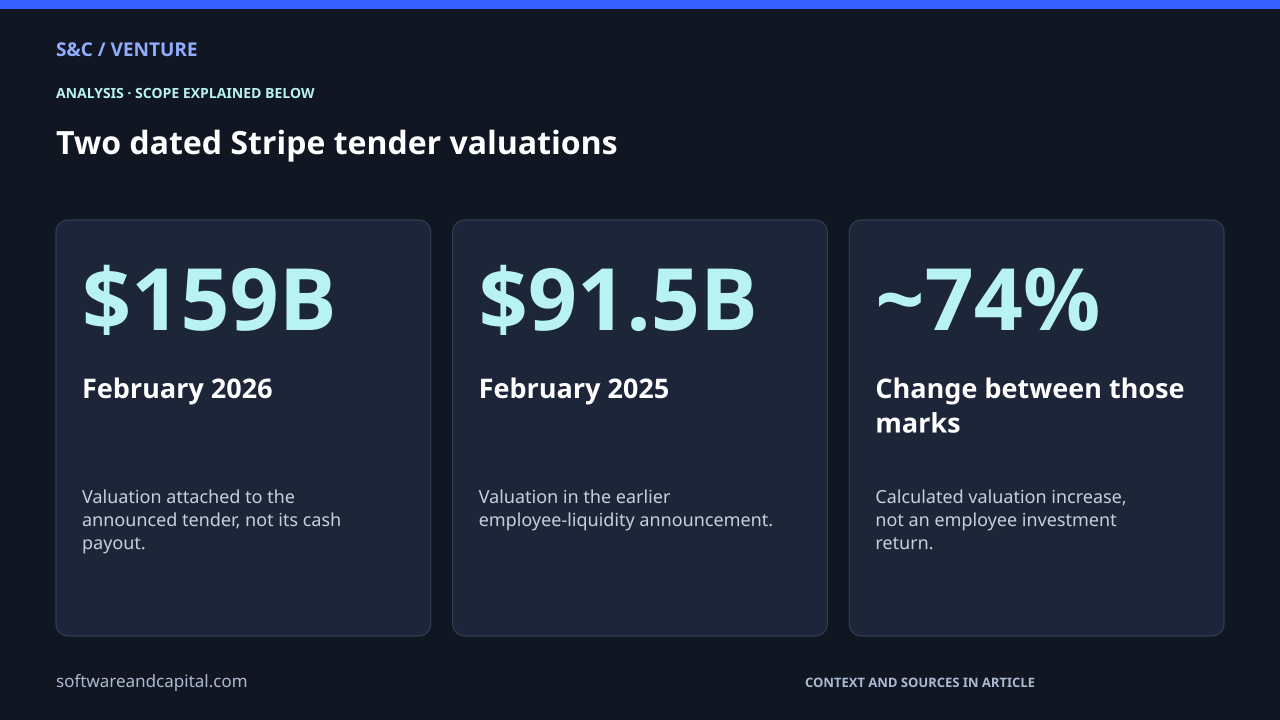
Two dated Stripe tender valuations
The distinction is simple: a funding round asks who will put money into a business. An employee tender asks who will buy shares from people who already own them. The same investor can do both, but the cash takes a different route.
The money goes to the seller, not automatically to Stripe
Stripe said investors including Thrive Capital, Coatue and a16z would provide most of the funds, while the company would use some of its own capital to repurchase shares. Its announcement described signed agreements for the transaction. It did not disclose the total payout or each employee’s entitlement.1
That makes the $159 billion headline a price signal for the company’s equity, not a giant bag of cash distributed to staff. To work out the payout, you would need the actual share price, the eligible shares offered for sale and the amount accepted. The valuation alone cannot supply those missing numbers.
| Transaction | Who receives the purchase money? | What the transaction achieves |
|---|---|---|
| New-share funding round | The company issuing shares. | Capital for the business, with new ownership issued. |
| Third-party employee tender | The shareholders selling existing shares. | A private liquidity event without a stock-market listing. |
| Company share buyback | The shareholders selling shares to the company. | Liquidity funded from the company’s own resources. |
An IPO can combine new company shares and sales by existing owners. Figma’s IPO cash split shows that combination in a public offering. A private tender separates one part of that story: shareholders can get a selling opportunity even when the company is not listing.
A higher valuation is not the same as money in the bank
Stripe announced a $91.5 billion tender valuation in February 2025. Comparing that with February 2026’s $159 billion gives an increase of approximately 74%. That calculation compares two announced company valuations, not the return earned by any particular employee.2, 1
An employee’s outcome also depends on what they own, their cost of acquiring it and what they can sell. Someone who keeps their shares has not realized the headline gain. Someone who sells part of a holding has converted only that portion into cash. Neither person’s result can be read straight from the percentage above.
This is why a private-company valuation and a liquid public share price are different experiences for an employee. The first can be a mark attached to a particular transaction. It does not, by itself, create a standing offer to buy everyone’s entire holding.
Stripe is a large example of a wider liquidity problem
Carta reported 71 tender offers administered on its platform in the first half of 2026, totaling about $3 billion in transaction volume. Its report distinguishes company buybacks from third-party purchases and notes the role of tenders in giving long-serving employees a way to sell. Those figures describe Carta’s activity, not the entire private market.3
For a company, that creates another option between two extremes: keep everyone waiting indefinitely or make a public exit the only route to cash. A tender can address a shareholder need without turning that need into the company’s whole financing strategy.
For the employee, the trade-off is more personal. Selling converts some uncertain future value into available cash. Keeping shares preserves exposure to what happens next, in both directions. This article explains the mechanism, not which choice an employee should make.
The question behind the next big valuation headline
Read the announcement in this order
- Identify the figure: company valuation, money raised or cash paid to sellers.
- Follow the buyer: outside investor, the company itself or both.
- Check the actual selling opportunity: who is eligible, how much can be sold and what remains undisclosed.
Stripe’s tender is interesting because it makes an exit less all-or-nothing. The company can remain private while some shareholders obtain liquidity. The $159 billion number draws attention. The cash route explains what the announcement actually offers.
Sources and methodology
Sources checked September 21, 2026. Dates and periods for individual figures are stated beside them.
- Stripe: February 24, 2026 employee-liquidity announcement ↗Accessed 2026-09-21
- Stripe: February 27, 2025 tender-offer announcement ↗Accessed 2026-09-21
- Carta: H1 2026 tender-offer activity and transaction structures ↗Accessed 2026-09-21
Scope and assumptions
The Stripe case concerns announcements in February 2025 and February 2026, not a current public share price or proof of every seller’s completed payout.
Employee eligibility, accepted sale quantities, costs and tax outcomes are not disclosed here. No investment or tax recommendation is made.
AI-assisted research and editing. Our editorial standards.