“The IPO raised a billion dollars” sounds like a billion dollars landed in the company’s bank account. Figma’s 2025 deal shows why that shortcut can be wrong. The offering contained two sales: new shares from the business and existing shares from shareholders. The money had different destinations.1
At its 2025 IPO, Figma issued 12,472,657 shares at $33, implying about $411.6 million in gross proceeds to the company. Existing stockholders sold more shares, and those proceeds did not go to Figma. The completed deal, including the additional-share option, was larger than the initially priced base offering.1, 2
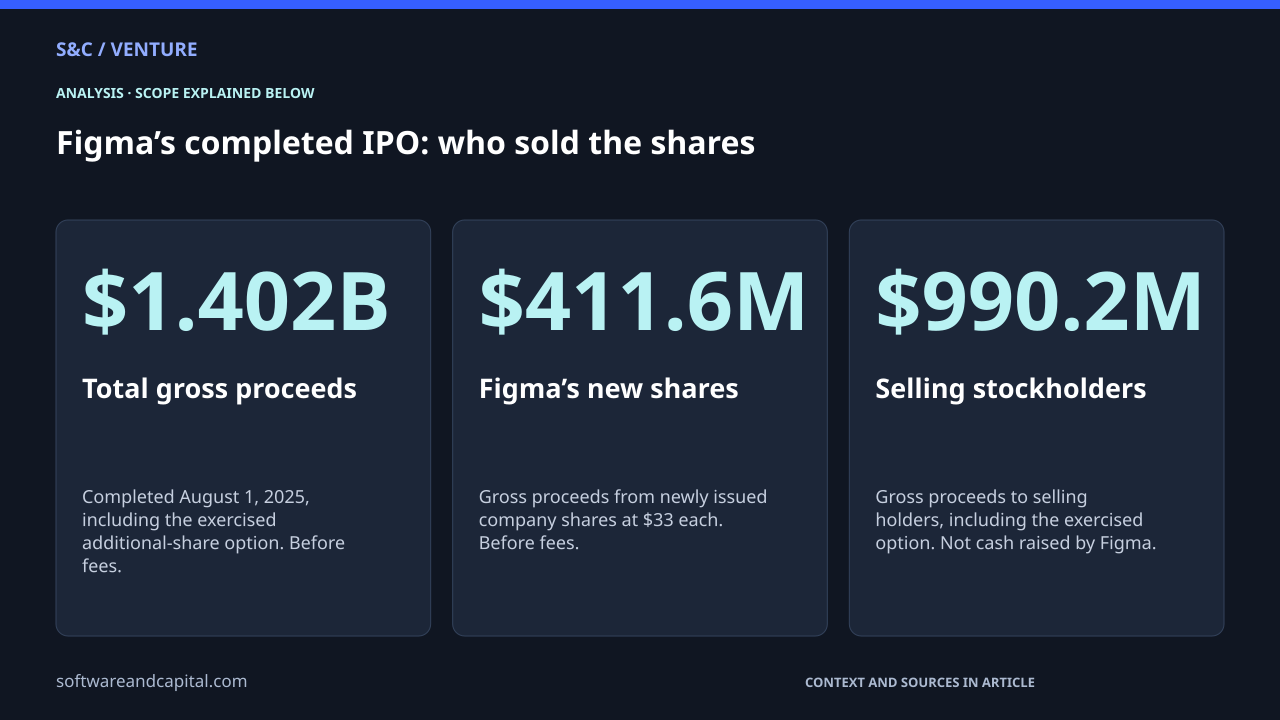
Figma’s completed IPO: who sold the shares
Completed August 1, 2025, including the exercised additional-share option. Before fees.
Gross proceeds from newly issued company shares at $33 each. Before fees.
| Seller | Initially priced base offering | Including the exercised additional-share option |
|---|---|---|
| Figma: newly issued shares | 12,472,657 shares ≈ $411.6M | 12,472,657 shares ≈ $411.6M |
| Existing stockholders | 24,464,423 shares ≈ $807.3M | 30,004,984 shares ≈ $990.2M |
| Total | 36,937,080 shares ≈ $1.219B | 42,477,641 shares ≈ $1.402B |
Two dates, two versions of the offering
- July 30, 2025
The IPO was priced
Figma announced the offer price and base share count, before any exercise of the additional-share option.1
- August 1, 2025
The offering closed
The later filing records completion and the fully exercised selling-shareholder option. The completed deal is larger than the base offering.2
1. $33 was the offer price, not every later trading price
Figma priced its IPO at $33 per share. That is the price used in this cash-flow calculation. A price quoted after shares start trading answers a different question. It does not retroactively change what was paid in the offering.1
2. $411.6 million was the company’s gross share-sale amount
Multiply the 12,472,657 newly issued shares by $33 and the result is $411,597,681. This is gross proceeds, before offering deductions. It is not the company’s market value, and it is not the revenue the business earned.1
This is the primary part of an offering: investors buy newly issued shares and the proceeds go to the issuer. Existing shareholders’ percentage ownership may change when more shares are issued. That dilution question is separate from calculating the cash raised.
3. $807.3 million initially belonged on the selling-shareholder side
The base offering’s 24,464,423 existing shares imply $807,325,959 in gross proceeds at $33 each. Figma’s announcement says the company would not receive proceeds from those sales.1
This is the secondary part of the offering: existing ownership changes hands. It can create liquidity for shareholders without putting the same amount of new cash into the operating business. The distinction matters whether the company is a famous software platform or a much smaller startup.
4. The option took the completed gross deal to about $1.402 billion
The subsequent filing records 30,004,984 shares sold by existing stockholders, including 5,540,561 through the fully exercised option. At $33, the sellers’ gross amount rises to about $990.2 million. Add the issuer’s roughly $411.6 million and the gross total is about $1.402 billion.2
The company’s issued-share count did not rise with that option. The additional shares came from selling stockholders. An initial headline and a completed offering total can therefore differ without describing another funding round.2
5. $393.1 million was a narrower net figure, not a contradiction
The filing reports about $393.1 million of proceeds to Figma after underwriting discounts and commissions, but before the company’s offering expenses. That definition matters. Compare it with gross proceeds without naming the deductions and a normal accounting difference can look like missing money.2
The issuer represented about 29.4% of the completed gross offering: $411.6 million divided by approximately $1,401.8 million. This is a cash-allocation calculation, not a conclusion about whether the IPO was a good investment.2
Read the next IPO headline with three separate questions
The deal-reading checklist
- Who is selling: the company, existing shareholders, or both?
- Which amount is quoted: gross proceeds, proceeds after particular fees, or a company valuation?
- Does the share count cover the base offering or the completed deal including an exercised option?
Figma’s IPO is a useful historical example because the pricing announcement and later filing make the split visible. The interesting story is not just how large the deal was. It is whose balance sheet changed.
Sources and methodology
Sources checked September 21, 2026. Dates and periods for individual figures are stated beside them.
- Figma: July 30, 2025 IPO pricing announcement ↗Accessed 2026-09-21
- Figma: June 30, 2025 Form 10-Q, subsequent-event disclosure ↗Accessed 2026-09-21
Scope and assumptions
All figures concern Figma’s July/August 2025 IPO. This is a historical deal explanation, not a current-price report or investment recommendation.
Gross proceeds are share counts multiplied by the $33 offer price and rounded for display. The cited $393.1M net figure excludes company offering expenses, as stated in the filing.
Continue reading
76% of Shopify’s Revenue Came from Merchant Solutions in 2025 →