Coding agents are usually demonstrated one developer at a time. Thai securities firm TCBS says it has taken a different route: more than 460 employees use AWS’s Kiro environment, including staff outside engineering. That makes the deployment interesting less as a benchmark and more as an organizational experiment.1
Thai securities firm TCBS says more than 460 employees use AWS’s Kiro coding environment, about 40% of users are in nontechnical roles, and financial products are delivered 25% faster. Those are customer/vendor-reported figures without a published control group or detailed measurement methodology, so the case is useful for deployment design rather than as a universal productivity benchmark.1, 2
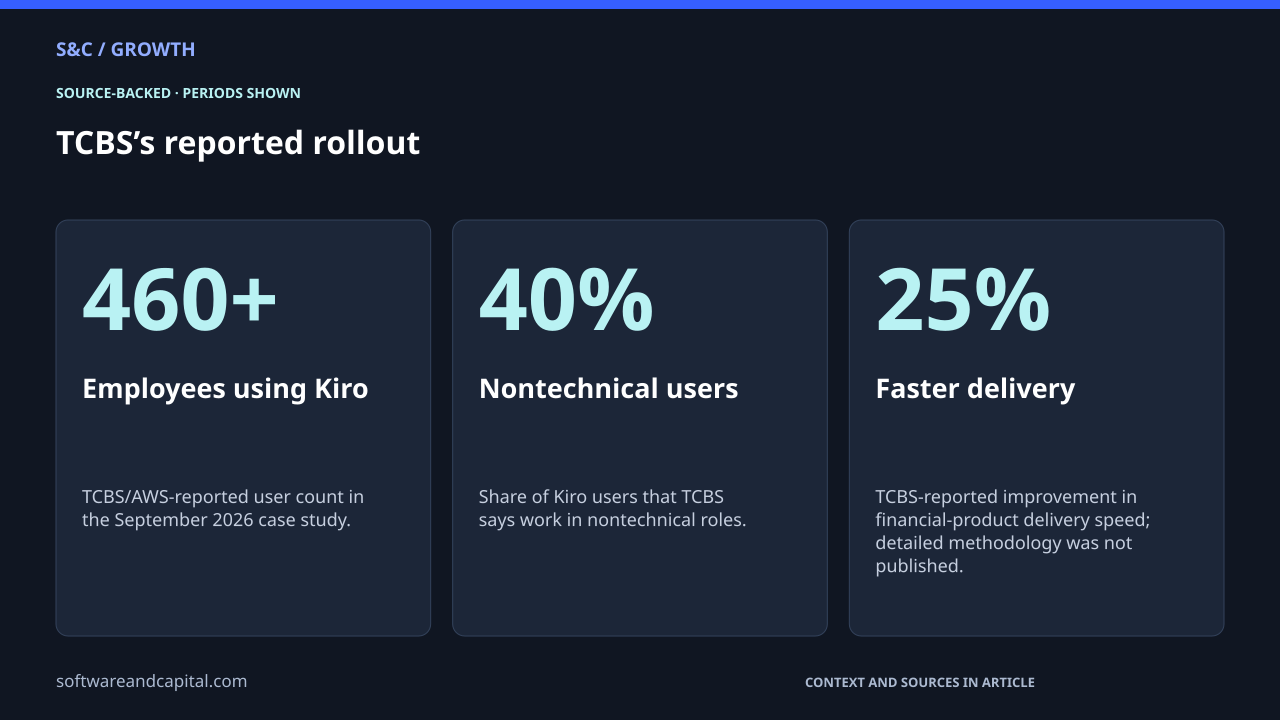
TCBS’s reported rollout
The interesting change is who gets to build
If non-engineers can use an agentic coding environment to create or modify internal software, the bottleneck can move from writing code toward defining requirements, reviewing changes and deciding what is allowed into production.1
| Stage | Traditional emphasis | With broader coding-agent use |
|---|---|---|
| Build | Developer writes most implementation | Agent can generate implementation for technical and some nontechnical users |
| Review | Code review checks developer work | Review must also govern agent-generated changes from a wider user base |
| Release | Engineering controls deployment | Financial controls still require testing, security and accountable approval |
Twenty-five percent faster needs a denominator
AWS reports that TCBS delivers financial products 25% faster, but the case study does not publish a control group, baseline duration or enough methodology to reproduce the number. It is evidence of TCBS’s reported experience, not a general productivity coefficient for Kiro.1
Finance makes governance part of the product
A securities firm cannot treat generated code as automatically deployable. Wider participation makes identity, review, testing and release permissions more important because the number of people able to create software has increased.1
What another company should measure
- Time from approved requirement to production release.
- Review and rework time for agent-generated changes.
- Defects or incidents after release, separated from delivery speed.
- Which roles can generate code and which roles can approve deployment.
The TCBS case is a useful picture of where coding agents may go next: not just faster developers, but a larger population capable of producing software. The management problem then becomes controlling that new production capacity.
Sources and methodology
Sources checked September 29, 2026. Dates and periods for individual figures are stated beside them.
- AWS: TCBS goes all-in with Kiro ↗Accessed 2026-09-29
- Kiro documentation ↗Accessed 2026-09-29
Scope and assumptions
The user counts and 25% delivery improvement are customer/vendor-reported.
The case study does not publish a control group, baseline duration or detailed measurement methodology.
Continue reading
If an AI Agent Can Act Like an Employee, It Needs an Identity →
AI Is Moving Into Plumbing and HVAC Software →
Google’s Security Agent Found 500+ XSS Bugs. The Trick Was Proving the Exploit →