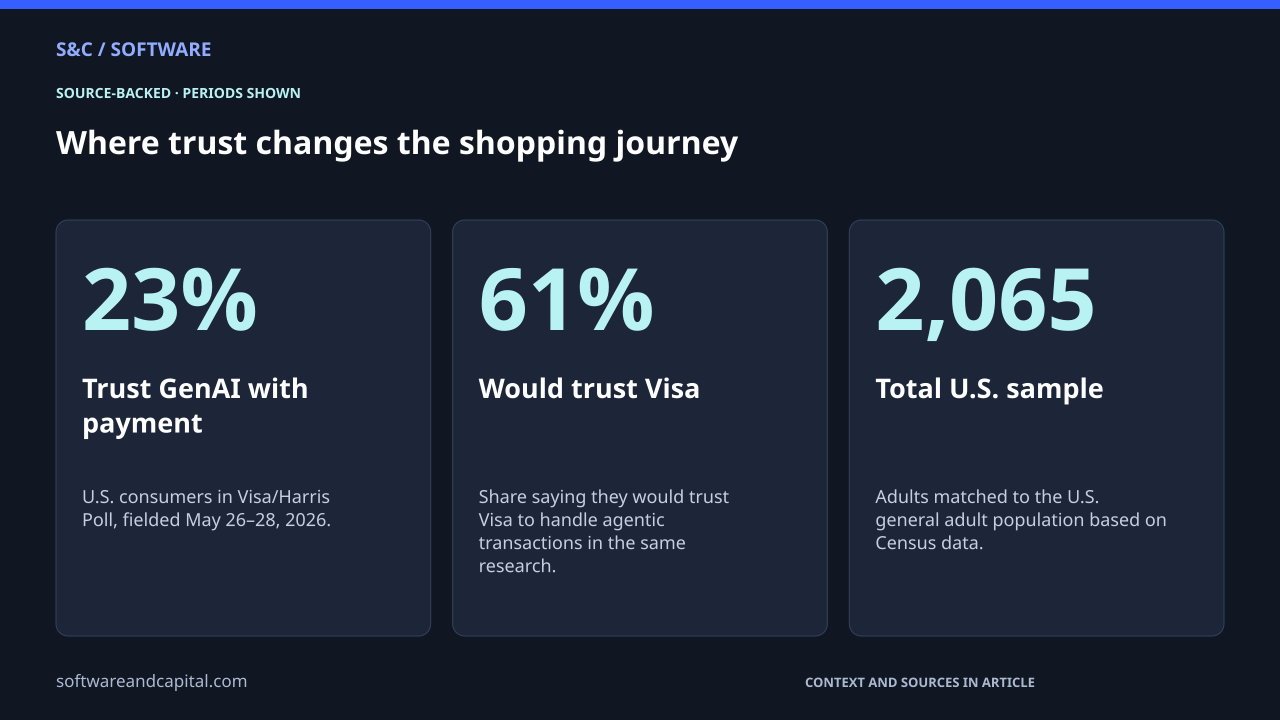
People are already comfortable asking AI what to buy. Letting the software actually move money is a different threshold. Visa’s new U.S. Trust Index puts a number on that gap: only 23% said they trust generative AI to handle payment transactions on their behalf.1
Visa says only 23% of U.S. consumers in its May 2026 Harris Poll trusted generative AI to handle payment transactions on their behalf. The survey covered 2,065 U.S. adults matched to the general adult population. The number measures stated trust, not actual payment adoption.1
Where trust changes the shopping journey
Shopping help and payment authority are not the same permission
An assistant can recommend a product without creating a financial consequence. Payment authority is different because a mistake can become a charge, a return, a dispute or a purchase the user never intended. The survey suggests adoption can advance unevenly across those steps.
Visa’s companion analysis says 72% of U.S. consumers have used an AI assistant in addition to search engines to discover products. That does not mean 72% want autonomous checkout. Discovery can be mainstream while delegated payment remains a minority comfort level.2
The 23% is a survey result, not a transaction count
The Harris Poll fielded the survey May 26–28, 2026. Visa reports 2,065 total U.S. consumers, matched to the general adult population, and 1,028–1,034 respondents per payment brand tested. The result captures stated trust at that moment. It does not measure completed AI-initiated payments.1
Trust infrastructure becomes part of the product
If an agent is allowed to buy, the user needs to know what was authorized, what limits apply and what happens when something goes wrong. Payment networks are treating identity, permission and transaction controls as part of the agentic-commerce stack rather than a checkout detail.
The same boundary appears in Meta Muse’s permission model: useful autonomy depends on narrowing what the agent can do. In commerce, the permission eventually touches money, which raises the consequence of getting it wrong.
What the survey does and does not tell us
- It measures stated trust among U.S. adults, not global sentiment.
- It measures willingness to trust GenAI with payment, not completed autonomous purchases.
- Brand trust can be higher than trust in GenAI itself, suggesting the infrastructure provider matters.
- The result can change as products, safeguards and consumer experience change.
Agentic shopping does not have one adoption switch. Consumers can accept AI for discovery, comparison and recommendations while drawing the line at payment. The 23% figure makes that boundary visible, and it explains why the next commerce race is as much about permission and trust as model capability.
Sources and methodology
Sources checked September 25, 2026. Dates and periods for individual figures are stated beside them.
- Visa: Trust Index for agentic commerce ↗Accessed 2026-09-25
- Visa: Your AI Just Bought You a Couch ↗Accessed 2026-09-25
Scope and assumptions
The survey measures stated trust in the United States in May 2026, not observed purchasing behavior or global sentiment.
The 61% Visa figure concerns trust in a named payments brand and should not be read as 61% adoption of autonomous payments.
Continue reading
Meta’s AI Can Send Emails and Make Purchases. What Should You Let It Touch? →
AI Search Orders on Shopify Are Up Nearly 13×. Is Chat Becoming a Storefront? →