Online shopping used to have a familiar path: search for a product, click into a store, compare options and check out. AI assistants are starting to compress those steps into a conversation. Shopify says Q1 2026 traffic from AI grew eightfold year over year, while orders from AI-powered searches rose nearly thirteenfold.1
Shopify says AI-driven traffic to its stores grew eightfold year over year in Q1 2026 and orders from AI-powered searches rose nearly thirteenfold. Those company-defined growth rates start from an undisclosed base, so they do not tell us AI’s share of total commerce. They do show AI conversations moving from discovery toward product data, checkout and attributed orders.1, 2
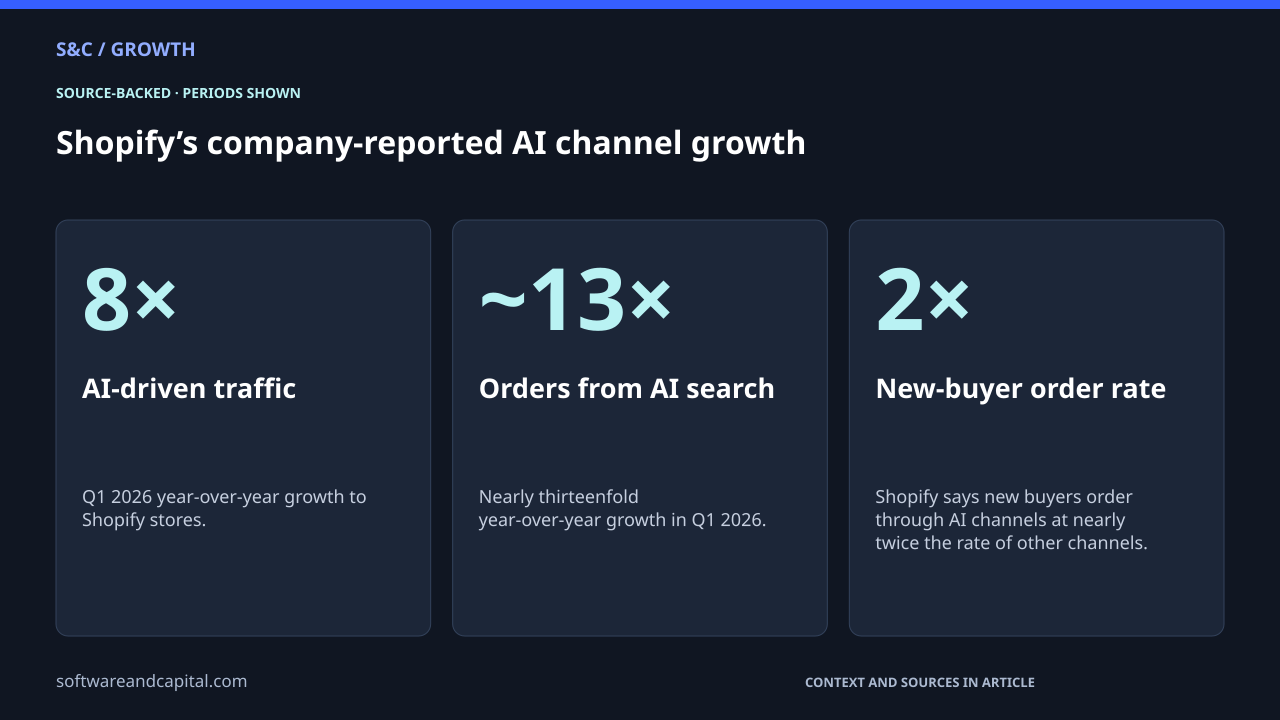
Shopify’s company-reported AI channel growth
Those multipliers are attention-grabbing but incomplete. Shopify does not disclose the starting base in the cited article, so eightfold growth could still represent a small share of total traffic. The figures show velocity, not the size of AI commerce relative to Shopify’s entire business.1
The storefront is becoming a data layer
An AI shopping assistant needs structured product information: what an item is, whether it is in stock, which variants exist and what it costs. Shopify says its Catalog and agentic storefront tools distribute synchronized product data across services such as ChatGPT, Copilot, Google AI Mode and Gemini.2
That shifts part of the merchant’s job. The product page remains important, but clean structured data becomes another storefront because an AI system may summarize and compare products before the shopper ever opens the merchant’s site.
| Step | Traditional path | AI-assisted path |
|---|---|---|
| Discovery | Search result, ad, social post or direct visit. | Assistant recommends products inside a conversation. |
| Comparison | Shopper opens pages and compares information. | Assistant can compare structured product data across options. |
| Checkout | Shopper enters the merchant’s checkout. | Some AI channels can hand off to or embed merchant checkout. |
| Attribution | Referrer and campaign data identify the source. | Shopify says AI-channel orders flow into admin with referral attribution. |
Shopify wants the merchant to stay the merchant
Shopify says merchants remain the merchant of record in its ChatGPT integration, retaining control of customer relationships and data. That is strategically important. If AI becomes the discovery surface, the platform underneath still wants the sale, fulfillment and customer record to belong to the merchant rather than the assistant.2
This makes agentic commerce different from a simple affiliate link. The AI interface can influence discovery, but the transaction still has inventory, tax, fraud, payment and fulfillment requirements. Shopify’s pitch is that its existing commerce infrastructure can supply those pieces behind the conversation.1
The new channel changes what merchants optimize
A classic ecommerce team thinks about pages, feeds, ads and search rankings. An AI channel adds another question: can the product be understood correctly by an agent? Missing attributes, stale inventory or ambiguous variants can become discovery problems before a shopper ever sees the storefront.
That connects to our existing Shopify business-model analysis. Merchant solutions scale when more commerce flows through Shopify. Agentic storefronts are an attempt to make sure a new discovery channel still flows through that commerce infrastructure.
A 13× growth rate does not prove the storefront is dead
AI channels can grow quickly from a small base while websites, apps, search and social remain much larger sources of commerce. Shopify itself describes behavior varying by market and product category. The near-term story is channel addition and redistribution, not evidence that one interface has replaced every other way people shop.2, 1
What will show whether chat becomes a real storefront
- Share of sales: how much total merchant revenue actually originates in AI channels.
- Conversion: whether AI-discovered shoppers buy at durable rates after the early novelty period.
- Economics: whether customer-acquisition and platform costs compare favorably with other channels.
- Control: whether merchants keep meaningful access to customer relationships, pricing and post-purchase service.
The most important shift may be psychological. A shopper can increasingly begin with “find me the right thing” instead of “take me to a store.” If the assistant becomes the place where comparison happens, commerce platforms have to make products legible to machines as well as attractive to people.
Sources and methodology
Sources checked September 22, 2026. Dates and periods for individual figures are stated beside them.
- Shopify: How agentic commerce works ↗Accessed 2026-09-22
- Shopify: Millions of merchants can sell in AI chats ↗Accessed 2026-09-22
Scope and assumptions
The 8× and nearly 13× figures are Shopify-defined year-over-year growth rates from an undisclosed base and do not establish AI’s share of total commerce.
No claim is made that AI channels have replaced stores, search, social or other major commerce channels.
AI-assisted research and editing. Our editorial standards.
Continue reading
76% of Shopify’s Revenue Came from Merchant Solutions in 2025 →
4 Numbers to Keep Separate: AI Citations Are Not Website Visits →