The empty driver’s seat is the part of a robotaxi that gets photographed. The factory, charging facilities and fleet operations are less visible. Waymo’s $16 billion funding announcement in February 2026 is a reminder that removing the driver does not turn a transport service into an app with almost no physical costs.1
Waymo announced a $16 billion investment round at a $126 billion post-money valuation in February 2026. The money supports expansion, but driverless does not mean costless. Vehicles still need to be equipped, validated and operated. A growing ride count shows demand, not the profit earned on each trip.1, 2
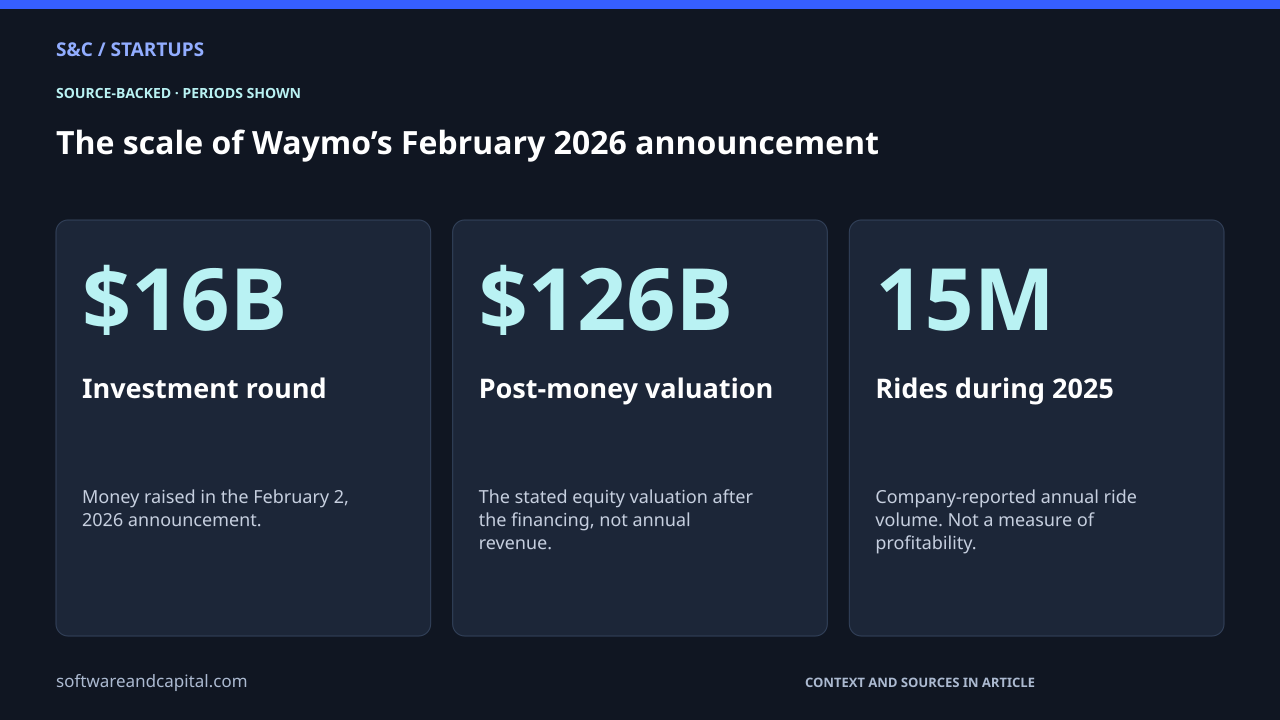
The scale of Waymo’s February 2026 announcement
The funding and valuation numbers answer different questions. One describes the new financing. The other describes the value attached to the company after that financing. Neither reveals how much a typical ride costs to provide or how long an investor will wait for a return.
An autonomous fleet has to be built before it can earn fares
In May 2025, Waymo described its 239,000-square-foot integration plant in Mesa, Arizona, with Magna. The operation installs its driving technology into vehicles. The company also described validation and commissioning before the vehicles carry riders. That is a manufacturing and deployment process, not just a software download.2
The point is not that every dollar must buy a car. It is that scaling requires several things to be ready together. More vehicles are useful only if they can be equipped, checked, delivered to the relevant market and supported once they enter service.
| Layer | What has to exist | Why it matters to the business |
|---|---|---|
| Vehicle integration | Cars equipped with the driving system. | Capacity cannot expand through software alone. |
| Validation and commissioning | Checks before a vehicle carries riders. | An assembled vehicle is not automatically a revenue-producing one. |
| Fleet operations | Facilities and charging infrastructure. | The service needs an operating system outside the car, too. |
The people do not all disappear with the driver
Waymo’s December 2024 Moove announcement laid out a division of responsibilities: Moove would take on fleet operations, facilities and charging infrastructure, first in Phoenix and later Miami. Waymo would remain responsible for validating and operating the Waymo Driver. That dated announcement describes the intended partnership structure, not a complete current staffing account.3
Outsourcing part of the work changes who performs it. It does not make the work free. A partnership can help a company scale, but the economics still need to cover the services supplied by the partner. The same distinction applies to any business that looks asset-light because someone else owns or operates part of the infrastructure.
This is where the robotaxi story becomes more interesting than a debate about whether the car can drive. The service must combine a capable driving system with a dependable operation. A rider buys a completed trip, not a successful demonstration of one component.
More rides can help, but a ride count is not a margin
Waymo said it provided 15 million rides in 2025. That is a measure of activity during a stated year. Dividing the $16 billion financing by that ride count would not reveal the cost of a trip. The financing is intended to support future work and capacity, not simply reimburse that past year’s rides.1
A vehicle that spends more usable time carrying paying passengers can spread some fixed costs over more trips. But the result depends on the fares earned and the costs of serving those trips. Charging, repositioning and time out of service can all affect the picture. This is the economic question to investigate, not a measured Waymo cost model.
The same principle appears in measuring AI cost per completed task: count the useful result and the costs needed to produce it. The robotaxi version adds a physical fleet, so the bridge between technological progress and an attractive business is even more tangible.
The next useful numbers are operational ones
What would make the economics easier to judge
- Revenue from completed paid trips, with the period and service scope clear.
- The cost of supplying those trips, including partners and vehicle-related costs.
- How much fleet time produces fares rather than charging, repositioning or waiting.
- How much additional capital is needed to open and sustain another market.
The cited announcements do not supply enough information to calculate a defensible profit per ride. That limits an investment conclusion, not the explanation of why a large financing can be necessary. The company is building a transport operation around its technology.
An empty driver’s seat is a striking product feature. A system that can keep vehicles useful, available and economically productive is the business underneath it. The funding headline tells us the scale of the bet, not that the bet has already paid off.
Sources and methodology
Sources checked September 21, 2026. Dates and periods for individual figures are stated beside them.
- Waymo: February 2, 2026 investment-round announcement ↗Accessed 2026-09-21
- Waymo: May 5, 2025 U.S. manufacturing and fleet-integration update ↗Accessed 2026-09-21
- Waymo: December 5, 2024 Miami and Moove partnership announcement ↗Accessed 2026-09-21
Scope and assumptions
The figures and operational examples are tied to the cited February 2026, May 2025 and December 2024 announcements. Planned capacity or expansion is not represented as a completed current milestone.
No cost-per-mile, per-ride profit, safety superiority or investment return is inferred. The operating-economics discussion is analysis, not a tested fleet model.
AI-assisted research and editing. Our editorial standards.