Adobe spent decades teaching people to open Photoshop, Acrobat or Illustrator first. Its newest integrations invert that habit. A user can begin in Gemini or Claude and call Adobe tools from inside the conversation, which turns the chatbot into the front door while Adobe becomes the specialist capability layer underneath.
Adobe is treating AI chatbots as a new distribution layer. Gemini can call Photoshop, Lightroom, Express and Firefly capabilities, while Claude can use more than 80 Adobe tools across creative and document workflows. The bet is that Adobe can preserve the value of its specialist software even when the user starts somewhere else.1, 2
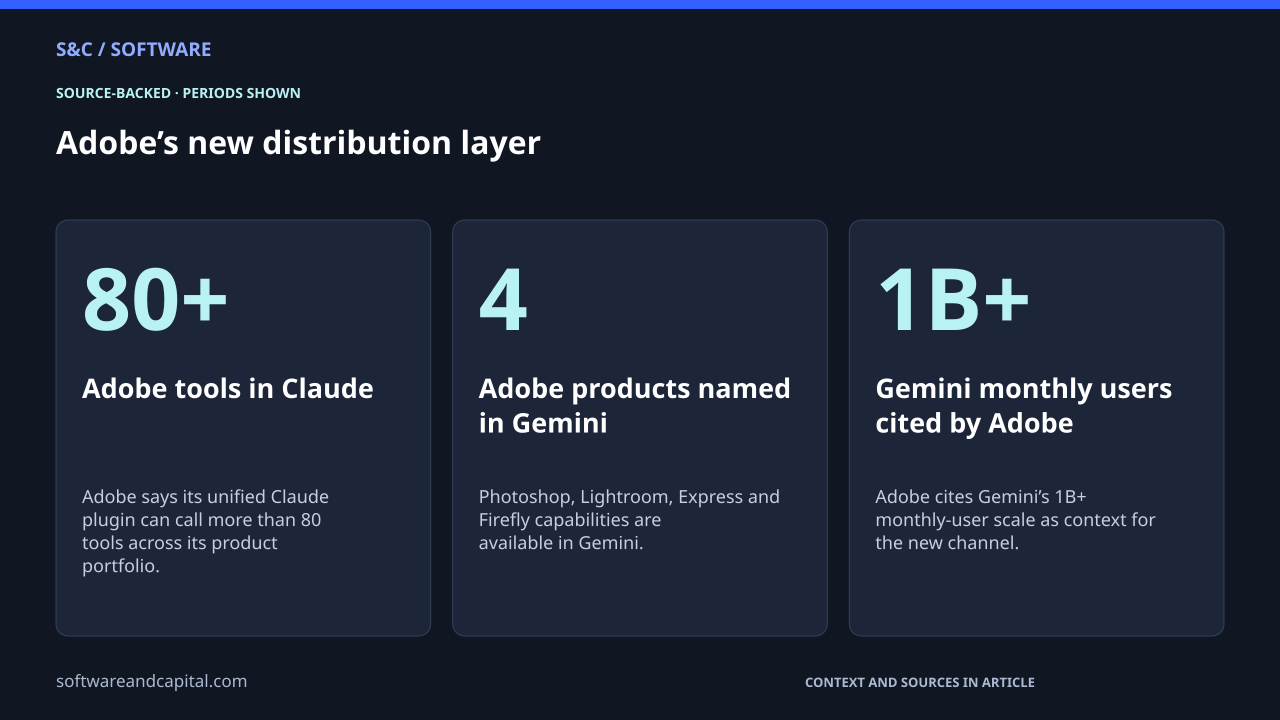
Adobe’s new distribution layer
Adobe says its unified Claude plugin can call more than 80 tools across its product portfolio.
Photoshop, Lightroom, Express and Firefly capabilities are available in Gemini.
Adobe cites Gemini’s 1B+ monthly-user scale as context for the new channel.
The interface and the tool are separating
A traditional software company owns both the interface and the capability. In this model, Gemini or Claude owns the conversation, but Adobe still supplies the image editing, PDF handling and design operations. That makes distribution less about getting somebody to launch an Adobe app and more about making Adobe callable wherever work starts.
| Layer | Who controls it | What Adobe contributes |
|---|---|---|
| Conversation | Gemini or Claude | Prompting, context and the starting interface |
| Specialist action | Adobe | Creative editing, document operations and media workflows |
| Deep editing | Adobe or embedded editor | Hands-on control when the chatbot is not enough |
| Account and limits | Platform plus Adobe | Access, sign-in and usage rules vary by integration |
Adobe is not abandoning the flagship app
Adobe’s own launch language keeps a handoff back to flagship applications when the work needs more depth or precision. That matters. The strategy is not simply to replace Photoshop with a chatbot. It is to make Adobe useful earlier in the workflow and then keep a path into the full application when conversational control reaches its limit.1
Acrobat is following the same pattern. Adobe is also building its own Productivity Agent inside Acrobat, which can turn documents into summaries, audio, visuals and presentations. That suggests Adobe is hedging both ways: it can own an AI interface in its own products while also supplying tools inside somebody else’s assistant.2
The business question is distribution, not just features
If chatbot interfaces become a major place where work begins, software companies face a choice. They can insist users come to their destination app, or they can expose valuable capabilities to outside assistants and compete on the quality of the underlying tool. Adobe is clearly testing the second path while keeping the first.
What would show whether the strategy is working
- How often chatbot users invoke Adobe tools rather than generic model capabilities.
- Whether chatbot-originated work converts into signed-in Adobe usage or paid plans.
- Which high-value workflows still require a handoff to Photoshop, Acrobat or another flagship app.
- Whether Adobe can maintain pricing power when the assistant, not Adobe, controls the starting interface.
This is different from Adobe’s AI revenue story. That article asks how large Adobe’s AI business is. This one asks a more structural question: if the chatbot owns the front door, can Adobe still own the valuable work behind it?
Sources and methodology
Sources checked September 26, 2026. Dates and periods for individual figures are stated beside them.
- Adobe: Adobe comes to Gemini and expands what you can do in Claude ↗Accessed 2026-09-26
- Adobe: Productivity Agent in Acrobat ↗Accessed 2026-09-26
Scope and assumptions
Adobe has not disclosed revenue, conversion or usage generated by these chatbot integrations.
Tool depth and availability differ between Gemini, Claude and Adobe’s own applications.
Continue reading
Adobe Has 1B Monthly Users—and Its AI-First ARR Is Up More Than 150% →