Generative AI was supposed to be a threat to software incumbents like Adobe because a prompt could replace part of the old creative workflow. Adobe’s latest numbers suggest a more complicated outcome. The company is still expanding its overall user base while building a fast-growing AI-specific recurring-revenue layer inside products that already have enormous distribution.1, 2
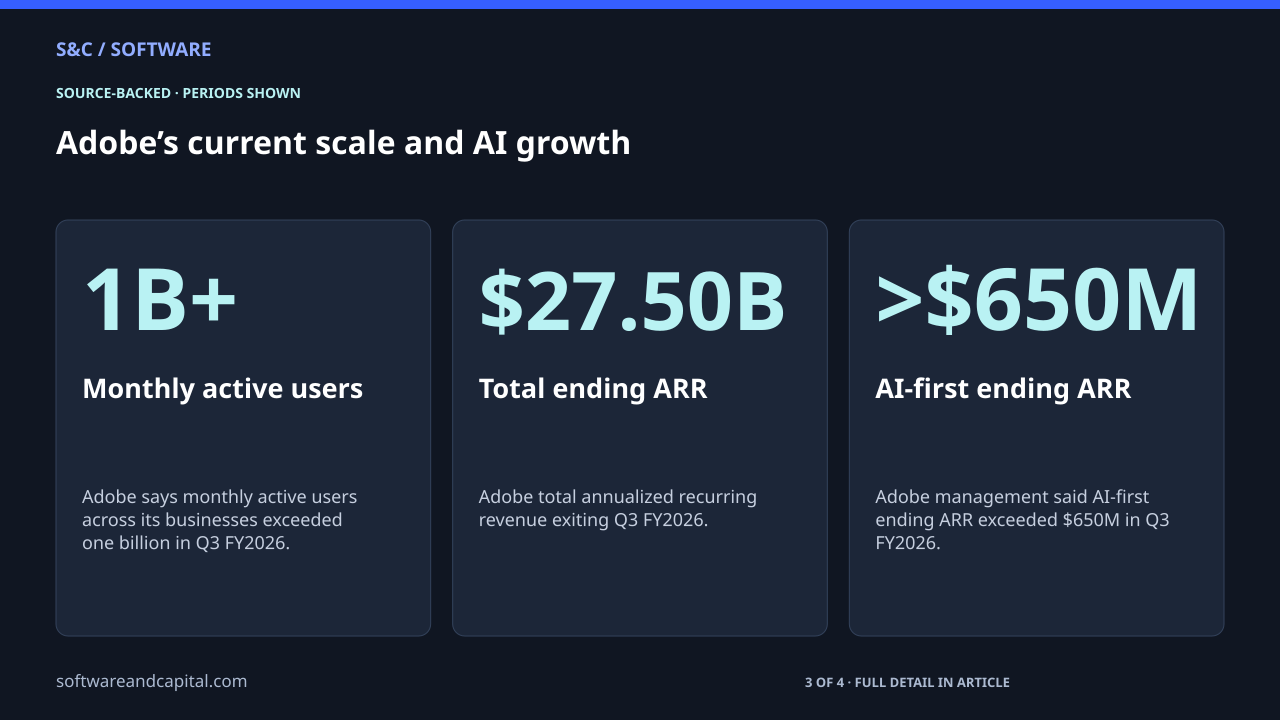
Adobe says it now serves more than one billion monthly active users across its businesses. Q3 FY2026 revenue reached $6.76 billion and total ending ARR was $27.50 billion. AI-first ending ARR exceeded $650 million and grew more than 150% year over year, showing fast AI monetization inside a much larger recurring-revenue base.1, 2
Adobe’s current scale and AI growth
Adobe says monthly active users across its businesses exceeded one billion in Q3 FY2026.
The growth rate and the revenue base should stay separate. AI-first ARR is growing much faster than Adobe’s overall business, but it is still only one layer inside $27.5 billion of total ending ARR. A 150% growth rate does not mean AI represents 150% of Adobe revenue, and it does not make the legacy subscription base irrelevant.1, 2
Adobe is using free products to widen the top of the funnel
Adobe says monthly active users grew more than 20% year over year to above one billion. Its creative freemium audience passed 100 million and grew more than 70%. That matters because AI lowers the barrier to trying creative and productivity tools, while Adobe still has paid products such as Creative Cloud, Acrobat and Firefly to monetize deeper usage.2
This is not a pure freemium company in the way a consumer app might be. Adobe already has a large paid subscription base. The strategic value of the free funnel is that it can introduce more people to products and AI workflows that later support paid plans, enterprise contracts or usage-based credits.2
| Measure | Q3 FY2026 figure | What it means |
|---|---|---|
| Monthly active users | More than 1B | Reach across Adobe’s creativity, productivity and other businesses. |
| Quarterly revenue | $6.76B | Total company revenue for the quarter. |
| Total ending ARR | $27.50B | Annualized recurring revenue across Adobe’s recurring subscription base. |
| AI-first ending ARR | More than $650M | A smaller but rapidly growing recurring-revenue layer tied to AI-first products and experiences. |
AI is being added to products people already pay for
Adobe’s advantage is distribution. The company can place AI inside Acrobat, Creative Cloud and Firefly rather than asking every user to adopt a separate destination product. Management says Acrobat AI Assistant monthly active users doubled quarter over quarter, while Firefly ending ARR across the Firefly app and credit packs grew 40% quarter over quarter.2
That resembles the buying logic in our AI tools guide: AI is often most useful when it fits an existing job rather than arriving as another isolated subscription. Adobe can monetize AI as an upgrade to familiar workflows, as a new standalone surface, or as enterprise capability inside existing contracts.
The incumbent advantage is not guaranteed
Distribution helps, but Adobe still has to prove that AI makes its products more valuable rather than simply more expensive to operate. Generative models introduce compute costs, new competitors and user expectations for faster iteration. Adobe’s AI-first ARR growth is evidence of monetization, not evidence that every AI product has attractive margins or durable differentiation.2
The next question is whether AI changes the mix
What to watch in Adobe’s AI transition
- How quickly AI-first ARR grows relative to Adobe’s total ARR base.
- Whether free and freemium user growth converts into paid subscriptions or enterprise expansion.
- Whether AI usage increases engagement without pushing delivery costs up faster than revenue.
- How much new AI revenue comes from standalone products versus upgrades inside existing subscriptions.
Adobe’s latest numbers do not show AI replacing the old business. They show AI growing on top of it. More than one billion monthly users gives Adobe a large distribution surface, while more than $650 million of AI-first ARR shows that some of that usage is already turning into recurring revenue. The key test is whether that layer becomes material without weakening the economics underneath it.
Sources and methodology
Sources checked September 23, 2026. Dates and periods for individual figures are stated beside them.
- Adobe: Q3 FY2026 earnings release, SEC-filed exhibit ↗Accessed 2026-09-23
- Adobe: Q3 FY2026 earnings script and slides ↗Accessed 2026-09-23
Scope and assumptions
Adobe’s AI-first ARR definition is a company-defined operating metric and is smaller than total Adobe ARR.
The greater-than-$650M AI-first ARR figure comes from management’s prepared earnings remarks rather than the headline financial table.
Fast AI-first ARR growth does not establish product-level margins or prove that AI revenue is incremental rather than partly replacing other Adobe spending.
Continue reading
5 AI Tools for Work: Choose by the Job, Not the Demo →
Apple Services Were 28% of Sales—and 42% of Gross Profit →
Meta One Has 15M Subscriptions and Trials. Can Meta Become a Subscription Company Too? →