The classic first job is partly an apprenticeship: do the routine work, watch how experienced people make decisions, then earn more judgement over time. PwC’s latest jobs analysis suggests AI can scramble that sequence. In some highly AI-exposed entry-level roles, employers are asking for leadership, creativity and judgement much earlier.1
AI is not simply removing entry-level jobs. PwC’s U.S. analysis suggests some highly exposed junior roles are being redesigned around more judgement, leadership and other human-intensive skills. At the same time, Dice reports rapid growth in AI and machine-learning tech postings. The practical change may be that junior workers are asked to demonstrate senior-style skills earlier.1, 2
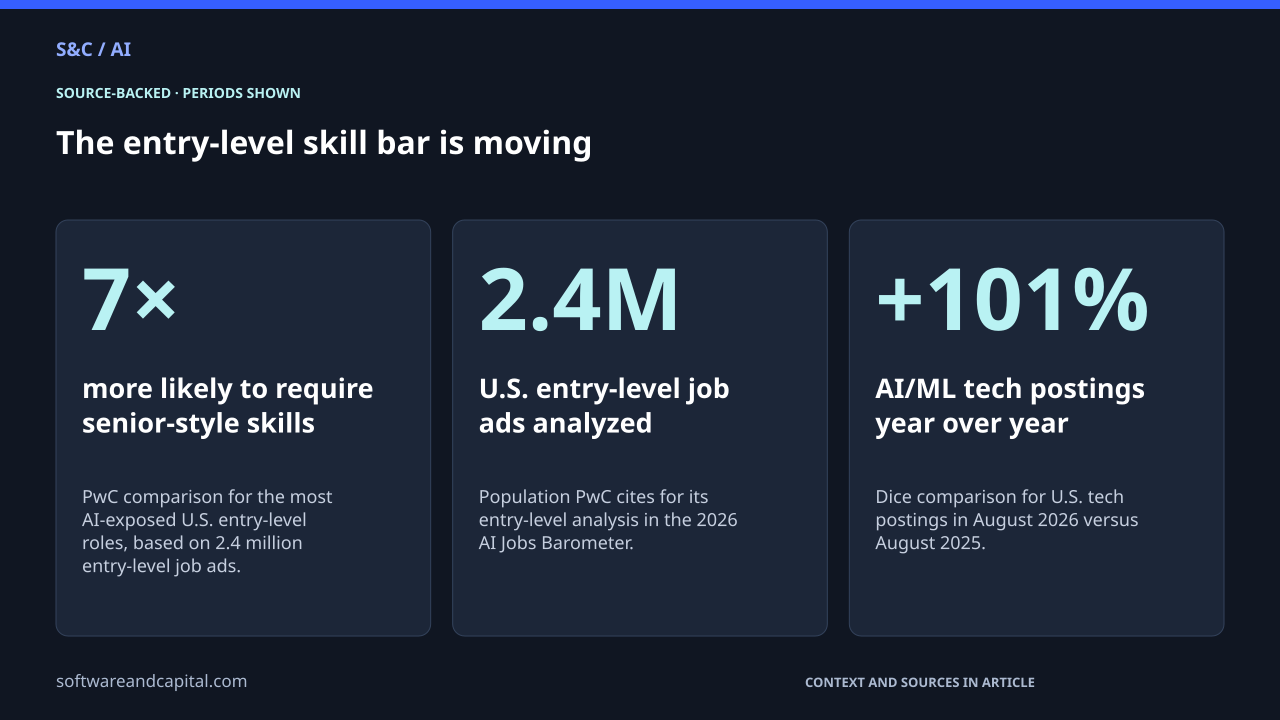
The entry-level skill bar is moving
PwC comparison for the most AI-exposed U.S. entry-level roles, based on 2.4 million entry-level job ads.
Population PwC cites for its entry-level analysis in the 2026 AI Jobs Barometer.
Dice comparison for U.S. tech postings in August 2026 versus August 2025.
These numbers do not say that AI caused every change or that employers have already hired the people behind the postings. Job ads measure demand signals, not completed hires. PwC’s entry-level result is U.S.-specific, while its broader barometer spans more countries and occupations. Dice’s report covers U.S. technology postings.
AI can remove the practice task without removing the whole job
A junior analyst may once have spent hours assembling a first draft, formatting a deck or gathering background material. If software handles more of that preparation, the remaining work can tilt toward checking the output, understanding the client, deciding what matters and explaining a recommendation. Those are harder responsibilities to learn only by reading about them.
That distinction is consistent with our AI job-exposure explainer. Exposure describes where tasks can change. It does not tell us whether a company will cut headcount, hire fewer juniors, redesign the role or use the same team to produce more.
| Source | Population | What it shows | What it does not show |
|---|---|---|---|
| PwC | 2.4M U.S. entry-level job ads | Highly AI-exposed junior roles are more likely to request human-intensive senior-style skills. | It does not prove AI caused every job-description change or predict individual hiring outcomes. |
| Dice | U.S. technology job postings | AI/ML postings grew 101% year over year in August 2026, versus 18% for tech postings overall. | It does not measure all occupations or tell us how many postings became hires. |
The new entry-level advantage may be knowing what good looks like
When a machine can generate a plausible first answer, the scarce skill shifts toward evaluating it. A new worker still needs enough subject knowledge to notice a bad assumption, missing context or confident error. That makes domain understanding more important, not less, even when the mechanical part of producing a draft gets easier.
PwC describes this as a split between roles where AI can democratize a task and roles where AI acts more like a force multiplier for expertise. Its entry-level result points toward the second path in some jobs: the tool may raise the value of human judgement because more routine production happens automatically.1
AI demand is also creating new entry points
Dice reports that AI and machine-learning technology postings grew 101% year over year in August 2026, more than five times the 18% growth rate for tech postings overall. That does not mean every early-career worker should become an ML engineer. It does show that AI-related skills are spreading through a labor market that is still adding technology roles.2
What an early-career worker can take from the data
- Learn the workflow, not only the tool: understand what a correct finished result requires.
- Practice judgement explicitly: compare outputs, explain trade-offs and identify what information is missing.
- Build domain knowledge: AI can draft faster than it can take responsibility for a bad business decision.
- Show evidence of finished work: employers can ask for more autonomy when routine production is easier to automate.
The risk is that companies can demand senior judgement without providing the years of supervised work that traditionally built it. The opportunity is that motivated junior workers may reach meaningful decisions sooner because the repetitive parts are cheaper to produce. Which outcome dominates will depend on how employers redesign training, review and responsibility.
The entry-level job is not vanishing into one clean statistic. It is changing shape. The useful question for a new worker is no longer only, “Can I do the task?” It is increasingly, “Can I tell whether the result is good, explain why and take responsibility for what happens next?”
Sources and methodology
Sources checked September 24, 2026. Dates and periods for individual figures are stated beside them.
- PwC: 2026 Global AI Jobs Barometer ↗Accessed 2026-09-24
- Dice: August 2026 Tech Jobs Report ↗Accessed 2026-09-24
Scope and assumptions
PwC’s seven-times entry-level result is an association in U.S. job advertisements, not proof that AI caused every employer to demand more senior skills.
Dice measures technology job postings rather than all jobs, and postings do not equal completed hires.
The article explains plausible career-ladder effects but does not predict a specific occupation’s employment outcome.
Continue reading
1 in 4 Workers Is Exposed to AI. That Is Not a Layoff Forecast →