AI work is being discussed as both a threat to jobs and a source of new opportunity. LinkedIn’s August research shows why both conversations can miss something important. The AI jobs it tracks tend to list much higher pay than non-AI roles, but the people landing those jobs are not a representative slice of the workforce.1
LinkedIn’s August 2026 research puts the typical listed salary midpoint for U.S. AI job postings at $177,000 versus $80,000 for non-AI roles. It also reports women were 26% of new AI hires in 2025 and about 91% of AI workers held a bachelor’s degree or higher. These are LinkedIn-platform measures, not the whole labor market.1, 2
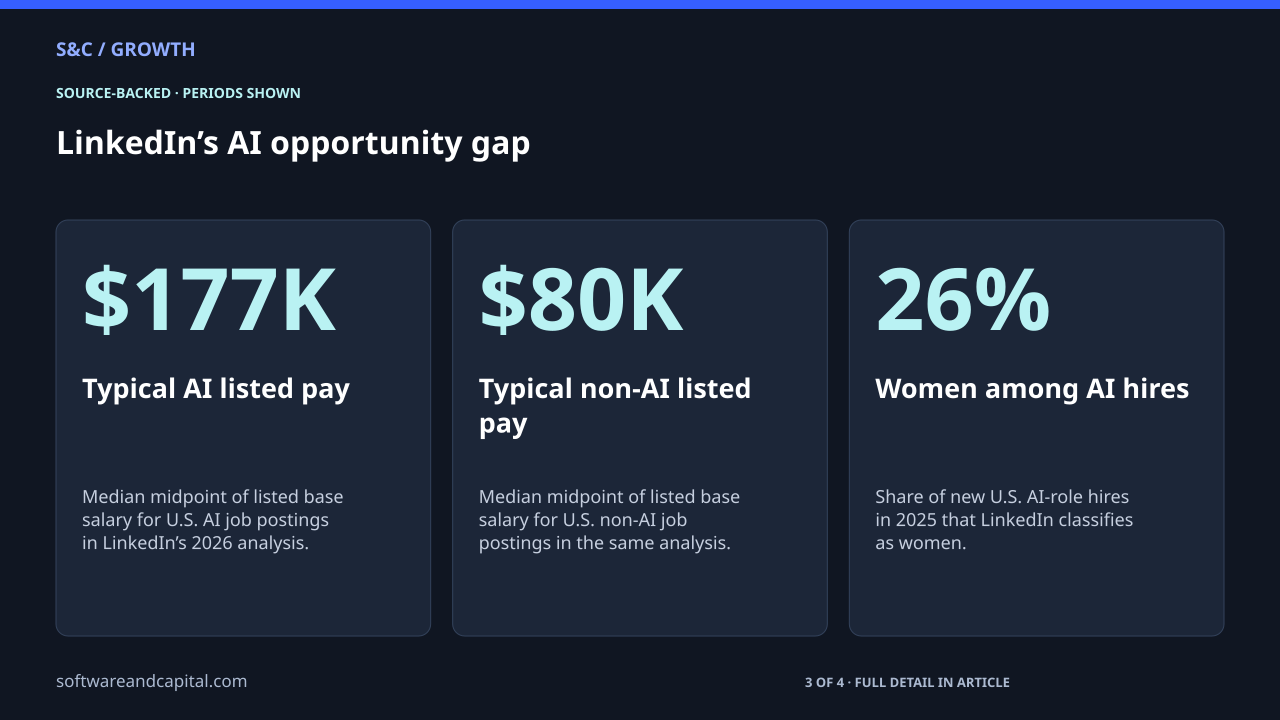
LinkedIn’s AI opportunity gap
Median midpoint of listed base salary for U.S. AI job postings in LinkedIn’s 2026 analysis.
Median midpoint of listed base salary for U.S. non-AI job postings in the same analysis.
Approximate share of AI-role workers holding a bachelor’s degree or higher in LinkedIn’s analysis.
The $177,000 number is listed compensation, not a paycheck
LinkedIn standardizes job-posting pay into annualized base-salary midpoints before comparing roles. That makes the $177,000 versus $80,000 contrast useful, but it is not the same as realized employee earnings, total compensation or the pay of every person working in AI. The paper also shows wide variation across occupations.1
| Measure | AI roles | Non-AI roles | Important limit |
|---|---|---|---|
| Typical listed base pay | $177K | $80K | Posting midpoint, not realized earnings |
| Women among 2025 hires | 26% | 50% | LinkedIn-classified hires, not every U.S. worker |
| Bachelor’s degree or higher | ~91% | ~82% | Workforce composition on LinkedIn |
| Job-posting trend | Roughly doubled vs 2023/24 | Not one comparable category | AI role definitions matter |
The premium is concentrated in particular roles
The paper explicitly warns that there is no single AI salary. Head of AI, Director of AI and Member of Technical Staff sit near the top of the reported pay distribution, while data annotation sits much lower. A headline average can therefore hide substantial differences in seniority, occupation and the kind of work being performed.1
Access is uneven even inside the AI category
Women made up 26% of new hires across the AI roles LinkedIn studied in 2025, but representation was lower in several of the highest-paying occupations. The education split is similarly sharp: LinkedIn reports around 91% of AI workers hold at least a bachelor’s degree, with some high-paying roles above 95%.1
Those patterns are descriptive, not a causal diagnosis. LinkedIn’s data can show who appears in these roles and what postings list. It cannot by itself establish why representation differs or what any single intervention would change.
The broader labor market is a different denominator
LinkedIn’s Economic Graph research is based on its own members, employment histories and job postings. That is a large dataset, but it is not the same thing as a census of the U.S. workforce. The right reading is therefore “LinkedIn finds” rather than “all AI workers earn” or “all employers hire” at these rates.2, 1
Four numbers worth keeping separate
- Listed base-salary midpoint in a job posting.
- Actual employee earnings after hiring.
- Share of hires in a demographic group.
- Share of workers with a particular education level.
This complements S&C’s entry-level AI skills article and AI job-exposure explainer. Those ask what AI changes about work. This one asks who is getting access to the new, higher-paying jobs being created around it.
Sources and methodology
Sources checked September 26, 2026. Dates and periods for individual figures are stated beside them.
- LinkedIn Economic Graph: The AI Talent Divide ↗Accessed 2026-09-26
- LinkedIn Economic Graph: Workforce Data Publications ↗Accessed 2026-09-26
Scope and assumptions
LinkedIn platform data is not the entire U.S. labor market.
Listed base-pay midpoints are not realized earnings or total compensation.
Representation gaps are descriptive and do not establish a single cause.
Continue reading
AI Entry-Level Jobs Are Asking for Senior Skills →
1 in 4 Workers Is Exposed to AI. That Is Not a Layoff Forecast →