Warehouse automation is no longer a futuristic illustration. Amazon said in 2025 that it had deployed its one-millionth robot. The interesting employment question is not whether robots “take jobs” in the abstract. It is which tasks move to machines, which human tasks remain and what new work appears around the automation.1
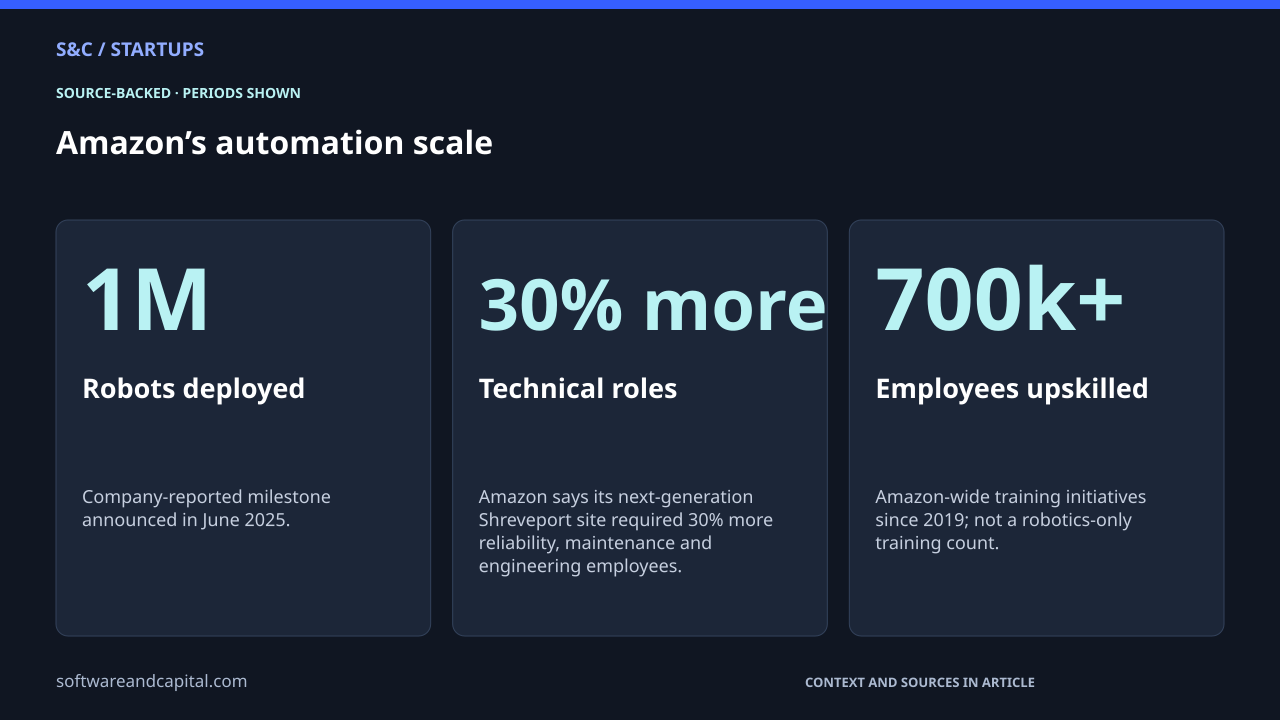
Amazon said in 2025 that it had deployed its one-millionth robot. The company says robots handle repetitive and heavy tasks while workers shift toward new responsibilities, and that its next-generation Shreveport fulfillment center required 30% more employees in reliability, maintenance and engineering roles. Those company claims do not prove automation raises employment overall.1, 2
Amazon’s automation scale
The caveat belongs beside the numbers. Amazon’s 700,000-person training figure covers broad upskilling initiatives, many involving advanced technologies. It is not evidence that 700,000 people were retrained because robots replaced their old tasks. The 30% figure is specific to technical roles at one next-generation facility.1
Robots change the task map before they change the job title
Amazon describes robots handling activities such as moving inventory and reducing repetitive movement. A fulfillment center still needs people to handle exceptions, maintain equipment, manage flow, solve problems and perform work that has not been automated. Automation therefore changes the bundle of tasks inside the operation.1
| Work | More likely machine-assisted | Human role that remains or grows |
|---|---|---|
| Moving inventory | Robots can transport shelves or goods. | People handle exceptions and coordinate flow. |
| Repetitive travel | Optimization can reduce robot and worker movement. | People focus on handling, judgment and problem solving. |
| Keeping automation running | Machines perform the production task. | Reliability, maintenance and engineering roles support the system. |
A new technical job does not cancel every displaced task
It is tempting to read “30% more maintenance roles” as proof that robots create more jobs than they remove. The source does not establish that. It says a particular facility design requires more employees in certain technical categories. To know the total employment effect, we would also need comparable staffing, output and task data across automated and less-automated sites.
The same discipline applies to AI job-exposure estimates. Exposure tells us which work can change. Employment outcomes depend on adoption, redesign, output growth, hiring and what organizations choose to do with the productivity gains.
Amazon is also using AI to coordinate the robots
Amazon says its DeepFleet model coordinates robot movement and reduced robot travel time by 10% in testing. That company result is about fleet efficiency, not a 10% reduction in labor or delivery cost. Better coordination can raise throughput without mapping one-for-one to headcount.1
This is an important form of AI because the model is not writing text for a worker. It is organizing physical machines in a real facility. The productivity question therefore spans software, robotics, building layout and human work design.
Management expects fewer people in some current roles
Amazon’s 2025 shareholder letter says AI and agents will change how work gets done and that, over time, the company expects to need fewer people doing some jobs while needing more people doing other jobs. That is management’s expectation, not a quantified forecast of warehouse employment.2
The statement is useful because it rejects the simplest version of both narratives. Automation is not described as having no employment effect, and it is not described as eliminating human work altogether. The mix of roles changes, and the transition can be uneven.
What a serious automation story should measure
- Tasks: which activities moved from people to machines?
- Output: did the facility process more work after automation?
- Headcount: how did total staffing and role mix change at comparable sites?
- Quality and safety: did errors, injuries or downtime change alongside throughput?
A million robots is a striking technology milestone. The business story is what the robots make possible, and the labor story is how the work is reorganized around them. Neither can be answered by counting machines alone.
Sources and methodology
Sources checked September 22, 2026. Dates and periods for individual figures are stated beside them.
- Amazon: One million robots and DeepFleet ↗Accessed 2026-09-22
- Amazon: 2025 shareholder letter from Andy Jassy ↗Accessed 2026-09-22
Scope and assumptions
Amazon’s robotics, staffing and training figures are company-reported and do not constitute an independent causal study of employment effects.
The article does not estimate net jobs created or lost, and the Shreveport technical-role figure is specific to one facility design.
AI-assisted research and editing. Our editorial standards.
Continue reading
1 in 4 Workers Is Exposed to AI. That Is Not a Layoff Forecast →