Humanoid robots are easy to make impressive for a few minutes on a stage. Agility Robotics is trying to prove something harder: that a bipedal machine can become ordinary industrial equipment. Its new Digit 5 arrives with operating history, customer contracts and a plan to raise public-market capital to manufacture and deploy more robots.1, 2
Agility has stronger commercial evidence than a humanoid demo alone: it says Digit has logged more than 65,000 operating hours and Digit 5 has more than $300 million in multi-year orders. But the order figure is potential value over time, subject to contractual milestones, and is not current revenue. Commercial scale still depends on deployment and production.1, 3
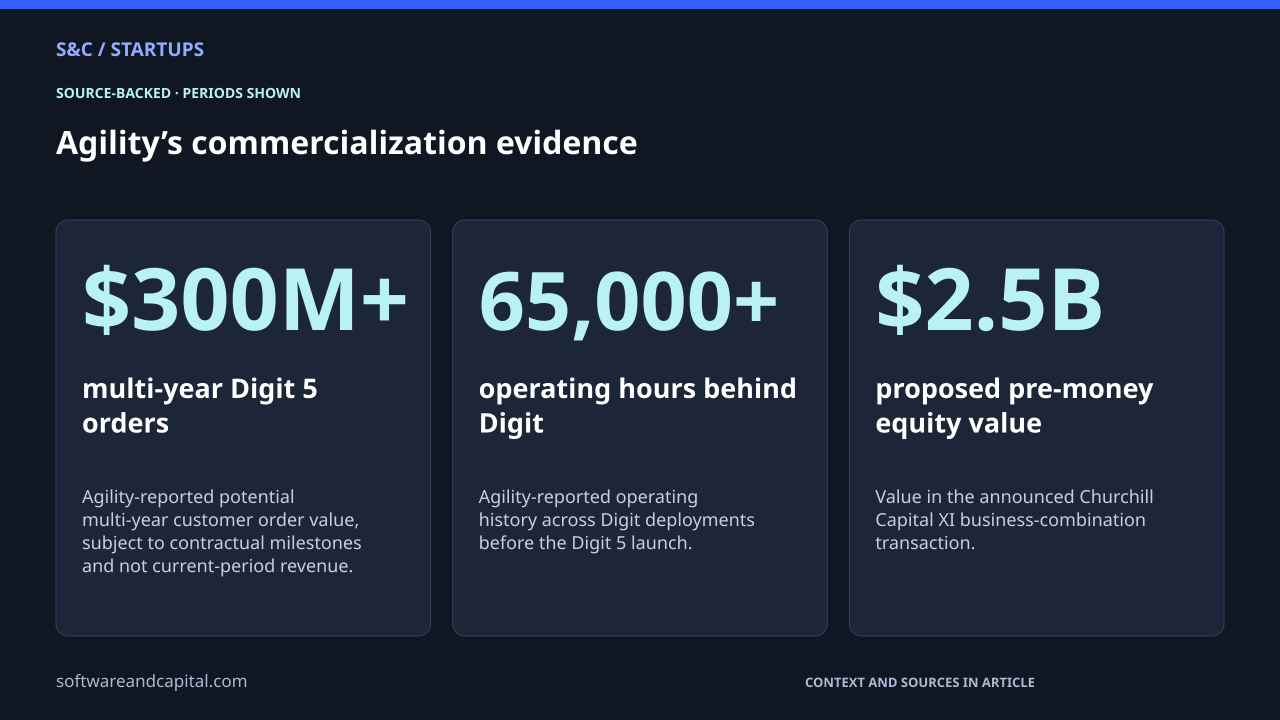
Agility’s commercialization evidence
Agility-reported potential multi-year customer order value, subject to contractual milestones and not current-period revenue.
Agility-reported operating history across Digit deployments before the Digit 5 launch.
Value in the announced Churchill Capital XI business-combination transaction.
The most important qualifier belongs next to the $300 million. Agility’s filed investor presentation says the figure represents potential multi-year value expected to be realized over time, subject to contractual milestones. It relates to 1,000 Digit 5 robots under three-year robotics-as-a-service contracts and is explicitly not a measure of current-period revenue.3
Orders are stronger evidence than a demo, but weaker than delivered revenue
A customer contract says more than a viral video because another organization has committed to a commercial relationship. It still does not tell us how many robots are deployed today, whether every contractual milestone will be reached or how quickly the order value turns into recognized revenue. The commercialization story therefore sits between prototype hype and mature industrial scale.
| Stage | Agility evidence | What it proves |
|---|---|---|
| Working system | 65,000+ operating hours behind Digit | The platform has operated beyond one-off demonstrations. |
| Customer use | Commercial deployments with industrial customers | Humanoids are being used in real facilities for defined tasks. |
| Contracted demand | $300M+ potential multi-year Digit 5 order value | Customers have made commitments beyond pilots, subject to milestones. |
| Scale-up capital | $2.5B proposed pre-money value and $620M+ expected gross proceeds | Agility is seeking capital to fulfill orders and expand production, not proving the scale-up is already complete. |
Digit 5 is designed around a less glamorous problem: safety near people
Agility says Digit 5 is designed for 'cooperative safety,' allowing the robot to work near people without the physical barriers common in industrial automation. The company describes new sensing and control features intended to detect nearby people and adjust behavior. Those are company claims about the product design, not independent certification of every deployment scenario.1
That focus matters because a humanoid is useful only if it can enter the messy environment already built for people. A robot that requires its own fenced-off zone may automate a task, but it loses part of the reason for having a human-shaped machine in the first place. Safety is therefore a commercialization constraint as much as an engineering feature.
The public-market deal shows how much scale-up capital still matters
Agility’s proposed merger with Churchill Capital XI values the company at $2.5 billion pre-money and is expected to provide more than $620 million in gross proceeds, assuming the stated transaction conditions. Agility says the money would support existing orders, more deployments and higher Digit 5 production.2
That capital requirement connects humanoids to other physical-AI businesses. Our Waymo financing analysis shows how removing a human operator does not remove factories, fleets and physical operations. Our Amazon robotics article shows what happens when automation is already deployed at enormous scale. Agility is earlier on that commercialization curve.
The numbers that would make the next stage easier to judge
- Robots deployed: how many Digit 5 units move from contracted orders into live customer facilities.
- Recognized revenue: how quickly multi-year order value becomes actual reported revenue.
- Utilization: how many productive hours robots deliver relative to downtime, maintenance and supervision.
- Production rate: whether Agility can manufacture and commission robots fast enough to fulfill the contracted pipeline.
Humanoid robotics has plenty of futuristic promises. Agility’s current numbers are useful because they are more concrete: operating hours, customer orders and a financing plan. They still stop short of proving a mature business. The next milestone is not a more impressive demo. It is turning contracted robots into repeatable deployments and booked orders into reported revenue.
Sources and methodology
Sources checked September 24, 2026. Dates and periods for individual figures are stated beside them.
- Agility Robotics: Digit 5 humanoid robot announcement ↗Accessed 2026-09-24
- SEC exhibit: Agility Robotics and Churchill Capital XI transaction announcement ↗Accessed 2026-09-24
- SEC exhibit: Agility Robotics investor presentation ↗Accessed 2026-09-24
Scope and assumptions
Agility’s $300 million figure is potential multi-year order value subject to contractual milestones and is not current-period revenue.
Operating hours, safety claims and deployment descriptions are company-reported and do not substitute for independent performance benchmarks.
The Churchill Capital XI transaction is proposed and expected proceeds depend on transaction assumptions and closing conditions.
Continue reading
Amazon Has 1 Million Robots. What Happens to the Warehouse Job? →
$16B for Driverless Rides: Why Robotaxis Need So Much Capital →