A spreadsheet often survives because building the alternative is too much work. Amazon Quick is attacking that gap. A product manager, finance lead or operations analyst can describe an internal tool in natural language, connect it to live business systems and publish it to coworkers without starting with a conventional software project.
Amazon Quick can build internal web apps from natural-language descriptions and connect them to systems such as Salesforce, Jira, Microsoft 365, Google Workspace, databases and warehouses. That does not eliminate spreadsheets. It changes the threshold for when a recurring spreadsheet-and-export workflow is worth turning into a governed, shared application.1, 2
What Quick changes
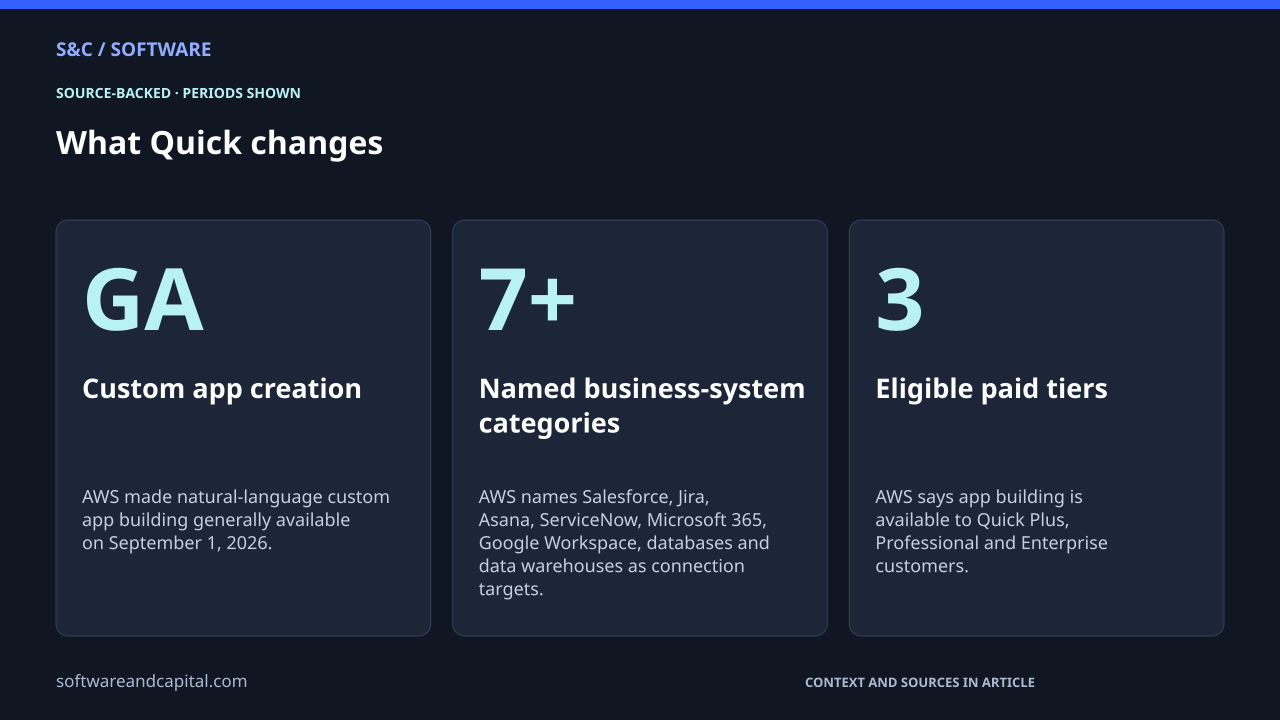
AWS made natural-language custom app building generally available on September 1, 2026.
AWS names Salesforce, Jira, Asana, ServiceNow, Microsoft 365, Google Workspace, databases and data warehouses as connection targets.
AWS says app building is available to Quick Plus, Professional and Enterprise customers.
The interesting target is the spreadsheet that became a system
Not every spreadsheet is an app waiting to happen. The strongest candidates are recurring workflows where several people copy data between systems, maintain status columns, chase updates or build the same report every week. AWS says its own Quick team replaced manual pulls from four systems with a leadership-review app during preview.1
| Workflow | Spreadsheet pattern | App pattern |
|---|---|---|
| Status tracking | People update rows manually | Connected records stay current from source systems |
| Data collection | Copy and paste from several tools | Live connectors bring authorized data into one interface |
| Permissions | File sharing and sheet-level access | Existing identity and access controls govern connected systems |
| Changes | Edit formulas, tabs and scripts | Describe changes conversationally and republish |
The hard part moves from coding to governance
Lowering the build barrier does not remove the need to decide what an app may read or change. Quick says connectors respect existing identity and authorization policies, and AWS now lets admins enable or disable individual connector tools and require consent for selected actions. That governance layer becomes more important when non-developers can create apps quickly.1, 3
This is closer to no-code software than a smarter spreadsheet
AWS documentation describes Quick apps as interactive web applications that can include dashboards, data-entry interfaces and document views. The user can refine the app through conversation and publish it for daily use. That is a different object from a sheet with AI formulas: it is a shared application whose interface and data connections are generated conversationally.2
The spreadsheet still wins when
- The task is genuinely ad hoc and does not deserve a maintained application.
- A few formulas and manual edits are faster than configuring permissions and connectors.
- The team needs unrestricted free-form analysis rather than a repeatable workflow.
- The source data is not available through an approved connection.
The software-pricing guide explains why the buying decision also depends on what the platform charges for. The practical question is no longer only whether a team can build an internal app. It is whether the recurring workflow is important enough to justify turning a flexible sheet into governed software.
Sources and methodology
Sources checked September 26, 2026. Dates and periods for individual figures are stated beside them.
- AWS: Amazon Quick now lets you build custom apps with natural language ↗Accessed 2026-09-26
- AWS: Build web applications with apps in Amazon Quick ↗Accessed 2026-09-26
- AWS: Amazon Quick connector tool settings and MCP sync ↗Accessed 2026-09-26
Scope and assumptions
AWS’s speed and customer examples are vendor-reported rather than independent productivity benchmarks.
The article does not claim that Quick can replace every spreadsheet or custom application.
Connector availability and actions depend on account configuration and permissions.