Identity theft protection used to sound like a narrow insurance-adjacent product. Aura is trying to turn it into a broader consumer software subscription that combines fraud, identity, family and online-safety tools. Its filing is useful because it exposes the subscriber count, monthly monetization and recurring-revenue base behind that pitch.1
Aura reported about 818,400 direct-to-consumer subscribers at June 30, 2026, monthly D2C ARPU of $16.61 and standalone ARR of $245.9 million. It also served about 2,200 employers. The business combines consumer subscriptions with employer distribution, while the July Qoria acquisition adds schools and parental-control products that should be kept separate from Aura’s standalone figures.1, 2
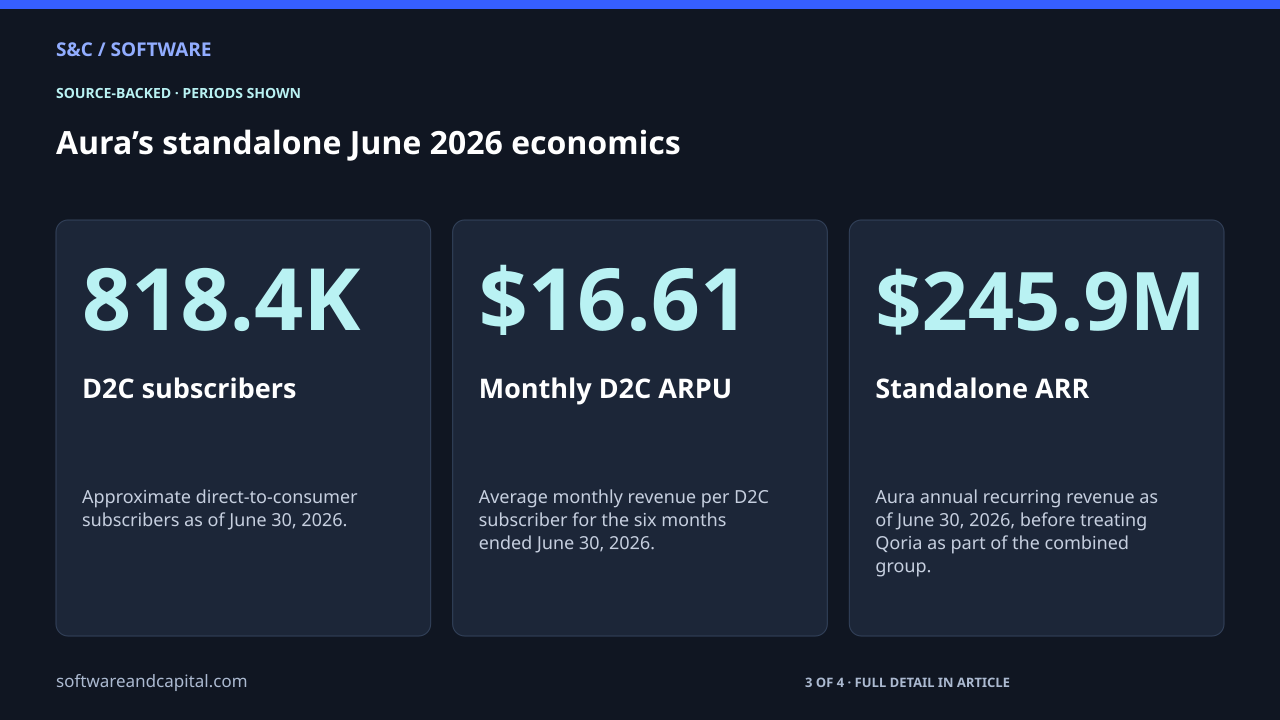
Aura’s standalone June 2026 economics
Average monthly revenue per D2C subscriber for the six months ended June 30, 2026.
Aura annual recurring revenue as of June 30, 2026, before treating Qoria as part of the combined group.
Approximate employers served through Aura’s Employee Benefits channel as of June 30, 2026.
The core business still looks like a subscription
Aura’s direct-to-consumer channel generated $79.3 million of revenue in the first half of 2026, up from $59.7 million a year earlier. Subscriber count rose 21% and monthly ARPU rose 7%. Those two levers explain why a consumer safety product can grow even without becoming a transaction-based financial service.1
| Channel | Customer relationship | What the filing reports |
|---|---|---|
| Direct to consumer | Individual or household subscription | 818.4K subscribers and $16.61 monthly ARPU |
| Employee benefits | Employer offers Aura to workers | About 2,200 employers and 110% NRR |
| Qoria / schools | Added through July acquisition | Separate school and parental-safety distribution |
| Combined group | Aura plus Qoria | Pro forma ARR of about $339.7M at Q2 |
Employer distribution changes the acquisition model
Aura says its employee-benefits channel had net revenue retention above 100%, including 110% for the first half of 2026. Employer distribution can create a different acquisition path from buying consumer ads one household at a time. That does not make the channel automatically more profitable, but it broadens how the subscription reaches users.1
Qoria makes the company bigger and the comparisons messier
Aura completed its Qoria acquisition in July, after the June 30 standalone metrics in the filing. The combined company reported pro forma ARR of $339.7 million for Q2. That number should not be compared directly with Aura’s $245.9 million standalone June ARR as if it were organic growth. The perimeter of the business changed.1, 2
Digital safety is becoming a bundle
The strategic logic is similar to other consumer subscriptions: increase the number of problems solved under one recurring payment, then reduce churn by making the bundle harder to replace. Aura spans identity theft, fraud and family safety, while Qoria adds school and parental-control distribution. The open question is whether breadth improves retention enough to justify the complexity.1, 2
What matters beyond subscriber count
- D2C retention and whether ARPU keeps rising without hurting churn.
- Customer-acquisition cost for direct subscribers.
- Employer-benefit retention and expansion.
- How Qoria changes combined margins and cash generation after integration.
The business resembles the recurring-revenue logic in S&C’s Oura subscription analysis, but without a wearable hardware sale at the center. It also provides a useful contrast with Meta’s subscription experiment: Aura starts with paid protection as the product itself.
Sources and methodology
Sources checked September 26, 2026. Dates and periods for individual figures are stated beside them.
- Aura: Form S-1/A ↗Accessed 2026-09-26
- Aura: Second-quarter 2026 financial results ↗Accessed 2026-09-26
Scope and assumptions
Aura’s S-1/A is a resale registration, not a new operating forecast.
Qoria closed after June 30, so standalone Aura and combined pro forma figures have different scopes.
The article analyzes business-model metrics and does not recommend Aura securities.
Continue reading
Oura’s IPO Filing Reveals an 89%-Margin Subscription Inside a Ring Business →
Meta One Has 15M Subscriptions and Trials. Can Meta Become a Subscription Company Too? →