The ring is the thing people see. Oura’s IPO filing makes the quieter business behind it easier to understand. The company sells a piece of hardware up front, then tries to turn that device owner into a paying member whose subscription can continue for years. The two revenue streams have very different jobs inside the model.1
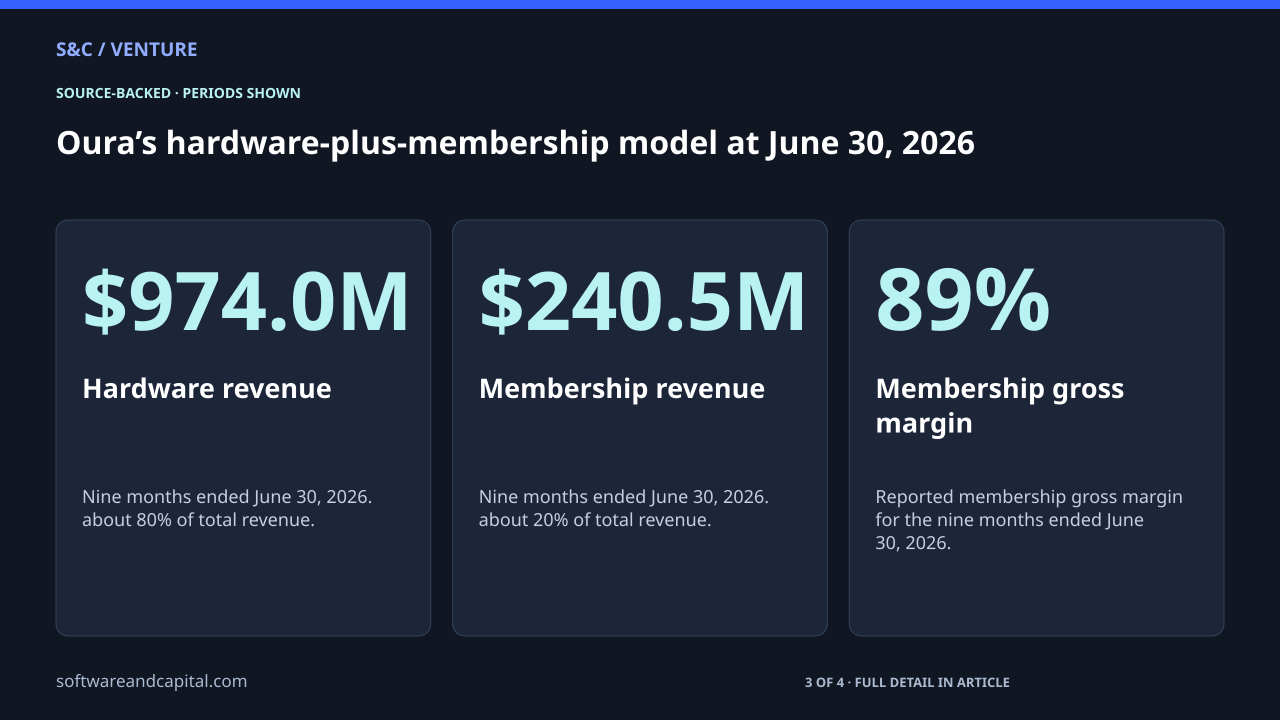
Oura reported $974.0 million of hardware revenue and $240.5 million of membership revenue for the nine months ended June 30, 2026. Membership was about 20% of revenue but carried an 89% gross margin. With 5.0 million paid members and 85% weighted-average 12-month retention, the filing shows a hardware business building a high-margin recurring layer.1, 2
Oura’s hardware-plus-membership model at June 30, 2026
Membership was still the smaller revenue stream. Divide $240.5 million by $1.2145 billion of total nine-month revenue and the result is about 19.8%. The importance of the subscription shows up somewhere else: Oura says membership gross margin was 89%, and the recurring relationship extends the lifetime value created by the initial ring sale.1
The ring acquires the member
Oura describes hardware as the acquisition engine. The company says roughly 94% of ring activations convert to paid membership, and hardware sales are designed to recover customer-acquisition cost at the point of purchase. The device therefore does more than produce one sale. It creates the installed base from which recurring membership revenue can grow.1
That is a useful inversion of the usual software funnel. Instead of giving the software away to acquire a subscriber, Oura sells the physical product first and then uses the software experience to extend the relationship. The economics depend on both pieces working: fewer ring sales would also mean fewer new members.1
The subscription changes the margin mix
| Measure | Hardware | Membership |
|---|---|---|
| Revenue | $974.0M | $240.5M |
| Share of total revenue | About 80% | About 20% |
| Primary role | Acquire and activate members | Extend engagement and lifetime value |
| Highlighted economics | Average revenue per ring of $311 | 89% reported gross margin |
| Recurring? | No, tied to device purchases | Yes, monthly or annual billing |
The filing does not give a matching 89% hardware gross margin, so the right comparison is not “hardware bad, subscription good.” Hardware produces most of the revenue and brings people into the system. Membership adds a more predictable stream whose direct economics are unusually attractive. The combination is the business model.1
Retention is what makes recurring revenue recurring
Oura reported 5.0 million Paid Members at June 30 and a weighted-average 12-month paid-member retention rate of about 85%. It also said 63% of new members in the nine-month period began with an annual plan. In the U.S., current membership pricing is $5.99 per month or $69.99 per year.1, 2
Those figures explain why the membership matters even when hardware still dominates revenue. A ring can be sold once. A retained member can contribute recurring revenue across multiple billing periods. That does not guarantee lifetime value, but it makes the installed base financially different from a hardware customer who disappears after checkout.
The IPO filing also shows the dependency
Oura says hardware and membership are closely related and that a decline in ring sales would be expected to reduce new member additions and renewals. The subscription is therefore not an independent SaaS business floating above the hardware. It is a recurring layer whose growth still depends heavily on device adoption.1
That tension is what makes Oura more interesting than a simple wearable-sales story. The company resembles a small version of the hardware-plus-services logic we examined at Apple, while the recurring relationship also invites comparison with subscription businesses such as Spotify.
What matters after the IPO
- Whether Paid Member retention remains strong as Oura reaches a broader customer base.
- Whether membership grows faster than hardware and becomes a larger share of revenue.
- Whether new health features increase engagement without requiring proportionally higher service costs.
- How ring pricing and product cycles affect the pipeline of new members.
Oura is still mostly a hardware-revenue company. Its filing shows why that description is incomplete. The ring creates the relationship, while membership turns part of that installed base into recurring, high-margin revenue. If the company keeps both sides working together, the subscription can matter far more to the economics than its current revenue share suggests.
Sources and methodology
Sources checked September 23, 2026. Dates and periods for individual figures are stated beside them.
- Oura: September 21, 2026 amended Form S-1 ↗Accessed 2026-09-23
- Oura: Membership pricing and billing ↗Accessed 2026-09-23
Scope and assumptions
The 19.8% membership revenue share is calculated from Oura’s reported nine-month figures; the filing rounds the mix to approximately 20%.
The 89% gross margin applies to membership revenue, not the company as a whole, and the filing does not provide an equivalent directly comparable hardware margin in the cited passage.
Five million Paid Members is a June 30 historical figure; Oura’s newer 5.7 million fiscal-year-end figure is a forward-looking expectation, not a current realized count.
Continue reading
Apple Services Were 28% of Sales—and 42% of Gross Profit →