Meta built Facebook, Instagram and WhatsApp around a simple consumer bargain: use the product for free, then let advertising pay the bill. Meta One adds a different proposition. Pay Meta directly for more AI usage, more app features or business tools layered onto products that billions of people already use.1, 2
Meta One is a direct attempt to add recurring subscription revenue to a company still dominated by ads. Meta says the service has 15 million subscriptions and trials across more than 50 features, with plans from $2.99 to $499 a month. It has not disclosed paid subscribers, subscription revenue, churn or trial conversion.1, 2
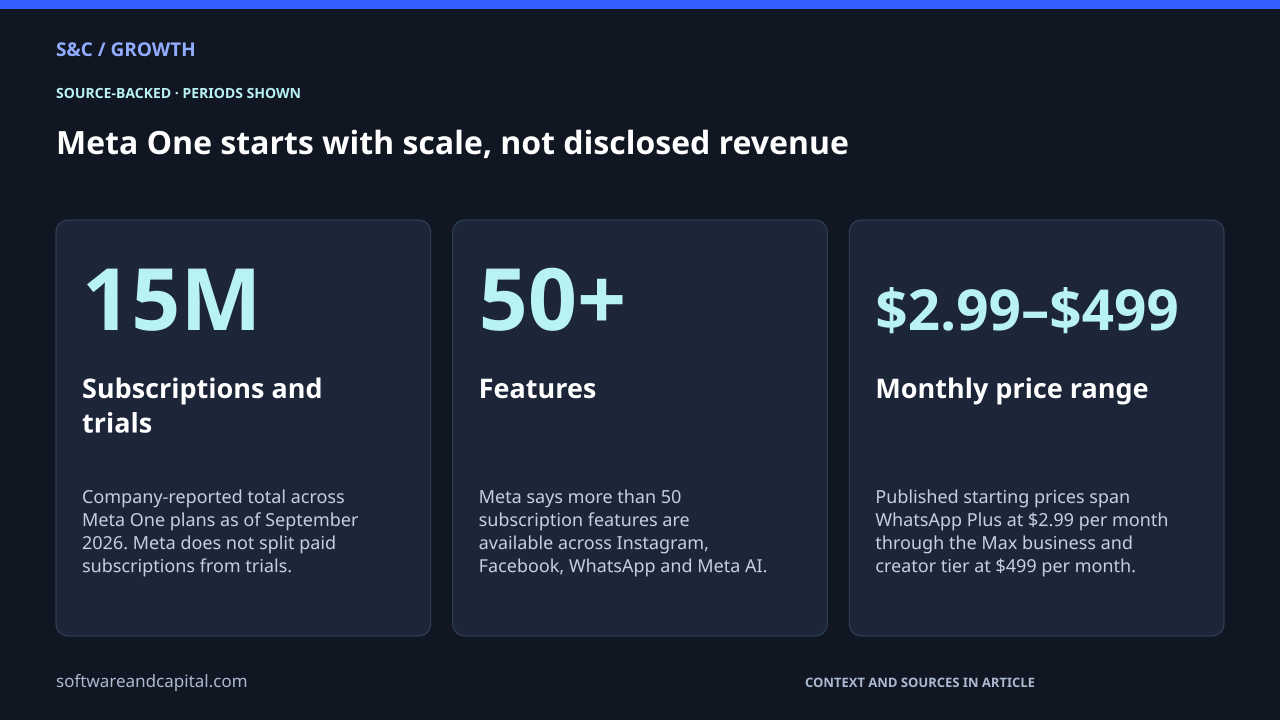
Meta One starts with scale, not disclosed revenue
Company-reported total across Meta One plans as of September 2026. Meta does not split paid subscriptions from trials.
Meta says more than 50 subscription features are available across Instagram, Facebook, WhatsApp and Meta AI.
Published starting prices span WhatsApp Plus at $2.99 per month through the Max business and creator tier at $499 per month.
The 15 million figure is deliberately less precise than a subscriber count. Meta combines subscriptions and trials, so it does not tell us how many people are paying today, how many trials convert, or how much recurring revenue the product generates. It is evidence of reach, not a disclosed subscription business size.1
Meta is selling three different kinds of value
| Customer | Published plans | What the fee unlocks |
|---|---|---|
| Individual app users | WhatsApp Plus $2.99, Instagram Plus $3.99, Facebook Plus $3.99 | Customization, organization and app-specific features. |
| AI-heavy individuals | Core $7.99, Premium $19.99 | More access to compute-intensive AI creation and in-app AI tools. |
| Creators and businesses | Essential from $14.99 through Max from $499 | Professional publishing, analytics, team tools, verification benefits and increasing Meta Business Agent capacity. |
Those categories matter because Meta is not betting on one subscription use case. Some plans sell convenience and self-expression. Others sell scarce AI compute. The highest-priced tiers sell workflow and business capacity. That gives Meta several reasons to ask for a recurring fee without putting the core social apps behind a paywall.1
Ads still dwarf the new subscription layer
In the second quarter of 2026, Meta reported $59.36 billion of advertising revenue on $60.80 billion of total revenue. Using those reported figures, advertising accounted for about 97.6% of quarterly revenue. Meta One therefore begins as diversification around an enormous ad engine, not a replacement for it.2
That is also why the subscription strategy can be patient. Meta does not need Meta One to become the main business immediately. A smaller recurring stream could still matter if it monetizes high-intent users, creators and businesses without reducing the reach that makes the advertising business valuable.2, 1
The business plans show where recurring value may be strongest
The clearest bridge from social app to paid software is the business bundle. Meta One includes more access to Meta Business Agent, publishing tools, analytics, team access and WhatsApp capacity. Meta is packaging things a business can use repeatedly, not only cosmetic perks.1, 3
That makes the top tiers structurally different from a blue check or a theme. If a subscription helps a business answer customers, schedule work or manage a team, the value can be tied to an operating task. Whether that is valuable enough to sustain $149 or $499 monthly tiers is still unproven.1
The missing numbers are more important than the launch prices
What would show Meta One is becoming a real second business
- Paid subscribers separated from free trials.
- Subscription revenue and average revenue per paying account.
- Trial-to-paid conversion and retention after introductory periods.
- Mix between low-cost consumer plans and higher-value creator or business tiers.
Meta One is already interesting because Meta is charging directly for things that used to sit inside a mostly free ecosystem. The 15 million subscriptions-and-trials figure shows the experiment has scale. The unanswered business question is whether those users become a durable recurring-revenue layer beside one of the largest advertising machines in the world.
Sources and methodology
Sources checked September 23, 2026. Dates and periods for individual figures are stated beside them.
- Meta: Introducing Meta One ↗Accessed 2026-09-23
- Meta: Second-quarter 2026 results ↗Accessed 2026-09-23
- Meta: Meta Business Agent launch ↗Accessed 2026-09-23
Scope and assumptions
Meta reports 15 million subscriptions and trials together and does not disclose the paid share, subscription revenue, churn or trial conversion.
Plan prices and availability can vary by region, app and account, and list prices do not establish average realized revenue.
The Q2 advertising share is calculated from Meta’s reported quarterly revenue figures and should not be treated as Meta One’s future revenue mix.
Continue reading
1M Businesses Already Use Meta’s AI Agent. Is Customer Service Becoming a Meta Product? →
Millions Use AI Glasses Every Day. The Assistant Is Moving Onto Your Face →
ChatGPT Ads Hit a $1B Annualized Run Rate. What Is OpenAI Selling? →