Connecting new generation or large loads to the grid can take years, but not every part of the process requires years of engineering judgment. AWS and Duke Energy are targeting the repetitive work inside interconnection studies. Duke says some data-preparation tasks that used to take two weeks of manual work can now be completed in hours with specialized AI agents.1, 2
AWS says Duke Energy reduced some interconnection-study data-preparation tasks from two weeks of manual work to hours. The agents coordinate existing models, scripts and workflows. Physics-based simulation software still performs deterministic analysis, and engineers keep review checkpoints and final engineering decisions. The result applies to specific workflow tasks, not an entire grid-connection process.1, 2
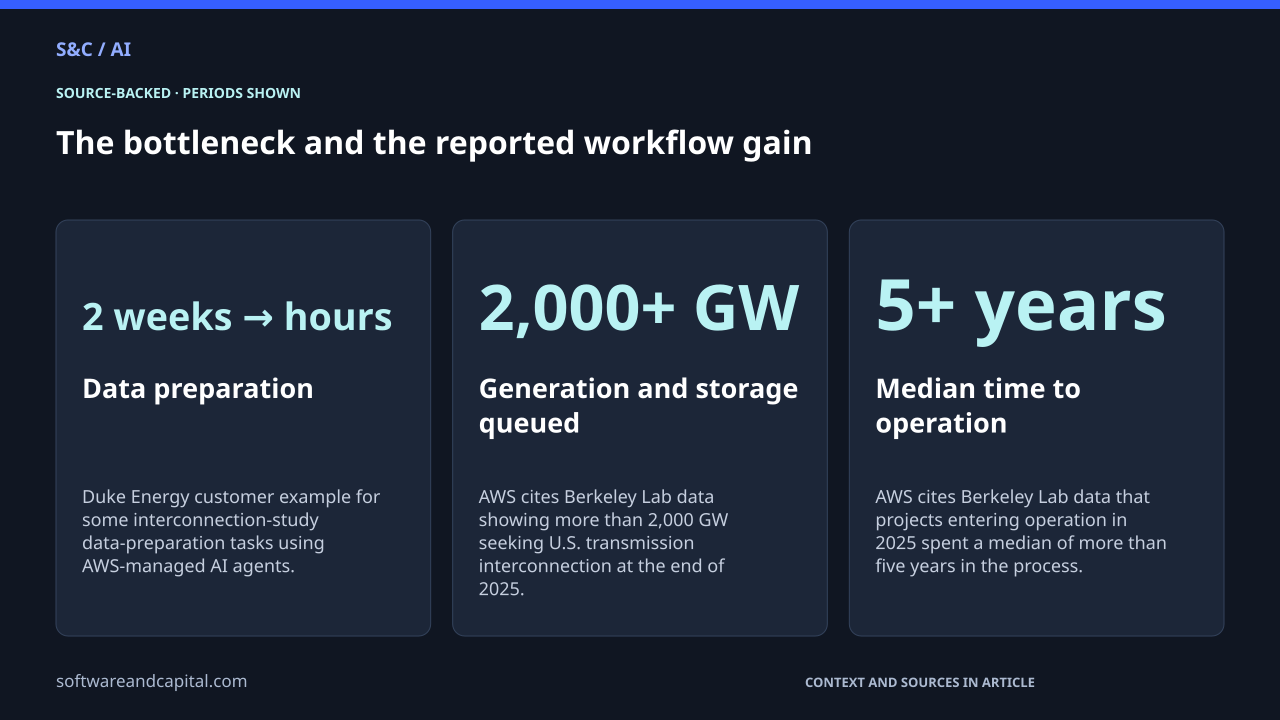
The bottleneck and the reported workflow gain
Duke Energy customer example for some interconnection-study data-preparation tasks using AWS-managed AI agents.
AWS cites Berkeley Lab data showing more than 2,000 GW seeking U.S. transmission interconnection at the end of 2025.
AWS cites Berkeley Lab data that projects entering operation in 2025 spent a median of more than five years in the process.
The two-week result is deliberately narrow. AWS does not say a full interconnection study now takes hours, and it does not say the broader approval process has collapsed from years to days. The agents are automating pieces of study preparation and coordination inside a much longer process shaped by engineering review, grid upgrades, regulation and project development.1
The agent does not replace the physics model
| Layer | Role | Authority |
|---|---|---|
| AI agents | Prepare cases, move data, coordinate tools, rerun workflows and draft outputs. | Can automate repeatable workflow steps but does not make the final engineering decision. |
| Physics-based simulation software | Runs power-flow and contingency analysis using established grid models. | Performs the deterministic engineering calculations. |
| Engineers | Confirm assumptions, review violations, approve mitigations and make final decisions. | Retain decision authority at defined review checkpoints. |
That division is what makes the use case interesting. The agents are not being asked to invent the laws of power systems or replace trusted simulation software. They are coordinating the expensive, repetitive work around those tools so engineers can spend more time on judgment and exceptions.2
Grid interconnection is a real capacity constraint
AWS cites Berkeley Lab data showing more than 2,000 gigawatts of generation and storage seeking U.S. transmission interconnection at the end of 2025. Most queued projects will not be built, but the process is still a major planning bottleneck. AWS also cites a median of more than five years in the process for projects entering operation in 2025.1
That connects directly to the physical bottleneck in our AI electricity analysis. More compute demand does not become useful capacity just because someone orders GPUs. Generation, storage and large loads still have to move through a grid-planning system with finite engineering capacity.
The useful pattern is agent plus deterministic tool plus human review
This workflow is a stronger model for high-stakes agents than “let the AI decide.” The agent handles orchestration, established simulation software produces the engineering outputs, and people approve decisions. That separation makes the audit trail clearer because reviewers can distinguish simulation evidence from AI reasoning and human judgment.2
The same pattern can apply beyond utilities. Many expert workflows contain repetitive setup wrapped around trusted analytical tools. An agent can reduce the setup burden without claiming authority over the final decision. The value comes from shortening the mechanical path to expert judgment, not pretending the expert is unnecessary.
The headline result still needs broader evidence
The two-weeks-to-hours result comes from AWS and Duke Energy’s collaboration, not an independent audit across many utilities. AWS also says the program is available to qualified utilities and grid operators, which means the broader performance record is still developing. The next question is whether similar gains appear across different systems, study types and data quality.1, 2
What would show the approach scales
- Total study-cycle time across several utilities, not only selected preparation tasks.
- How often engineers revise agent-prepared cases before approving them.
- Whether faster preparation lets teams complete more studies without increasing errors or rework.
- How the workflow performs when inputs, models or utility procedures differ substantially.
The strongest claim here is not that AI solved grid interconnection. It is that a carefully bounded agent can remove days of manual preparation while established engineering software and people keep control of the high-consequence decisions. In a system where expert capacity is scarce, that narrower result can still matter.
Sources and methodology
Sources checked September 23, 2026. Dates and periods for individual figures are stated beside them.
- AWS: Agentic Grid Planning launch ↗Accessed 2026-09-23
- AWS: Agentic Grid Planning program ↗Accessed 2026-09-23
Scope and assumptions
The two-weeks-to-hours result is reported by AWS and Duke Energy for some data-preparation tasks and has not been independently audited across utilities.
The result does not mean an entire interconnection study or grid-connection process can now be completed in hours.
The national queue statistics are quoted by AWS from Berkeley Lab research and provide context, not a direct measure of AWS program performance.
Continue reading
AI’s Next Constraint May Be Electricity, Not Intelligence →
Cloud Growth Is Accelerating Again. AI Demand Is the Common Thread →
Unit 42 Says New CVEs Can Be Weaponized in 15 Minutes. Cybersecurity Is Becoming AI vs. AI →