AI feels weightless when the product is a text box in a browser. The infrastructure is not. Behind the screen are buildings packed with chips, cooling systems, transformers and power connections. As AI data centers become larger and denser, getting enough electricity to the right place can become a constraint before the software runs out of ideas.1
The IEA projects total data-center electricity use rising from 485 TWh in 2025 to 950 TWh in 2030, about 3% of global demand. AI-focused data-center consumption is projected to triple. The 950 TWh figure covers all data centers, not AI alone. Grid connections, transformers and other infrastructure can constrain individual projects even when global electricity supply keeps growing.1, 2
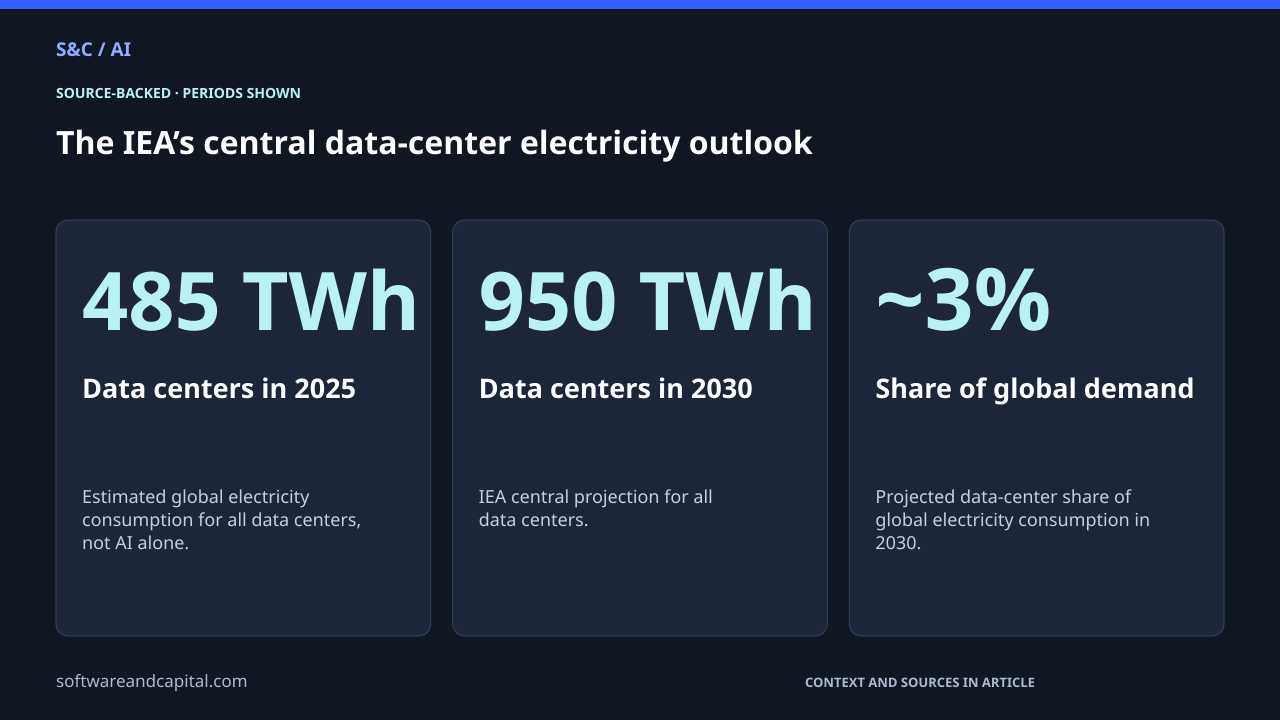
The IEA’s central data-center electricity outlook
The biggest caveat belongs beside the biggest number: 950 TWh is the IEA’s projection for all data centers. It is not an estimate of AI-only electricity use. The agency says electricity consumption from AI-focused data centers grows much faster than the overall category and is projected to triple from 2025 to 2030.1
The global electricity total is not the whole problem
A data center needs power at a specific site, through a specific grid connection, on a specific schedule. Global electricity generation can be ample while a local project waits years for transmission equipment, substations or permission to connect. This is why the physical location of AI infrastructure matters.
The IEA’s 2025 grid analysis estimated that grid constraints could delay around 20% of global data-center capacity planned for construction by 2030 if the risks were not addressed. That is capacity at risk of connection delay in the scenario, not a prediction that 20% of data centers will never be built.2
| Constraint | What can be scarce | Why more chips do not solve it |
|---|---|---|
| Grid connection | Transmission and distribution capacity at the site. | The building still needs a path to receive power. |
| Electrical equipment | Transformers, power electronics and related supply-chain capacity. | More computing hardware can increase the equipment requirement. |
| Power density | The amount of electricity and cooling required in a small physical space. | A site can face engineering limits even when annual energy is available. |
AI racks are becoming unusually power-dense
The IEA says an advanced data-center server rack could have peak power demand equivalent to 65 households by 2027. That comparison is about peak power, not annual household electricity consumption. The agency also says AI-server power density increased elevenfold from 2020 to 2025 and is set to rise a further fourfold by 2027.1
High power density changes the design problem inside the facility. Supplying and cooling a concentrated load can require different equipment and operating practices from a less dense computing room. The bottleneck is therefore not merely how many terawatt-hours exist on a national balance sheet.
The demand is large, but it is not the world’s only new electric load
The IEA projects strong data-center growth, but its broader Energy and AI analysis says data centers account for less than 10% of global electricity-demand growth between 2024 and 2030 in its base case. Industry, electrification, electric vehicles and air conditioning also add large loads. AI is important without being the only reason grids need investment.3
View the underlying values
| Measure | Value (TWh) |
|---|---|
| 2025 | 485 |
| 2030 | 950 |
That chart is a scenario comparison, not a measured 2030 outcome. Data-center construction, chip efficiency, model use, energy prices and grid availability can all move the result. The IEA’s 2026 update explicitly discusses both near-term bottlenecks and the possibility of higher longer-term demand if those bottlenecks ease.1
This changes how to read the AI infrastructure boom
Nvidia’s data-center revenue shows one side of the buildout: customers buying enormous amounts of compute and networking infrastructure. Energy analysis shows another side. Installing chips does not complete a data center if the site cannot obtain enough reliable power to operate them.
The constraint can also influence where projects are built. A region with available generation, grid capacity and faster connections can become more attractive even if it is not the closest place to the end user. That is one reason AI infrastructure can become an energy and geography story as well as a software story.
What to check when a new AI data center is announced
- Power: how much electricity does the project expect to require, and is that a peak-power or annual-energy number?
- Connection: is grid capacity already available, contracted or still waiting in a queue?
- Timing: are the chips, electrical equipment, building and power supply expected to arrive on the same schedule?
- Scope: does a headline describe AI-focused facilities or the broader data-center market?
Electricity is not proof that AI development will stop. It is a reminder that digital growth ultimately lands in the physical world. A smarter model can reduce the energy required for one task while total demand still rises because far more tasks, larger models and new applications are deployed.
The next AI breakthrough may still be an algorithm. The next AI bottleneck may be a transformer, a grid connection or a place with enough power. Both can be true at the same time.
Sources and methodology
Sources checked September 21, 2026. Dates and periods for individual figures are stated beside them.
- IEA: Key Questions on Energy and AI (2026 report PDF) ↗Accessed 2026-09-21
- IEA: Energy and AI (2025 report PDF) — grid constraints ↗Accessed 2026-09-21
- IEA: Energy and AI (2025 report PDF) — electricity-demand outlook ↗Accessed 2026-09-21
Scope and assumptions
The 950 TWh figure is the IEA’s central projection for all data centers in 2030, not AI-only consumption or a guaranteed outcome.
The roughly 20% delay figure is a scenario estimate for planned data-center capacity exposed to grid-connection risk, not a forecast that those projects will be permanently cancelled.
AI-assisted research and editing. Our editorial standards.
Continue reading
Nvidia’s $193.7B Data-Center Business, Explained →
$16B for Driverless Rides: Why Robotaxis Need So Much Capital →