Cloud computing was supposed to be entering its mature phase. The latest numbers look different. AWS just posted its fastest growth in 18 quarters, Google Cloud accelerated sharply, and Oracle’s infrastructure business more than doubled. The companies measure cloud differently, but they share one explanation for the renewed demand: customers need more infrastructure for AI.1, 2, 3
AWS grew 37% in Q2 2026, Google Cloud 82%, and Oracle IaaS 121% in Q1 FY27. Those segments are not directly comparable, but all three companies point to AI infrastructure, training or inference demand as a meaningful driver. The pattern suggests AI is creating another growth cycle for large cloud platforms.1, 2, 3
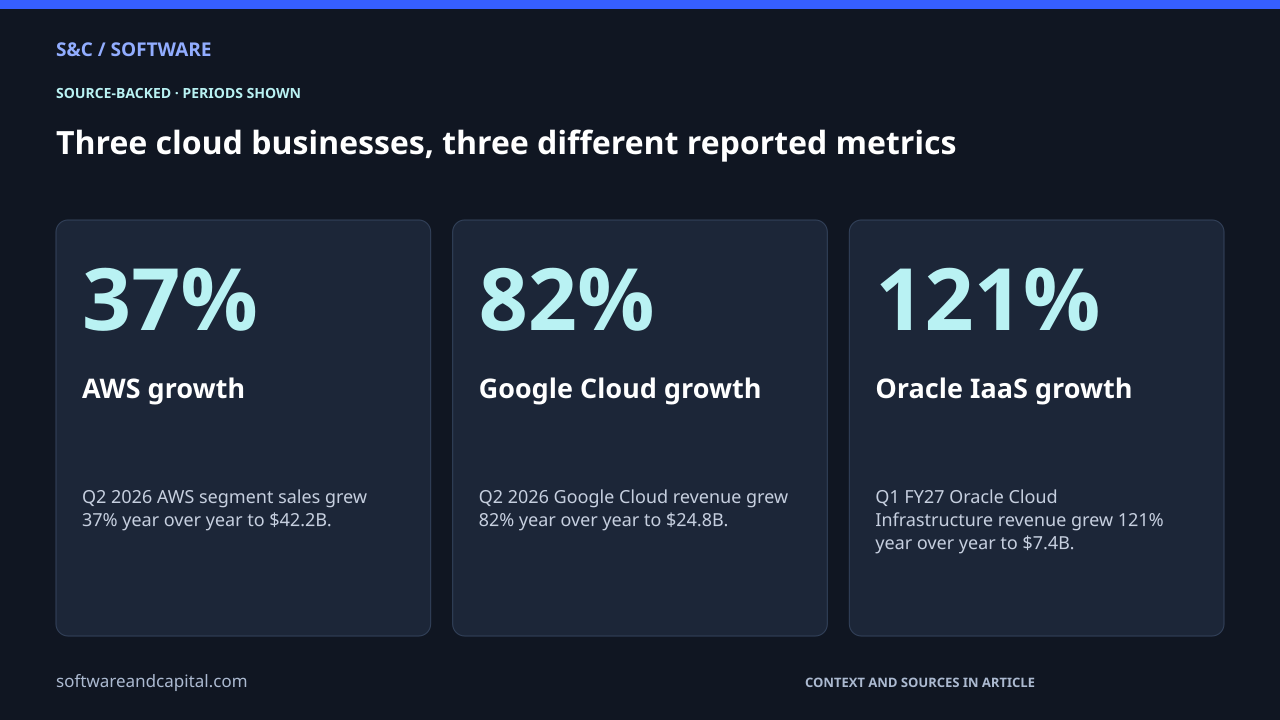
Three cloud businesses, three different reported metrics
The percentages should not be read as a market-share ranking. AWS is a full reporting segment. Google Cloud includes Google Cloud Platform and Workspace. Oracle’s 121% figure is specifically infrastructure-as-a-service, while its total cloud revenue grew 62%. The useful comparison is directional: each company is reporting unusually strong infrastructure demand at the same time.1, 2, 3
AWS is reaccelerating inside an already enormous base
AWS reported $42.2 billion of Q2 sales, up 37%, which Amazon called its fastest growth in 18 quarters. Amazon also said its AWS AI business exceeded a $25 billion annual revenue run rate and was growing at triple-digit percentages. That makes AI a visible business inside AWS rather than only a future capacity bet.1
The investment side reinforces the point. Amazon said trailing-twelve-month free cash flow swung to a $7.6 billion outflow as property-and-equipment purchases rose by $66.1 billion year over year, primarily reflecting artificial-intelligence investments. Growth and infrastructure spending are moving together.1
Google says AI infrastructure helped drive the acceleration
Google Cloud reached $24.8 billion in Q2 revenue, up 82%. Alphabet explicitly said the acceleration was led by Google Cloud Platform across enterprise AI infrastructure, enterprise AI solutions and core GCP services. That matters because it ties the growth claim to paid cloud workloads, not just consumer Gemini usage.2
| Company | Reported cloud measure | Latest revenue | YoY growth | AI demand signal |
|---|---|---|---|---|
| Amazon | AWS segment | $42.2B in Q2 2026 | 37% | AWS AI business above a $25B annual revenue run rate; AI investment drove much of the property-and-equipment increase. |
| Alphabet | Google Cloud | $24.8B in Q2 2026 | 82% | Company says GCP growth was led in part by enterprise AI infrastructure and AI solutions. |
| Oracle | Cloud Infrastructure (IaaS) | $7.4B in Q1 FY27 | 121% | Oracle says AI training and inference demand is growing faster than supply and it booked more than $30B of new AI cloud contracts. |
Oracle’s bottleneck is capacity, not demand
Oracle reported $7.4 billion of infrastructure revenue, up 121%, and said demand for AI cloud training and inference continued to grow faster than supply. It booked more than $30 billion of additional AI cloud contracts in the quarter and delivered more than 300,000 GPUs to AI cloud customers since the previous quarter ended.3
That is a different business scale from AWS, but the operating problem sounds familiar: capacity has to arrive fast enough to convert demand into revenue. The electricity constraint and the capital intensity documented at CoreWeave sit underneath the same cloud expansion.3
AI is not the whole cloud business
A common demand driver does not mean all cloud growth is AI. Amazon still sells general compute, storage and databases. Google cites core GCP services alongside AI. Oracle sells both infrastructure and applications. The safer conclusion is that AI workloads are adding a powerful new source of demand to cloud businesses that were already large.1, 2, 3
What to watch next
- Whether growth remains elevated as new data-center capacity comes online.
- Whether AI workloads expand cloud margins or keep capital spending unusually high.
- How quickly capacity constraints shift from GPUs to power, networking and construction.
- Whether customers increasingly spread AI workloads across several cloud providers.
The striking part is not that three cloud companies posted different growth rates. It is that three different businesses are describing the same underlying pressure: customers want more AI compute than existing infrastructure can comfortably supply. Cloud may be old technology infrastructure, but AI is making its growth story feel young again.
Sources and methodology
Sources checked September 23, 2026. Dates and periods for individual figures are stated beside them.
- Amazon: Second-quarter 2026 results ↗Accessed 2026-09-23
- Alphabet: Second-quarter 2026 results, SEC-filed exhibit ↗Accessed 2026-09-23
- Oracle: First-quarter fiscal 2027 results ↗Accessed 2026-09-23
Scope and assumptions
AWS, Google Cloud and Oracle IaaS use different segment definitions and fiscal periods, so the reported growth rates are not a market-share or performance ranking.
AI is a meaningful stated demand driver, but none of the three companies says all cloud revenue growth came from AI.
Company-reported run rates, contract bookings and capacity figures are operating indicators rather than identical revenue measures.
Continue reading
Nvidia’s $193.7B Data-Center Business, Explained →
CoreWeave Grew From $229M to $5.1B—and Still Lost $1.2B →
AI’s Next Constraint May Be Electricity, Not Intelligence →
Alphabet and Oracle Raised $69.5B in Equity While Scaling AI Infrastructure →