Amazon calls chips such as Graviton and Trainium custom silicon. That does not mean AWS draws every reusable component itself. Its new multi-year Synopsys agreement is worth more than $1 billion and will give Amazon access to licensed silicon IP for future custom-chip engineering.1
Amazon and Synopsys signed a multi-year agreement worth more than $1 billion for silicon IP and engineering collaboration. AWS designs custom chips such as Graviton and Trainium, but custom does not mean every component is built internally. Licensing reusable IP can shorten development while AWS focuses on differentiated architecture.1, 2
Custom silicon is assembled from make-or-buy decisions
A chip contains many functions that can be differentiated, standardized or reused. A cloud company can design the architecture and proprietary pieces that matter to its workload while licensing proven blocks for other functions. The result can still be a custom chip even though not every block originated inside Amazon.1
| Layer | Possible approach | Why |
|---|---|---|
| Reusable silicon IP | License proven blocks | Reduce design time and verification burden |
| Application-specific logic | Design internally or jointly | Differentiate performance for AWS workloads |
| Physical implementation and verification | Use engineering tools and partner IP | Turn the design into manufacturable silicon |
| Cloud software and services | Build inside AWS | Expose the chip's capabilities to customers |
Synopsys wants to get paid as customer chips scale
Synopsys says its application-optimized IP model is evolving toward license-plus-royalty economics. That means value can extend beyond an upfront design license if the customer's production volume grows. The structure gives an IP supplier a way to participate in the success of custom silicon without manufacturing the finished chip itself.1
The agreement does not tell us which Amazon chip comes next
AWS already develops Graviton processors and Trainium AI accelerators, but neither company identified which future products will use the newly licensed IP. It would be speculation to assign the agreement to a specific unannounced chip.1
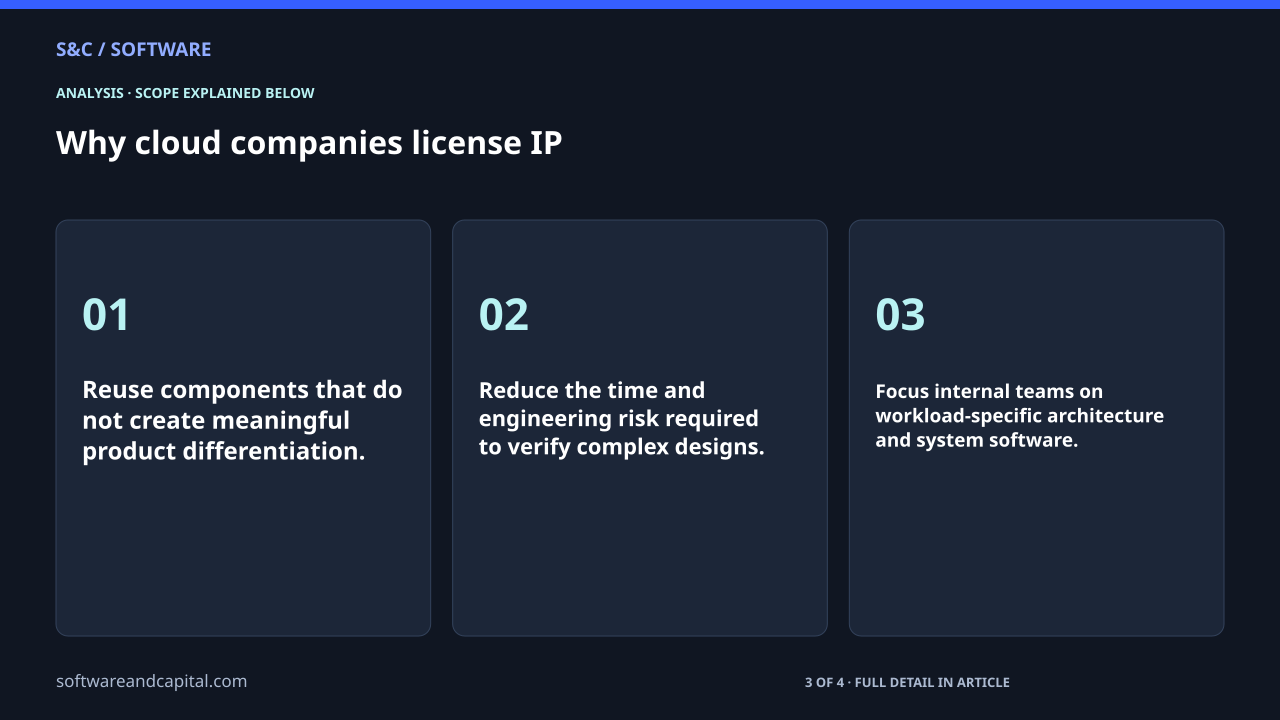
Why cloud companies license IP
- Reuse components that do not create meaningful product differentiation.
- Reduce the time and engineering risk required to verify complex designs.
- Focus internal teams on workload-specific architecture and system software.
- Share some development economics with specialist suppliers rather than recreating every block.
The billion-dollar headline is a reminder that 'custom' is an economic choice, not a purity test. Amazon can own the chip strategy while buying pieces of the design from a company whose business is making those pieces reusable.
Sources and methodology
Sources checked September 30, 2026. Dates and periods for individual figures are stated beside them.
- Synopsys: Amazon strategic multi-year IP agreement ↗Accessed 2026-09-30
- Synopsys: 2026 Investor Day growth strategy ↗Accessed 2026-09-30
Scope and assumptions
The companies did not identify which future Amazon chips will use the licensed IP.
The agreement value does not reveal Synopsys' revenue recognition schedule or Amazon's per-chip economics.
Continue reading
Nvidia’s $193.7B Data-Center Business, Explained →
The $150M Bet on AI Chips That Keep the Data Off the Cloud →
AMD Is Paying $8.2B for World Labs. The Bigger Bet Is the Feedback Loop →