The biggest AI clusters are measured in megawatts. A robot, drone or vehicle may have only a small onboard power budget and cannot assume a fast connection to a data center. SiMa.ai’s new $150 million round is aimed at that opposite end of the compute market.1, 2
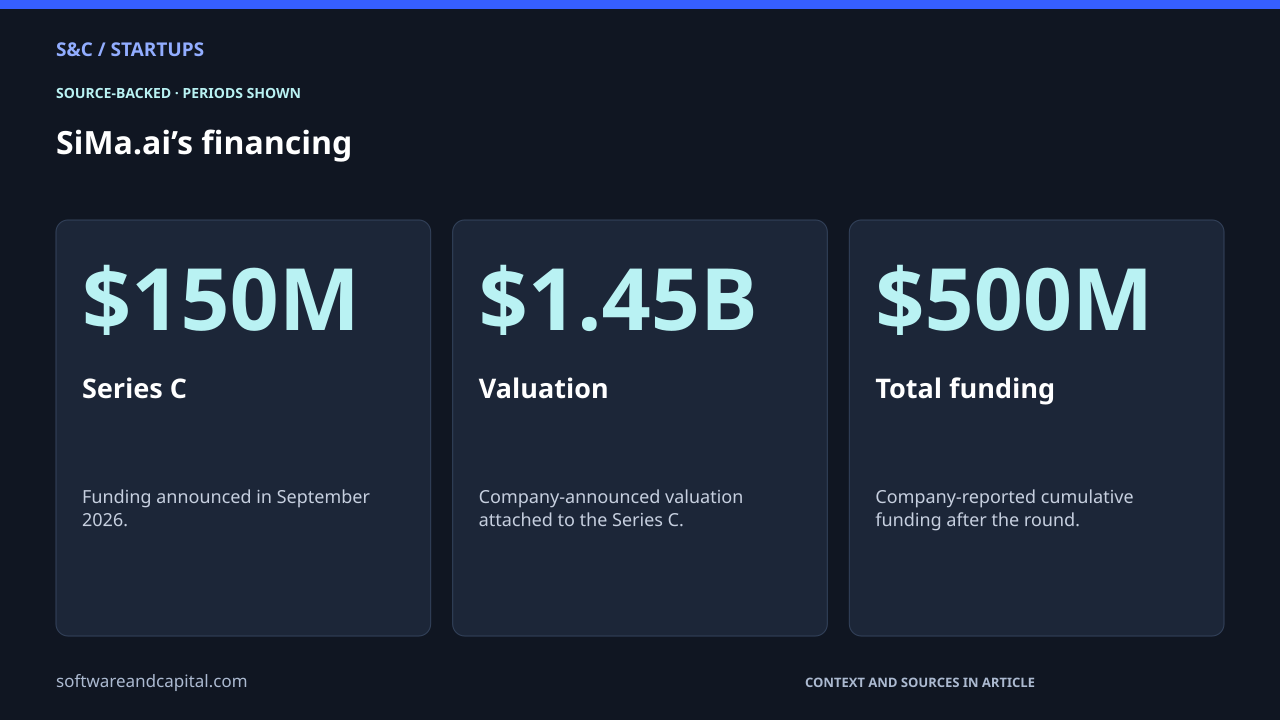
SiMa.ai raised $150 million in Series C funding at a $1.45 billion valuation, taking total funding to $500 million. Its chips and software target AI inference in robots, drones, vehicles and other edge systems where latency, power and connectivity can make a cloud round trip impractical. Funding and valuation do not establish customer adoption or profitability.1, 2
SiMa.ai’s financing
Edge inference has a different constraint set
Cloud inference can pool expensive hardware and power across many users. Physical systems have to carry their compute with them. Latency, connectivity, thermal limits and battery life therefore become product constraints rather than data-center engineering details.2
| Constraint | Cloud data center | Robot, drone or vehicle |
|---|---|---|
| Power | Large shared electrical budget | Tight onboard power and thermal envelope |
| Network | High-bandwidth connectivity | May be intermittent or unavailable |
| Latency | A network round trip can be acceptable | Control and perception can require local response |
| Hardware refresh | Centralized fleet can be upgraded | Compute is embedded in a physical product |
The software layer matters because hardware gets replaced
SiMa.ai emphasizes a software stack intended to let developers deploy models across its hardware. That portability matters in physical products with long development cycles: a customer does not want every chip generation to require rebuilding the application from scratch.1, 2
This is a picks-and-shovels bet on physical AI
The company is not trying to build every humanoid, drone or car. It wants to sell the compute layer those machines use. That resembles the infrastructure position in S&C’s D-Robotics analysis, with a sharper emphasis on low-power edge inference.
What the financing does not prove
- How much revenue SiMa.ai currently generates.
- Whether one edge-AI architecture will win across robots, automotive and drones.
- Customer concentration, gross margins or profitability.
- That the $1.45 billion private valuation will persist in a future financing or public market.
Physical AI makes compute local again. If more machines need to perceive and decide without a reliable cloud connection, the edge chip becomes part of the product’s behavior rather than just its IT infrastructure.
Sources and methodology
Sources checked September 29, 2026. Dates and periods for individual figures are stated beside them.
- SiMa.ai: $150 million Series C announcement ↗Accessed 2026-09-29
- SiMa.ai: Machine Learning System-on-Chip platform ↗Accessed 2026-09-29
Scope and assumptions
Funding and valuation are company-reported financing figures, not measures of revenue, customer adoption or profitability.
The article does not use third-party physical-AI market forecasts as evidence of future demand.
Continue reading
D-Robotics Raised $400M to Sell the Picks and Shovels for Robots →
Show a Robot One Video. Skild Says It Can Learn the Task Without Retraining →
Qualcomm Is Buying the Open-Source Software That Helps Robots Move →