A banker does not need only a smart model. The job also depends on filings, private-company data, market news and the ability to trace a number back to its source. OpenAI’s new financial-services product packages those ingredients together, moving ChatGPT closer to a vertical software product than a general chatbot with a few connectors.
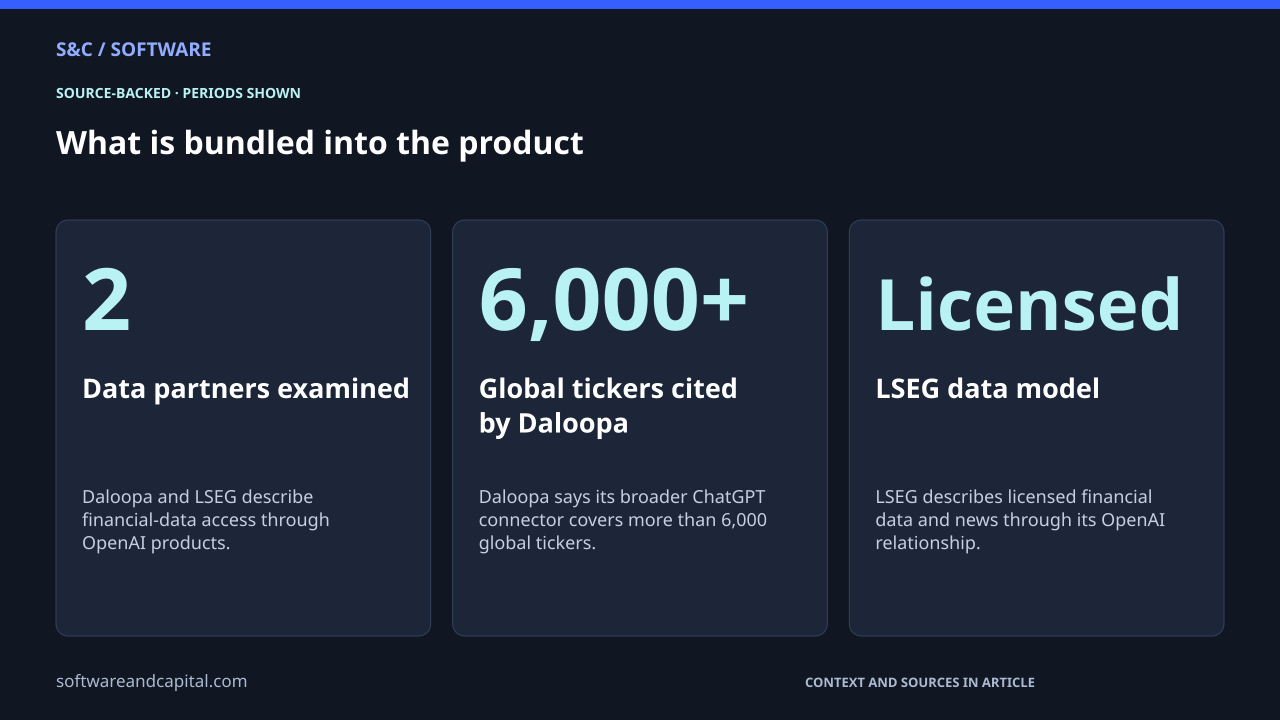
ChatGPT for Financial Services is packaging model reasoning with specialist financial data. Daloopa says select verified fundamentals are natively available in the product, while LSEG describes licensed financial data and news access through its OpenAI integration. The strategy moves ChatGPT closer to vertical software where data, workflow and the model are sold together.1, 2
What is bundled into the product
The product is becoming a data bundle
In a general AI product, the model is the center and outside data is something a customer connects. Here, OpenAI says selected premium datasets are indexed and hosted by OpenAI. That changes the value proposition: access to some industry data becomes part of the workspace itself rather than a separate integration project.1, 2
| Layer | What it contributes | Why it matters |
|---|---|---|
| Reasoning model | Analysis, drafting and synthesis | Turns source material into work product |
| Built-in premium data | Financial and private-market information | Reduces setup for included datasets |
| Firm data | Internal documents and authorized sources | Adds organization-specific context |
| Citations | Links claims and figures back to evidence | Makes review and checking easier |
| Workflow templates | Research, models and client materials | Packages the model around finance-specific jobs |
Included does not mean unlimited
The partner announcements show why the word “included” needs care. Daloopa refers to select verified fundamental data, while LSEG describes licensed data and news available through its OpenAI integration. Coverage, timing and entitlements differ by source, so the bundle should not be read as unrestricted access to every product each provider sells.1, 2
This is how horizontal AI becomes vertical software
The model alone is horizontal. The moment an AI vendor adds domain data, citations, compliance controls and repeatable workflows for a particular profession, it starts competing for a larger share of the application budget. That is the strategic significance of the launch more than any single dataset name.
The approach also changes the position of data vendors. They remain valuable because the proprietary information still matters, but the user may encounter that information through an AI workspace rather than through the data provider’s own terminal or web interface.
What to watch next
- Whether more premium datasets become native to the bundle rather than optional connections.
- How financial institutions divide spending between data providers, AI platforms and traditional workflow software.
- Whether citations and audit tooling are strong enough for regulated research workflows.
- Which tasks remain in spreadsheets, terminals and specialist applications even after AI becomes the conversational layer.
This extends the business described in OpenAI’s consumer-and-enterprise flywheel. The difference is that vertical AI tries to sell not just intelligence, but a prepared bundle of intelligence, data and workflow for one industry.
Sources and methodology
Sources checked September 26, 2026. Dates and periods for individual figures are stated beside them.
- Daloopa: partnership with OpenAI ↗Accessed 2026-09-26
- LSEG and OpenAI ↗Accessed 2026-09-26
Scope and assumptions
OpenAI does not disclose standalone pricing or revenue for ChatGPT for Financial Services.
Dataset coverage and timing differ by provider and are governed by source-specific terms.
Continue reading
1B Weekly Users, 2.5M Businesses: OpenAI’s Two-Sided Growth Flywheel →
5 AI Tools for Work: Choose by the Job, Not the Demo →
ChatGPT Ads Hit a $1B Annualized Run Rate. What Is OpenAI Selling? →