CoreWeave built its name renting expensive AI compute. Forge is an attempt to own more of what customers do after they get access to that compute. The new development layer connects running models and agents with observing them, curating data, improving the next version and evaluating it before another deployment.1, 2
CoreWeave launched Forge as a development layer spanning model and agent execution, observability, data curation, improvement and evaluation. It combines capabilities from acquired companies including Weights & Biases, OpenPipe and Marimo while remaining usable with other clouds. Strategically, CoreWeave is moving from supplying infrastructure toward owning more of the software loop around it.1, 2
| Stage | What the team is doing | Forge role |
|---|---|---|
| Run | Train, serve or execute models and agents | Connect workloads to the development environment |
| Observe | See how production systems behave | Capture traces and performance context |
| Curate | Turn production interactions into useful data | Organize data for the next iteration |
| Improve | Build or tune the next version | Connect model and agent development |
| Evaluate | Test whether the new version is better | Compare quality before deployment |
The acquisitions are becoming one product surface
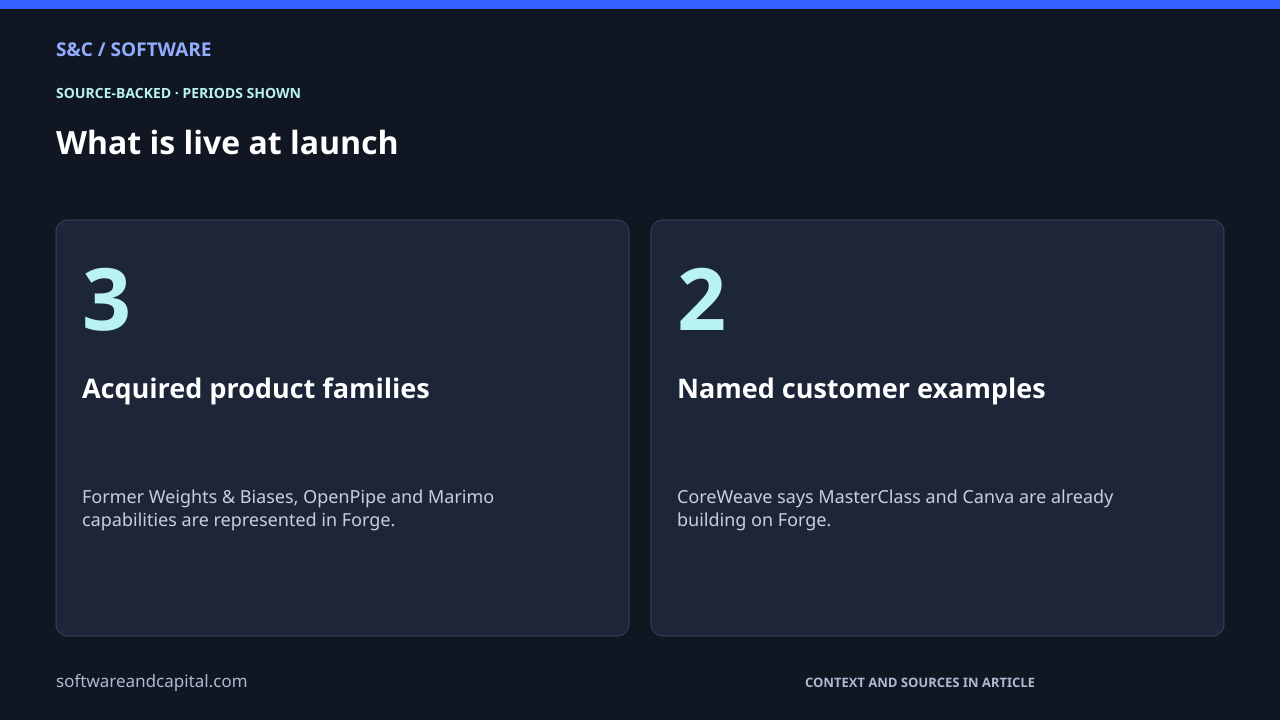
CoreWeave says Forge brings together the former Weights & Biases, OpenPipe and Marimo products. That matters strategically because buying software companies only creates a platform advantage if their capabilities become easier to use together rather than remaining separate logos in a portfolio.2
What is live at launch
Moving up the stack can change cloud economics
Infrastructure revenue depends heavily on capacity, utilization and financing. Software can make a cloud harder to replace if the development workflow becomes embedded around it. That does not mean Forge is already a high-margin software business. CoreWeave has not disclosed an attach rate, standalone Forge revenue or margins.1
That distinction makes Forge a different story from S&C’s CoreWeave financial analysis. The earlier article explains why AI-cloud growth is capital intensive. Forge asks whether the same company can add a software layer above that infrastructure.
Cloud-agnostic software creates a useful tension
CoreWeave explicitly says Forge can work across other clouds. That lowers the migration barrier for customers and preserves the Weights & Biases heritage. Strategically, however, CoreWeave still benefits if a connected development experience eventually sends more workloads toward its own infrastructure.2
What would show whether the strategy is working
- Standalone or attached Forge revenue rather than customer logos alone.
- The share of Forge users that also increase CoreWeave infrastructure consumption.
- Retention or workflow adoption across the former Weights & Biases, OpenPipe and Marimo products.
- Evidence that cloud-agnostic users stay on Forge even when compute runs elsewhere.
Forge turns CoreWeave’s acquisition strategy into a product thesis: the AI cloud does not have to stop at the GPU boundary. It can try to own the loop that decides what runs on those GPUs next.
Sources and methodology
Sources checked September 30, 2026. Dates and periods for individual figures are stated beside them.
- CoreWeave: Forge launch ↗Accessed 2026-09-30
- CoreWeave: Forge product overview ↗Accessed 2026-09-30
Scope and assumptions
CoreWeave has not disclosed standalone Forge revenue, attach rate or margins.
Named customer usage is company-reported and does not establish broad adoption.
Continue reading
CoreWeave Grew From $229M to $5.1B—and Still Lost $1.2B →
DeepInfra Says It Passed $100M ARR While Serving 22T Tokens a Week →